Another episode of “Living with Parkinson’s”: In which I visit the neurologist

Every six months, come rain, shine, earthquake, or wildfire, I go to see Dr. S, my neurologist.(1) This is ostensibly a follow-up visit, or so the honey-voiced appointment clerk tells me, to check on my Parkinson’s “progress.” She says this like I’m recovering from a broken leg, a bad case of hives, or maybe pneumonia—a self-limited medical calamity that’s expected to resolve in time. But Parkinson’s isn’t like that. It’s going to get worse, the only question is how fast. So, twice a year I check in with Dr. S to see whether my Parkinson’s is sticking to the speed limit or engaging in a bit of reckless driving.

Dr. S’s office is a 30-mile freeway trip from our house – down in Marin County, that legendary land of hot tubs, up-upscale shopping malls, and over-the-top estates tucked back in the redwoods. We will see none of that on our visit today, though; Dr. S’s office is a literal stone’s throw from the freeway.

After a half-hour of medium-bad traffic, Elisabeth noses the Kia into the neurology parking lot. For some reason Dr. S’s office shares a building with the county coroner’s office, a rather unsettling relationship I haven’t yet had the courage to explore. We enter the non-coroner side of the building, take our seats in the waiting room, and wait to be called. My health plan offers online check-in these days; this is my first attempt to use the service. As I understand it, having checked in by phone yesterday, all I have to do is sit and wait until, magically, a staff member will appear to take me to my doctor.

The lady at the registration desk notices me, eyeing me a bit suspiciously at first as I skip the line and plop into a chair. Patients come, patients go, while Elisabeth and I catch up on old People magazines. During a registration lull she waves, catches my attention, motions me to her window. “Sir,” she says. “Can I help you?” In my Parkinsonian head the words of explanation are all there, sorting themselves for an orderly exit, but my mouth can’t quite usher them out. I wave my phone in the air and point. “Already done,” I rumble-mumble. “Online.” The lady seems like she’s seen this before. “Let’s make sure about that.” She takes my card, types in my number. “There,” she says with a smile, returning my card. “Now you’re checked in.” I thank her and return to my seat, where Elisabeth waits, eager to update me on Prince Harry’s new life in California.

The door to the patient care area whooshes open. A young medical assistant calls my name. We follow her down the hallway and through the usual rooming-in procedures: weight, blood pressure, an oxygen saturation reading from the little E.T. thingie she clips to my index finger. Then come the questions: Any new allergies? (No.) Do I smoke? (No, for the thousandth time.) How many hours do I exercise a week? (Oodles, I want to say, but instead I throw out an estimate that seems to satisfy her.) Do I feel safe at home? (I shoot Elisabeth a sidelong glance, think for a moment about passing the medical assistant a “Help me!!” note, then think twice and say, “Safe? Sure.”) Her work completed, the assistant smiles sweetly and tells us Dr. S will be right in. And, a few minutes later, there she is.

Dr. S knocks at the door and enters, her hands glistening with freshly applied sanitizer. She is a slender woman with dark, kind eyes, and a warm smile that I only see from time to time – it all depends on the clinic’s Covid masking requirements du jour. Her presence is reassuring; there’s a comforting routine to these appointments. 

We start with a bit of chit-chat, announcing the next-springtime arrival of our first grandchild. Dr. S seems genuinely happy for us. She asks about my recent ear surgery ( a minor, and unsuccessful, attempt to fix a eustachian tube problem). I tell her that the ear problem is making it difficult for me to carry on a simple conversation – my voice was soft to begin with, then made softer by Parkinson’s, and now, thanks to the loud vibration of my eardrum when I speak above a certain volume, it’s even worse. “Wow, that sounds like it’s really impacting you,” she says, and I nod. She makes a note to herself. “I’ll get in touch with your surgeon, so he knows how much this is bothering you.” And I know she will. Dr. S is one of the most empathic doctors I know.

She moves on to my Parkinson’s symptoms. Have I fallen since our last visit? Any new tremors? Am I depressed? Sleeping well? How about heartburn? Nausea? Constipation? She doesn’t ask me about seeing or hearing things that aren’t there this time – hallucinations are not uncommon as Parkinson’s advances. Either she assumes I’d tell her, or maybe (probably?) she got sick of my bantering: “But if I can see them, how would I know that they’re not real?” Such a funny guy.

Now comes the neurologic examination, a series of hoops and hurdles designed to see how well my sometimes meandering description of how I’m doing correlates with objective reality.

Dr. S starts with my hands. She tells me to make a modified “okay” sign: thumb and index finger making a flattened “o,” with the other three fingers extended above them. (If you have a flashlight and a wall handy, you’ll see that this makes a passable shadow-animal profile of Wile E. Coyote’s head.)

Sorta-kinda like this guy…

“Okay now, do this,” Dr. S says as she opens and closes her “o” (i.e., Wile E.’s mouth), rapidly tapping her index finger on her thumb. I do that; my Wile E. looks like he’s babbling now. I think I’m doing pretty well, speed-wise, until I look at Dr. S’s shadow animal – the graceful fox from the old Disney movie, The Fox and the Hound, I think – babbling about twice as fast as mine. (Bibibibi versus bah-bah-bah, if you’re taking notes.) She calls a halt to this cartoon standoff a few moments later.

Next, we move on to what I call the “dying-fish-flop” test. (I know it has another, more clinical sounding name, but hey, I’m retired: I’ve already forgotten more medicine than I ever knew.) Dr. S puts her hand on her thigh and flip-flops it back and forth, palm-up/palm-down, and invites me to follow suit. I do, and once again I’m struck by the difference in speed between us. Her fish looks like it has a decent chance of flopping off her lap, out the door, across the hall and back into the river from whence it came. Mine gives a resigned gasp, gazes heavenward, and prepares itself for the grill.

Dr. S runs me through a number of other tests. I touch the tip of her index finger, then my own chest, then back and forth like this until she’s satisfied that my finger won’t wander off willy-nilly and poke me in the eye; I tap my toes on the floor; I cross my arms, Aladdin-like, and stand up from my chair as quickly as possible. There are other parts to the exam – she smacks me a lot with a rubber-tipped hammer, for one thing – but I get exhausted just trying to describe them. Through it all – the Wile E. Coyote, the dying fish, the genie-levitating thing, the hammering and the rest, Dr. S concentrates, her face – or at least her eyes, since she’s still wearing a mask – inscrutable.

“Okay,” she says, when she finally runs out of hoops for my hands and feet to jump through. “Let’s go out in the hallway.” Ha! I know what comes next. She may not seem like the violent type, but I don’t let that placid exterior fool me. As soon as we get out of the exam room, Dr. S is going to try like heck to knock me over. I pull on my shoes (a glacially slow process these days) and follow Dr. S into the hallway. Elisabeth smiles and flashes me a quiet thumbs up.

“Turn and face the wall,” Dr. S says, like a kindly-voiced cop about to cuff a robbery suspect. “I’m going to pull you backwards, hard.” She shows me her outstretched left arm, the one that, she assures me, will catch me if I fall. (A bit of perspective here: I’m tall, with a fair amount of leftover muscle from my athletic youth. Dr. S is eight or ten inches shorter than me and slightly built; I doubt she played football. I’ll know I’m in trouble the day she manages to floor me.) She tugs on my shoulder a few times, but comes up short in our quasi-sumo match. I’m still standing.

We re-enter the exam room; Dr. S returns to her stool while I settle into my chair. She smiles and tells me she’s pleased – I’ve had little disease progression since our last visit. We do a quick review of my plan, make a couple of minor adjustments, and then we say our goodbyes. “See you in six months,” Dr S says. “Bring pictures of that grandbaby!” “Thanks,” I reply with a smile. “I’ll definitely do that.” Someday Dr. S will have to give me bad news; for now, though, I’ll take her “(almost) no news is (pretty much) good news” summary to heart.

Neurology is a much more physical specialty than I realized, what with all the pushing, pulling, and hammer swinging. If, God forbid, Dr. S ever keels over from exertion in the middle of examining me and passes on to that big neurology waiting room in the sky – the one where online check-in actually works – I’ll know just what to tell the inquiring TV reporters as they gather around me for comment.

“At least she was doing what she loved,” I’ll say. (“Which was trying her best to knock me over,” I’ll keep to myself.)


  1. “Dr S” isn’t my neurologist’s real name. Heck, it’s not even her real initial…
Family history No.2: Mom’s turn…

My mother, Peg Sloan, died in 2017 of Parkinson’s-related aspiration pneumonia. She inhaled some thick pudding, one of the last foods she was allowed to eat as her swallowing grew dangerously uncoordinated, and that set the end in motion. She had been hospitalized with pneumonia several times; this time was the worst, and Mom had decided beforehand to refuse extraordinary measures to keep her alive.

Long before Parkinson’s closed in on her life, Mom had been a writer and editor. She spent her entire professional career at the Kankakee Daily Journal, a small-to-medium-sized newspaper in a small-to-medium-sized town in east-central Illinois. 

Starting as an op-ed contributor, she was soon named editor of “Accent,” a lifestyle-themed section of the paper that had long been heavy on the doings of Kankakee’s elite: weddings, engagements, costumed soirees, and the like. Mom dragged Accent out of its rich-folk doldrums and pushed it into the present. By the mid-1980s, just a few years after she took over the editorial reins, Accent had twice been honored by United Press International, including an award for its follow-up investigation of a secretive religious cult near Kankakee that had vanished five years previously, taking the children of several local residents with them. 

Mom also wrote a popular weekly “personals” column. Her first published essay was on the trials and tribulations of being a redhead.*1 By her retirement she had written more than 700 columns on a wide variety of subjects, including her Irish heritage, her travels, the sometimes-humbling experiences of a big-city girl who married into a farm family, and—her go-to topic—the ups and downs of raising six kids. My mother’s warm, accessible, often funny writing style won her a devoted readership, syndication in a smattering of small Midwestern papers, and a number of awards. Mom was honored for her columns by the Illinois chapters of the Associated Press and United Press International, and the National Federation of Press Women.  

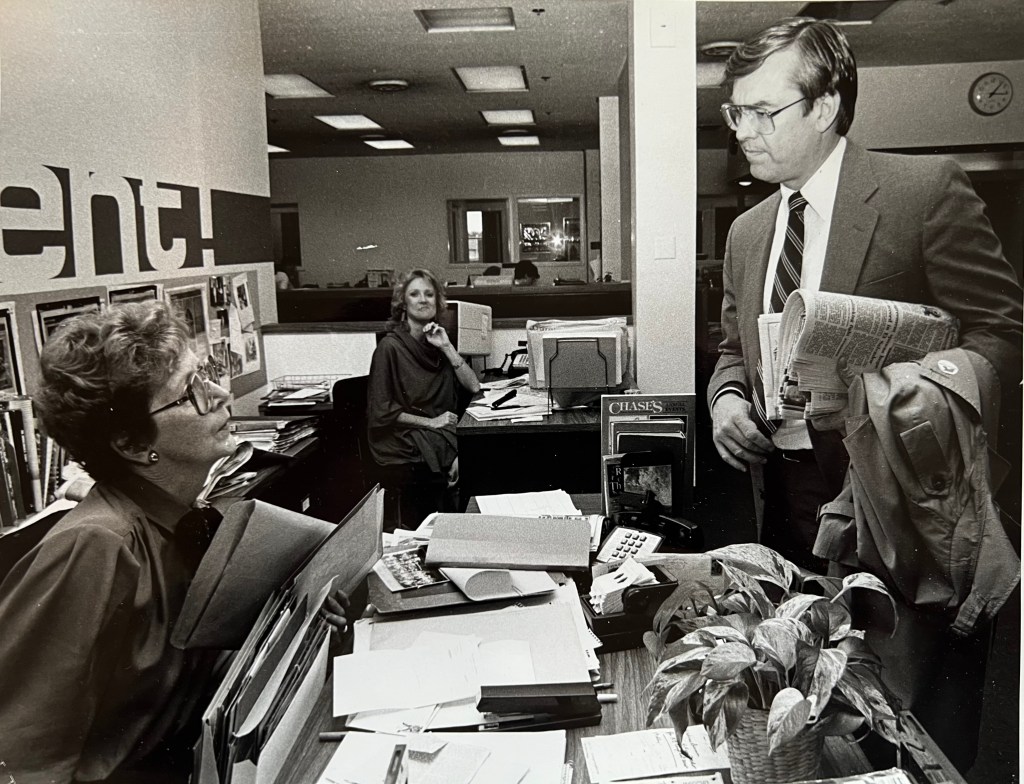
Peg Sloan (left) meets with CBS newsman Bill Kurtis during the investigation of a religious cult near Kankakee, late 1970s. (And yes, that’s the same Bill Kurtis who’s now the announcer, judge, and scorekeeper on the popular NPR program, Wait Wait…Don’t Tell Me!)

The most remarkable thing about Mom’s journalism career is that it didn’t start until she was in her fifties. Before ever setting foot in the Daily Journal offices, Mom raised the six of us. And when I say that she raised us, she did just that. For nearly thirty years Mom was up to her elbows in mid-century mothering: diapering, cooking, sewing, first aid, PTA meetings, birthday parties, church socials, football Fridays, and laundry, laundry, laundry. Not until the last of us was grown and out of the house (or nearly so – my youngest brother, Chris, abruptly became a “latchkey kid” when Mom joined the Daily Journal a few months before his high school graduation) did she pursue her long-deferred dream.

She told me years later that she had always wanted to be a writer, that if she’d been born a generation later she would have been a journalist right out of school. Mom kept that desire hidden from her kids for decades, but from time to time it slipped out.

I must have been about ten years old when I came across Mom sitting on a stool in the laundry area of our basement, barricaded behind baskets of dirty and/or wet clothes, scribbling with a pencil in a small, spiral-bound notebook. 

This was truly strange behavior. One thing to know about my mother: she absolutely abhorred heat and humidity, so for her to spend even one extra mid-July minute in our often-hellish southern Indiana climate—in our stuffy basement with the washer and dryer running, no less—meant that whatever she was working on must have been important. *2

She didn’t notice me at first. I watched sweat run down her cheeks and drip off the tip of her nose. Her soaked blouse clung to her shoulders. I knew adults had heart attacks sometimes—was that what this was? She paused and stared into space for a moment, immobile, then quickly erased a line and started scribbling again. I watched her a minute or so, until I couldn’t contain my concern.

“Mom?” I shouted, loud enough to be heard over the clanking Maytags. “Are you okay?” I touched her arm. “Maybe you should go upstairs and sit by the air conditioner?” *3

Startled by my sudden appearance, she slapped her notebook shut, slipped it into a shoebox with several others, and grabbed a towel to wipe the perspiration from her face. “Yes, let’s get upstairs,” she said with a wan smile. “I’m boiling.” 

Later, camped out with a glass of ice water by the air conditioner in her bedroom (I inherited my mother’s hatred of Evansville’s wilting summertime swamp-heat), Mom slipped some rubber bands around her shoebox full of notebooks and slid it high up on closet shelf. My eyes followed the box; she could see I was curious about it.

“I was just writing a grocery list,” she said.

The notebook had been filled with writing. “That’s a lot of groceries,” I said.

“Well,” she said, smiling, “you kids eat a lot of food.” She took my glass to the kitchen to refill it, and that was that.

Mom retired from the Journal in the mid-1990s. When I asked her why she was giving up her column, she shrugged and said, “I guess I’ve said all that I have to say.” Looking back, this was about the same time that her Parkinson’s symptoms first emerged, although she wouldn’t be diagnosed for several more years. I’d noticed that her hands now shook, especially when trying to hold a cup of her beloved coffee. Her once-gorgeous handwriting had shrunk to the point of near-illegibility. Her gait had slowed, and she stooped a bit when she walked. Mom was an elegant, proud woman – I can’t help but think that she could feel her talents slipping away, and wanted to retire while she was still at the top of her game. She wouldn’t have wanted anyone’s pity.

_____

When I arrived at the hospital on the day before Mom died, she was barely conscious, but she was comfortable, thanks to the efforts of the hospice staff. When she saw me she raised her hand, smiled weakly, and said, “Oh, you came!” 

I stayed by her bedside that night, as part of a round-the-clock vigil shared with my sibs. Mom was breathing softly, eyes closed, no longer interacting with the world. But I thought she might still hear me, so I read her favorite columns to her, one after the other: the stories of her adored Irish father, the affection that slowly grew between Mom and her no-nonsense farmer mother-in-law, her childhood in a multi-cultural, pre-air-conditioning Chicago neighborhood, her kids—us. She didn’t respond, but she didn’t struggle, either.

The next afternoon, with Dad and her children at her side—just two months shy of their 70th wedding anniversary—Mom quietly stopped breathing. It was Valentine’s Day, my parents’ favorite personal holiday. 

_____

*1 – The cons of being a redhead, per Mom: ghostly pale skin, freckles, raging sunburns. Pros: Um, not so many, apparently… 

*2 – One Evansville summertime climate example will suffice: There was a section of the Yellow Pages devoted entirely to companies that would come and remove the melted road tar your kids tracked onto your wall-to-wall carpet with their shoes. Road tar in Evansville was sort of like mud in cooler climes, I imagine, but a lot harder to get out.

*3 – We had one window air conditioner for the whole house, in my parent’s bedroom: a boxy Whirlpool colossus that was about as loud as the washer and dryer combined. If you kept the bedroom doors closed all day with the Whirlpool blasting away, the room was tolerably comfortable for sleeping at night. I would often find Mom in her bedroom on summer afternoons, hugging the Whirlpool like a long-lost friend, her red hair blowing in the breeze. The rest of us slept in a converted attic bedroom, which was just as hot as that sounds. (Dad did install a window air conditioner in the attic eventually, but it’s cool-air zone was even smaller than the one downstairs…)

Diagnosing Parkinson’s disease – a tricky business

Some diseases are easy to diagnose. Take chickenpox—back in the day, before chickenpox vaccine became popular and case numbers plummeted, I’d see itchy, rashy, feverish kids several times a week during the winter and early spring. The stories were consistent: fevers for a day or two, then came the rash – dozens of small vesicles (thin-walled blebs filled with a watery fluid), each one on a red base.* 

Quick, name that rash! (Hint: it’s not Parkinson’s)

I’d typically see the kids about 4 days into the rash, when the fevers and itchiness were driving everyone batty. I’d check for secondary bacterial infections and we’d discuss comfort measures that can make waiting out the illness less awful for both sick child and sleep-craving parent. Barring any unusual complications, things were better in a few days, and the scabby young victim now had lifelong immunity. Easy diagnosis, predictable stuff.

You might be tempted to think that Parkinson’s disease would be easy to diagnose too, if you never looked past the opening lines of the Movement Disorder Society’s (MDS) clinical diagnostic criteria (See Table 1):

“The first essential criterion [in diagnosing PD] is parkinsonism, which is defined as bradykinesia  and at least one of these two: a resting tremor or rigidity.” **

  • (Bradykinesia is defined as “reduction in speed and amplitude of voluntary movement.” This is much more than just slow walking. It includes such things as tiny handwriting that gets even smaller as the person writes; decreased facial expressiveness; weak voice; less frequent blinking; decreased arm swing when walking; and difficulty with dressing and with turning in bed.)

So, if you’ve got a slow-moving, retired pediatrician with either shaking limbs or unusual stiffness you’re looking at a guy with PD, right?

Not so fast… 

What you’ve got so far is parkinsonism; you haven’t diagnosed Parkinson’s disease – at least not yet. PD is the most common neurologic condition that causes parkinsonism, but it’s far from the only one. So, once you clear the parkinsonism hurdle, you’ve got the rest of the Movement Disorder Society’s diagnostic criteria to consider: Supportive Criteria, Absolute Exclusion Criteria, and Red Flags. (Again, see Table 1. I never said this would be easy…)

Supportive criteria:

These are signs and symptoms that are often found in people with Parkinson’s but are not required to make the diagnosis. They include the effects of taking a “dopaminergic” medication (levodopa, for example)– is there a “clear and dramatic response?” Does the patient experience dyskinesia as a side effect? Other supportive criteria include the loss of the sense of smell and evidence of PD-related heart disease.

Absolute exclusion criteria:

The name says it all. Absolute exclusion criteria can exclude PD from your diagnostic possibilities…absolutely. The criteria include a number of complex neurologic features that would point to other diseases; taking medications that are known to cause parkinsonism (e.g., some seizure medications); not improving despite taking high doses of dopaminergic medications; having a normal PD-related brain scan; and (the neurologist’s wild card) an expert’s opinion that something else is going on.

Red flags: 

These are signs and symptoms that may warn of something other than PD, but aren’t quite definitive in and of themselves. Among them is another batch of complex neurologic signs and symptoms that boil down to this: if your symptoms progress too quickly or too slowly (or not at all); if you fall down or faint a lot; if your symptoms are symmetrical (PD usually affects one side of the body more than the other); or if you’re not having sleep problems, constipation, psychiatric problem, and a host of other non-movement-related symptoms within 5 years of your diagnosis…maybe you don’t have PD after all.

Final score:

If your neurologist finds that you have parkinsonism, plus at least two supportive criteria, and no red flags or absolute exclusion criteria, you’ve got “clinically established PD.” If your supportive criteria exceed your red flags (of which there can be no more than two), you are considered to have “probable PD.” And if you have more than 2 red flags or any absolute exclusion criteria, you most likely have something other than PD. Back to the diagnostic drawing board with ye!

As you can see, it’s complicated. That’s why it can take weeks, months, sometimes even years for a slowly progressive disease like PD to declare itself, and why you really need a neurologist – even better, a neurologist who specializes in movement disorders like PD – to help you get an accurate diagnosis. (Retired pediatrician = not the guy you’re looking for.)

Coming up in the “Parkinson’s – the Basics” series: Now that you’ve got your diagnosis, you may ask yourself, “What is Parkinson’s disease, anyway? And why did I get it?” And the biggest question of all: “What’s next for me?” Answers (or at least some answers) to follow…

_____

* The classic description of the chickenpox lesion – “a dewdrop on a rose petal” – harkens to a more poetic medical era. A more accurate description: “An unattractive, sometimes yellowish bloblet plopped on a tiny patch of red skin. When it hasn’t been scratched beyond all recognition, that is…” (Copyright: me)

** Sometimes a picture really is worth a thousand words – click on link at bottom for a concise discussion of these three cardinal features of PD:

  • Bradykinesia (see in post above)
  • Resting tremor: “…slow, regular movements of the hands and sometimes the legs, neck, face, or jaw, when those parts are at rest; the tremor usually stops when that part is voluntarily moved.” 
  • Rigidity: “…a stiffness of the arms or legs beyond what would result from normal aging or arthritis. Some people call it ‘tightness’ in their limbs.”
    • There are two main types of rigidity: “lead pipe rigidity,” which presents as a smooth resistance to movement of the limb, and “cogwheel rigidity,” which is a ratchet-like jerkiness superimposed on lead pipe rigidity.

MEDSKL – “Parkinson’s Disease: What You Need to Know

Hayes Street

I’m sitting in a coffee shop on Hayes Street in San Francisco, as I am most Monday mornings. I’m waiting for my wife, Elisabeth, who is taking a ballet class at the San Francisco Ballet School, just around the corner. Elisabeth rekindled her long-dormant love of dancing ballet when she and I started taking the SF Ballet for People with Parkinson’s class a few months ago (more on that wonderful resource in a future post). She’s a pretty good ballerina, plus, she doesn’t have Parkinson’s. Me? At no point in my life, not even when I was a strapping young-man-on-the-town, would I have been mistaken for Mikhail Baryshnikov. I’m a lifelong clumsy dancer at best; Parkinson’s has just made that more painfully obvious. *

Time for a symptom inventory. Today is a good day; I got a good night’s sleep and woke up feeling as energetic as I get these days. Looking at me now—sipping my coffee, gazing out on a steady parade of young tech workers passing in the street—you wouldn’t know that I have Parkinson’s disease (PD). I look like any bespectacled, gray-headed, almost-70ish guy—like somebody’s grandfather, a throwback from the 1970s who stumbled into the 2020s. At least my laptop is new(ish)—lends me a bit of street cred with the waitress.

The thing that bothers me most, always, is my gait. As soon as I stand up I’ll feel it: that slowness and clunkiness, the sensation that my feet aren’t quite landing where my brain expects them to. I had a lot of ‘being-chased’ nightmares when I was a kid—either a tiger or a tornado was close on my heels, and my feet were stuck in mud. It’s kind of like that, minus the carnivores and funnel clouds. 

What I’m experiencing is bradykinesia—the slowness of movement that’s one of the cardinal symptoms of PD. Bradykinesia shows up in different ways. There’s the general slowness and clumsiness with walking, as I’ve just described, but also a decrease in movements that should just be automatic, like blinking, or swinging your arms when you walk. Typically, since it comes on so gradually, other people notice it before the PwP does.

Elisabeth was the first to notice the changes, in 2018. I had felt them a bit before she mentioned them, but I chalked them up to the fact that I was taking care of my nearly-100-year-old father at the time. My whole world had slowed down, after all: whether it was getting Dad up in the morning, helping him shower and dress, or fixing his meals, life moved at a centenarian’s pace. 

Taking him to church, for example: we’d trudge along side-by-side, him with his walker, me holding his arm, from the parking lot into the side door of St. Rose. When it was time for communion, we’d walk up the main aisle at turtle-speed, Dad doggedly refusing the wheelchair offered by the usher, me waving traffic around us. By the time I got him back to the car and belted in his seat, the parking lot was just about empty. I was slow because he was slow, I figured.

Then Dad moved to my brother’s home, and I never sped back up.

—–

*Well, that’s not entirely true. Back in college, when being a “good” dancer involved beer-fueled faux­-polkas and ricocheting one’s partner around sticky, dive-bar dance floors, I did okay.

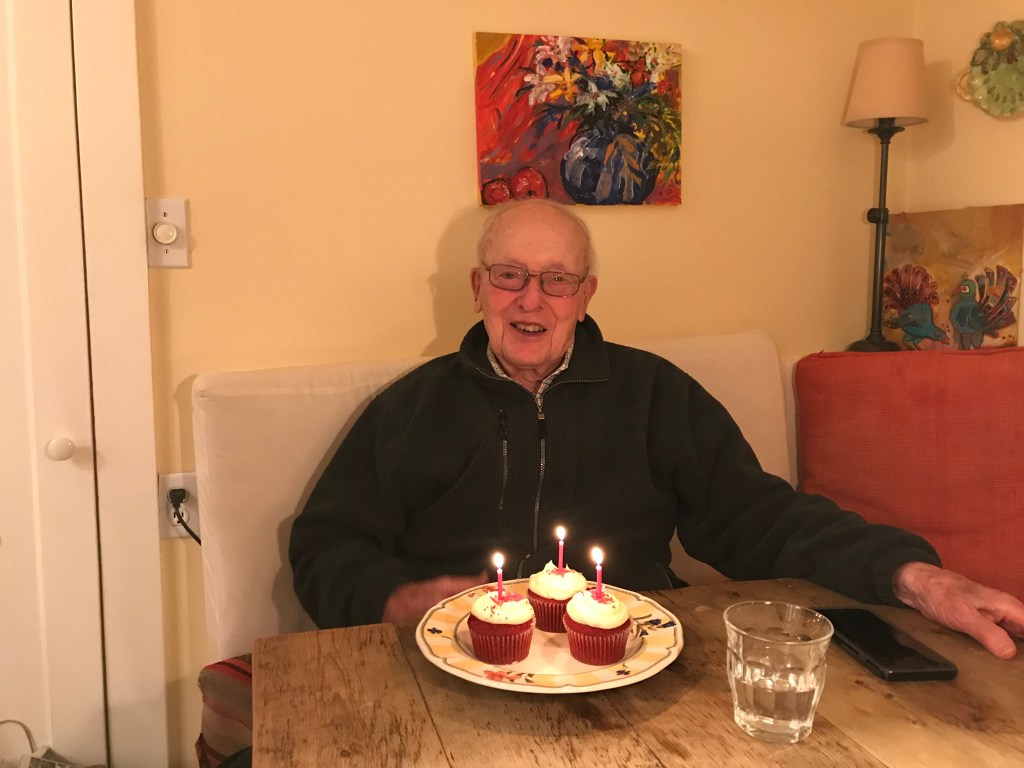
Dad on his 99th birthday, complete with cupcakes…

Parkinson’s – one tough disease to explain (No. 1)

If my blog had a title like “A Broken Leg,” explaining my medical woes would be so much easier. What’s my condition, you ask? Why, it’s right there in the title: I broke my leg. How did I get it? I slipped on a banana peel, maybe, or proved that there is such a thing as “too old to learn to rollerblade.” How do you treat it? You slap a hunk of plaster on it and then wait. What are my chances of complete recovery? Pretty good, if I stop buying Safeway bananas and sell my rollerblades on eBay pronto.

But, no…I had to go and get a disease that can take years to diagnose, is highly variable in its symptoms, and can involve pretty much any body system you’d care to name. The etiology – the medical term for the reason I got it in the first place – can be genetic, or related to toxic exposures, or recurrent head injuries, or some combination of things. Or just bad luck. The treatment is complex, involving an often mystifying array of medications, brain implants, therapies (physical, occupational, speech, psycho), and exercise – everything from ballet, to tai chi, to boxing. The chances of complete recovery? Slim to none. Frankly, I’d rather have a broken leg. Maybe six.

But, hey, this is a Parkinson’s journal, so in upcoming posts in this series I’ll try to explain the medical intricacies…