Another episode of Living with Parkinson’s: In which I regain my voice for a night

My nephew married a delightful young woman in Montana this past summer. The ceremony was very much a Montana affair: the bride rode down the aisle on horseback (it’s okay — it was outdoors), the flower girls wore matching white cowboy boots, and the officiant did the marrying from beneath the brim of a black Stetson hat.

At the rehearsal dinner the night before the wedding, the bride’s and groom’s friends and family members told stories about the couple. These were the kinds of stories you tend to hear at weddings, from early childhood memories to recent adventures — the kind that tend to grow longer and more convoluted in direct proportion to the number of drinks the speaker has downed prior to grabbing the mic. But, no problem: the stories were sweet and funny and spoke well of the betrothed couple.

I had no intention of telling any stories that evening. There was a time I enjoyed public speaking, a time that followed a decades-long period of hating public speaking. I was a shy kid from a family of shy-ish Irish-American folk not prone to spinning extravagant wedding tales.* My elementary school approach to being forced to speak in public consisted of turning red, staring a hole in the floor, and spluttering my message as quickly and quietly as I could.

Things improved somewhat through high school and college, mainly due to forced repetition, but I can’t say that I actually enjoyed talking to crowds until my book, Birth Day, came out in 2009, and I embarked on a brief publicity tour. My appearances at first were mostly in small, independent bookstores. (Once, in Utah, I spoke to an attentive audience of one.) But then, as interest in Birth Day grew, I was invited to speak to larger groups at meetings and conferences around the U.S. and Canada. As I grew more comfortable with speaking to large groups of strangers, I discovered that I actually enjoyed interacting with an audience. I was a man transformed: my inner “ham” emerged.

I discovered that the key to winning over audiences — and boosting my confidence in the bargain — was to hit them early in the presentation with humor. My go-to Powerpoint icebreaker was a “speaker disclosure” slide that was simply a picture of Dr. Mark “McSteamy” Sloan, the hunky plastic surgeon on the TV show Grey’s Anatomy, with my “disclosure” (“I’m not him…”) typed next to McSteamy’s left bicep.
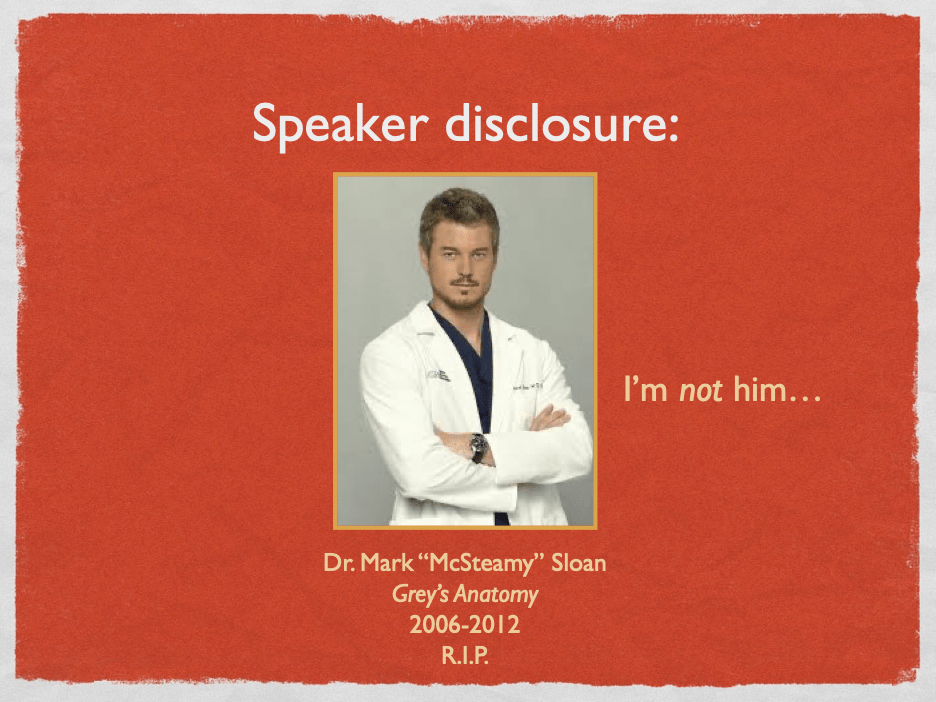
I’d stand there, deadpan, and wait for the slide to sink in. The crowd would inevitably erupt — this being McSteamy’s early 2010s heyday — and then, when the initial hubbub died down, I’d offer to refund the registration fees of any disappointed Mc Steamy fans, which led to even more hubbing and bubbing. By the time things settled down I had both the audience’s attention and the confidence I needed to talk for an hour about the wonders and oddities of human birth.

My public speaking career hit its peak in 2013, when I was invited to deliver the keynote speech at the Western Australia Rural Health Association conference, the annual gathering of half the continent’s far-flung family doctors, in Perth. Peeking through the curtains offstage, waiting to be introduced, my heart sank. The audience looked pretty tough. Picture a few hundred sunburnt Crocodile Dundees packed into a steeply banked auditorium, backslapping and shouting greetings to colleagues they hadn’t seen in a year or more. It had all the earmarks of an “old home week” reunion, writ large. I suddenly regretted not ditching my McSteamy slide — had they even seen Grey’s Anatomy in the vast isolation of the rural Western outback? Would they stare uncomprehendingly at my strange American pop-cultural reference, hoot me off the stage, and then leave, en masse, in search of cold beer?

But it was way too late to make changes to my slide deck. So, I marched to the podium, shook the hand of the woman who introduced me, and launched into my talk. Up went McSteamy, and just as I’d feared, my wildly popular American slide was met with a wall of what seemed like puzzled Ozzie silence. A few awkward moments passed as I searched for a way to gracefully move ahead. Then, from a seat high up in the back, came a deep, booming voice: “We loove McSteamy!” The place went nuts and I knew I was good to go. Nobody asked for a refund.

I did a few more large-crowd speaking dates after Australia. Things naturally tailed off as readers moved on to other books, other authors. My speaking gigs became centered more on local community events, and teaching pediatrics and writing skills to family medicine residents. Then, a few years later, I began having problems with my voice — hoarseness and coughing, difficulty with enunciation and projection — early symptoms of what would turn out to be Parkinson’s. Speech therapy helped me fight back, but in the end, Parkinson’s robbed me of my public-speaking confidence. My large-crowd grand finale was at my daughter Claire’s wedding a few years ago, at which, in my father-of-the-bride role, I got to roast Claire and her new husband in front of 150 guests. I kept McSteamy out of things; the audience loved it anyway.

So, I had no intention of getting up and speaking at the rehearsal dinner — until I got up and spoke, that is. A few of the stories from friends and family had centered on the intense adolescent rivalry between the groom and his older brother, a rivalry that sometimes spilled over into actual fights. I suddenly recalled a vivid example of one of those near fights, but one that ended with a bit of a twist. Maybe it was a desire to soften the warring-sibs tales a bit, or maybe I just wanted to speak to an audience again, but suddenly — bing, bam, boom — there I was, up front, talking.

Long story short, my tale involved the groom in middle school, his budding high-school football star older brother, and my startled introduction to the “swirly,” defined by the Oxford English Dictionary as “a prank in which a person’s head is immersed in a toilet bowl while it is simultaneously flushed.” (The immersed head in this case being the future groom’s, inserted into the toilet by his brother.) Immediately post-swirly, the swirl-ee broke free of his tormentor, and amidst much bellowing and posturing it seemed that sibling blood might soon be let.

Just as straightforward as it looks…

My brother charged into the ensuing melee — this was obviously not his first offspring police action — and quickly separated his sons. In a scene that looked like something out of Animal House, he sat on the edge of the bathtub between his boys, one smirking to his right and the other, red faced and drippy headed, on his left. They sat in weary silence for a time. Finally, my brother tossed his younger son a towel and sighed. “You may not believe this,” he said, “but someday you two are actually going to love each other.” Twenty-five years later, I said in closing, that day had arrived.

I don’t know how my voice sounded — whether I was loud enough, or spoke too fast, or mushed my words into a congealed lump — and I really didn’t want to know. Some people laughed, some clapped, there were even a few “awww”s. On a warm, breezy Montana evening, eleven years removed from Perth and exactly four years since my diagnosis, I’d been heard, and that was enough.

Footnotes:

* My father was a big fan of wedding-speech concision. He often spoke admiringly of a distant relative, who, in his role as best man at his friend’s wedding, rose to cheer the newlyweds, raised his glass, and — perhaps in a nod to his blood alcohol level — completely forgot his speech. He stood blearily silent for a moment, then slurred/shouted “Ah, what the hell. Happiness forever!” and passed out on the floor. (“Now that,” Dad said, “was a toast.”)

You know you’re getting old when…

…your iPhone can’t recognize your face until you’ve had your morning coffee.*

* Couple of clarifiers:

1. Yes, this happened to me — this morning as a matter of fact. Rolled out of bed, tried to use Face ID to open my iPhone, failed twice. Then I made my coffee, and just as the caffeine made my eyes go ping!, I tried to open my mail again, and this time my (new? improved?) face did the trick. That is not a coincidence.

2. No, that’s not me in the picture — it’s my AI-guided image of a cranky old man with bed-head, holding a coffee cup and an iPhone, done up in the style of Van Gogh. (So, maybe it’s me after all…).

Book review: “Bend, Don’t Break: A Memoir of Endurance,” by Frank O’Mara

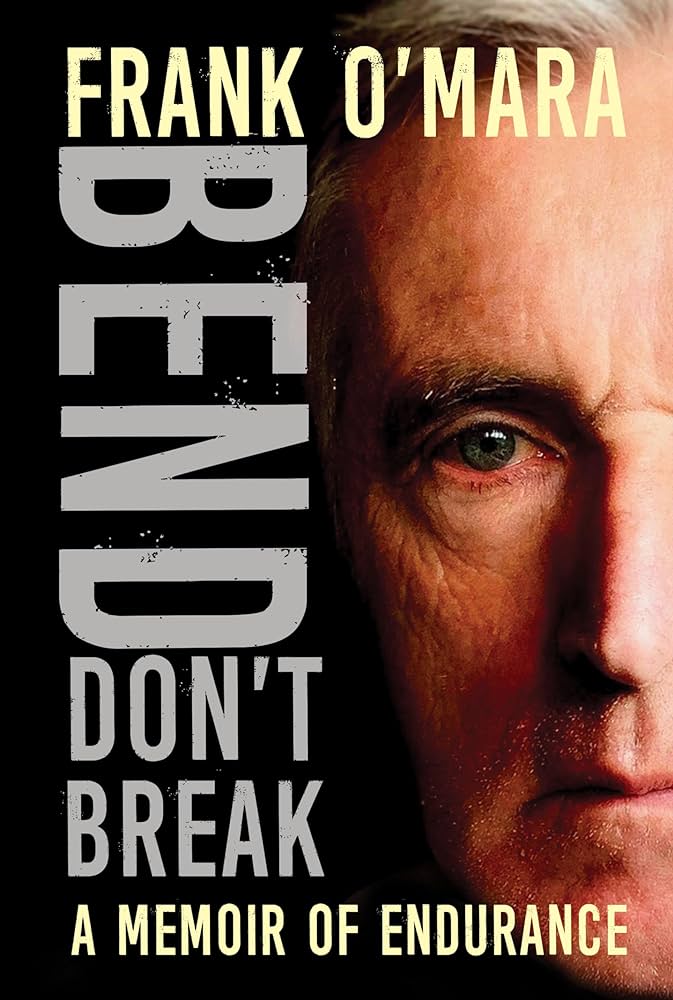
Bend, Don’t Break: A Memoir of Endurance, by Frank O’Mara. (The O’Brien Press. April 19, 2024)

Frank O’Mara and I have three things in common: a) we’re both Irish citizens, b) we both competed in track and field in college, and c) we both have Parkinson’s disease.

The commonalities only carry so far, though. Take the issue of Irish citizenship. O’Mara was born and raised in Ireland’s County Limerick; I’m a Midwestern American boy, a product of the “I-states”: Iowa, Indiana, Illinois. He became an Irish citizen at birth, while I claimed Irish citizenship only recently, “through descent.” My maternal grandfather, who emigrated to America in the 1910s, was a Limerick man, like O’Mara, while my maternal grandmother hailed from County Clare, Limerick’s neighbor to the north. The basic difference between us: O’Mara sounds like an Irishman. Me, not so much.

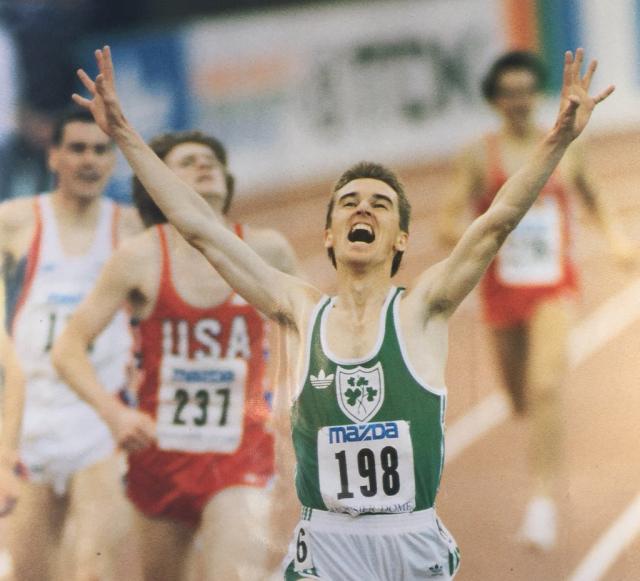
Then there’s the matter of college track (or “athletics” as it’s called in Ireland). O’Mara ran for the University of Arkansas in the 1980s, while I was a shot-putter at Notre Dame several years earlier. He was a key member of a dominant wave of Irish middle-distance runners recruited by American universities in the 1970s, ’80s, and ‘90s (along with Eamonn Coghlan, Sonia O’Sullivan, Marcus O’Sullivan, Ray Flynn, and others). O’Mara went on to win an NCAA title, two World Championship gold medals, and to represent Ireland in three Olympic Games. In 1985, he was part of an all-Irish relay team that broke the world record in the 4 x 1-mile relay – a record that, nearly 40 years later, still stands.

O’Mara, winning the 3000-meter Indoor World Championship gold medal in 1987.

Me? The peak of my collegiate track career was a second-place finish at the Ball State Relays in my sophomore season. (There were no medals; my prize was a too-small tee shirt.) Frustrated by my lack of progress and fed up with spending so much time in dank, windowless weight rooms with sweaty football Goliaths, I retired from shot-putting that spring. But I’ve kept an intense love for all things track and field ever since.

As for Parkinson’s disease (PD) – well, nobody comes out a winner on that one, but of the two of us, I’ve had the easier go by far. I was diagnosed four years ago, at 67, and my difficulties – mainly speech, swallowing, and a clunky gait – are still manageable. I get around without walker, wheelchair, or cane, and I’m fortunate not to have much of a tremor. And since I was an older man when PD came calling, I haven’t missed much that life has to offer. I watched my kids grow into adulthood before I got sick, and I retired from my pediatric career at a time of my own choosing, not prematurely knocked to life’s margins as so many are when PD strikes at an earlier age. 

O’Mara’s course, on the other hand, has been nothing short of nightmarish. After being diagnosed with the early-onset variety of PD, his disease progressed rapidly. He soon experienced the worst symptoms that PD can dish out: severe gait disturbances, full-body tremors, excruciating muscle spasms, speech and language difficulties, complications from medications and treatments, and much more. He was sidelined from running, his great passion, and more-or-less forced into retirement from a highly successful career in the wireless communication industry. He writes movingly – and heartbreakingly – of the impact on his close-knit family, of not being able to parent his three sons, Jack, Colin, and Harry, as much, or as long, as he’d have wished. It is O’Mara’s reaction to his plight, though, his refusal to give in to despair – to “break,” as his title suggests – that makes Bend, Don’t Break such a compelling read.

The book opens with a scene familiar to perhaps all of us with PD: the moment when, after months of denial – stubbornly blaming his persistent left leg weakness on a running injury – O’Mara’s unwillingness to accept his diagnosis crumbles when he comes upon his wife, Patty, and an old friend sobbing in their kitchen. “I couldn’t keep reality at bay any longer,” O’Mara writes. “I had early onset Parkinson’s disease at the age of forty-eight.”

O’Mara tells his story in an engaging, non-linear way, weaving the strands of his life – both pre-PD and now with the disease – into a complete picture of the man at all stages of his life. Remarkably, for one who has lost so much to Parkinson’s, O’Mara’s sense of humor seems untouched. He writes with the dry, self-deprecating wit I came to love during my own childhood, spending holidays with my ex-pat Limerick and Clare relatives in Chicago’s vibrant Irish community.

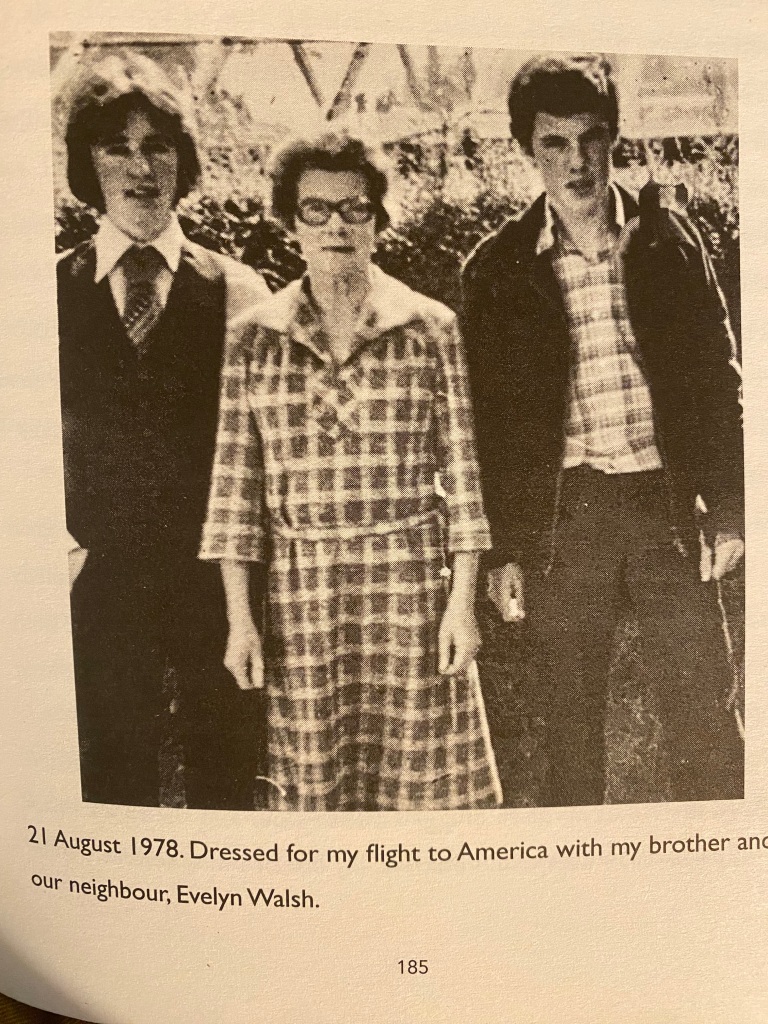
Bend, Don’t Break features a surprising number of funny moments, including one in which O’Mara’s mother buys him a brown, woolen, three-piece suit to wear on the plane for his initial visit to the University of Arkansas, insisting that a nice suit was the key to making a good first impression. Unfortunately, neither young Frank nor his mother understood the oppressiveness of an Arkansas August: “I discovered that brown absorbs heat, and that wool absorbs sweat,” he writes of a layover in Dallas. “Then I encountered the miracle of air conditioning for the first time.” Piece by piece, his suit disappears into his suitcase – replaced by more weather-appropriate attire – until, upon arrival in Little Rock, he sports the under-dressed look of a young man headed for a swimming pool…”[i]f only there was a pool.”

O’Mara (left) and the infamous brown suit, headed for a broiling in Arkansas.

O’Mara’s childhood was marked by two seminal events. The first was his enrollment in an all-boys boarding school – the Dickensian-named St. Munchin’s College1– at age eleven. It was at St. Munchin’s that O’Mara first learned that he was a fast runner. Pressed into service as a speedy “ringer” by a group of older boys hoping to claim possession of a coveted piece of the College’s recreation area for after-dinner games, O’Mara developed the strategies – pacing, sharp elbows, and avoiding “calamity” in the crowded sections of races – that would serve him well in his grownup running career.

The second formative event of O’Mara’s childhood was the sudden death of his father from a heart attack when O’Mara was fifteen. In a poignant section, the author describes his last communication with his hospitalized father – a hand-scrawled letter in which he promised to win the Irish Schools 1,500-meter title the following year. (“Hope you recover,” he signed off, awkwardly, in the way of teenagers everywhere.)

This was a big promise. O’Mara was coming off a string of average-at-best performances (for him) that left him doubting his abilities. But he took his vow to his late father seriously, and through discipline and stepped-up training reached his goal, winning the Irish Schools championship the following year in impressive form, breaking the old record by more than four seconds.

Much of Bend, Don’t Break is devoted to the mature O’Mara’s two main passions: running and the business world. I particularly enjoyed the behind-the-scenes sections on the international track and field circuit of the 1980s and 90s, back when amateurism was still the rule – if only in name – for Olympians. Fans of business success stories will enjoy, too, the high-stakes tale of O’Mara’s tenure as president and CEO of AllTel – the wireless company that once went toe-to-toe with the likes of Verizon and AT&T. This period of O’Mara’s life overlapped with the onset of his PD symptoms, an untimely coincidence that greatly complicated his business dealings.

And then there’s the often-grueling story of the author’s struggles with Parkinson’s, told in straightforward, clear-eyed prose. O’Mara will never be accused of being a Pollyanna; there is neither false optimism nor self-pity in his telling. His description of his disease may be too blunt for someone newly diagnosed, those whose symptoms are still mild and who may well be in the throes of denial. But as someone who only recently passed from denial to acceptance, I find comfort in hearing someone tell his story like it is, particularly someone who has lost so much, but who still sees the value of living his life moment by moment, day by day, and celebrating what small victories PD allows.

It’s typical for a reviewer to gush a bit when he loves a book, to rave about how the author’s story has inspired in him some sort of life-changing epiphany. I can’t say that Bend, Don’t Break has changed the course of my life – I’ve seen what Parkinson’s disease did to my mother and grandfather, and I know that, barring a miracle cure or a timely heart attack, I’m likely headed down that same path.

But I can say that O’Mara, with his love of life, his un-killable sense of humor, his work ethic (he painstakingly typed every word of his manuscript, one keystroke at a time), and his unflinching description of his struggles with Parkinson’s, has inspired me nonetheless. His acceptance of his physical limitations, his determination to challenge those limits, his unembarrassed embrace of his wide circle of family and friends – and his assertion that without that circle he wouldn’t have survived – have made me see my own situation differently.

I’ve always been the physically strong one, the guy who hoisted the heavy stuff, who helped carry others as their bodies failed. It has been very difficult for me to accept the fact that I’m the one needing help now, whether it’s when I stumble, or mumble, or can’t manage those damnably small cuff buttons by myself. I’ve wasted a lot of time deflecting that help, trying to convince everyone – myself, mainly – that I’m just fine, thanks.

Frank O’Mara learned early in the course of his disease to surround himself with the people who loved him and were willing to help. And he took risks, making plans for an uncertain future and carrying through on those plans, even as he dealt with the daunting symptoms of his disease. (I won’t spoil the book’s ending, but it involves a long, arduous trip and remarkable physical challenges.)

Those are the lessons I’ll take from this marvelous book. My wife and I are planning a European vacation for our 40th anniversary next spring, figuring we’ll deal with any changes in my condition between now and then as they arise, and I’m going to start my looong-delayed second book.2  My new mantra: Yes, someday I’ll need a wheelchair, but today is not that day.

And I’ll drop the ‘I’m fine’ act and accept assistance from those around me. Thanks to Frank O’Mara and Bend, Don’t Break, the next time I need help rising from a chair, or un-wedging myself from an overstuffed couch, I’ll gratefully reach out to the hand that’s offered.

_ _ _

Footnote:

  1. St. Munchin (7th cent A.D.), the patron saint of Limerick, is believed to have been the first Bishop of Limerick, although little trace of him can be found in the historical record. He seems to have been a peculiar choice for a patron saint. According to one source, he is renowned for having cursed the citizens of Limerick for not helping him build his church. (Apparently, they forgave him.)
  2. My first (and, so far, only) book, Birth Day: A Pediatrician Explores the Science, the History, and the Wonder of Childbirth (Ballantine Books) was published in 2009. There’s science, history, memoir, and humor, and more about my family members than you may care to know. Got a lot of great reviews, and there’s a Japanese edition if you’re tired of English. You really should buy a copy!

One more (brief!) Moving Day item: How did Shake, Rattle, and Pointe do, fundraising-wise?

In waxing poetic (and at length) in my last post about the weather conditions on Moving Day, I neglected to mention our raison d’être for braving the deluge…fundraising! So, how did our SF Ballet’s Parkinson’s Foundation Fundraising Team  – “Shake, Rattle, and Pointe” – do in the total-donations contest?

Well, we were up against more than 40 other teams, and…

We won!

Total donations: more than $18,000 and counting!

(The Parkinson’s Foundation‘s overall Moving Day SF goal was $145,000. They’ve achieved > 95% of that goal so far!)

A big thank you to my friends, relatives, and blog readers for supporting me in raising money for PD research and services, and for donating more than $2000! I appreciate it, and you, very much. Thanks again!!

Moving Day 2024: A fun (if waterlogged) time was had by all!

About a week before this year’s edition of Moving Day SF – the annual Parkinson’s Foundation fundraiser held Saturday, May 4, at Crissy Field in San Francisco – I decided to check out the long-range weather forecast. Last year’s celebration featured a meteorological mixed bag of light rain, fog, cold wind, bright sun, then more fog and cold wind blowing in under the Golden Gate Bridge. I achieved my exercise goals that day just by putting on and peeling off my multi-layers of sweater, vest, windbreaker, and heavy coat, and still ended up half-frozen. I wanted to do a more efficient bit of layer-planning for this year’s event; hence the early weather check.

I wasn’t expecting rain; San Francisco’s last round of wet weather had ended on April 13, and scanning my iPhone’s forecasting app, I saw a week’s worth of sunshine leading up to May 4, and another week of sunshine afterwards. But there on the 4th itself, isolated from all the smiling suns on either side of it, was a lonely dark cloud with raindrops falling from its cartoon underbelly. There was a 65% chance of rain that day, the tiny blue text told me.1

I didn’t worry too much about it at that point. Lots of times those predicted rainstorms don’t materialize. The “% chance” diminishes as the day approaches and finally disappears altogether, the little dark cloud at last swallowed up by yet another inanely smiling sun emoji. I figured that’s what would happen here, too.

But as the day approached, the “% chance” increased steadily, so that by Friday, the day before the event, we were looking at a 95% chance of rain on May 4. It got even worse. Drilling down into the forecast, the heavy Saturday rain was predicted to peak between 9AM and noon – the exact hours of our event.

I read all this on my phone at 5pm on Friday, a hand held to my forehead to shield my eyes from the brilliant sunshine pouring from a beautiful San Francisco sky. As far as I could see – all the way to the Pacific Ocean on the horizon, maybe all the way to Japan – there wasn’t a single cloud in the sky. How could heavy rain be possible within a few hours? Where was it going to come from? Okinawa?

But the weather in San Francisco is prone to change at the drop of the hat that just blew off your head, and change it soon did. By 8pm it was cloudy and misting, around midnight the rain started for real, and by morning the whole city – including Crissy Field, the Moving Day site – was soaked.

_ _ _

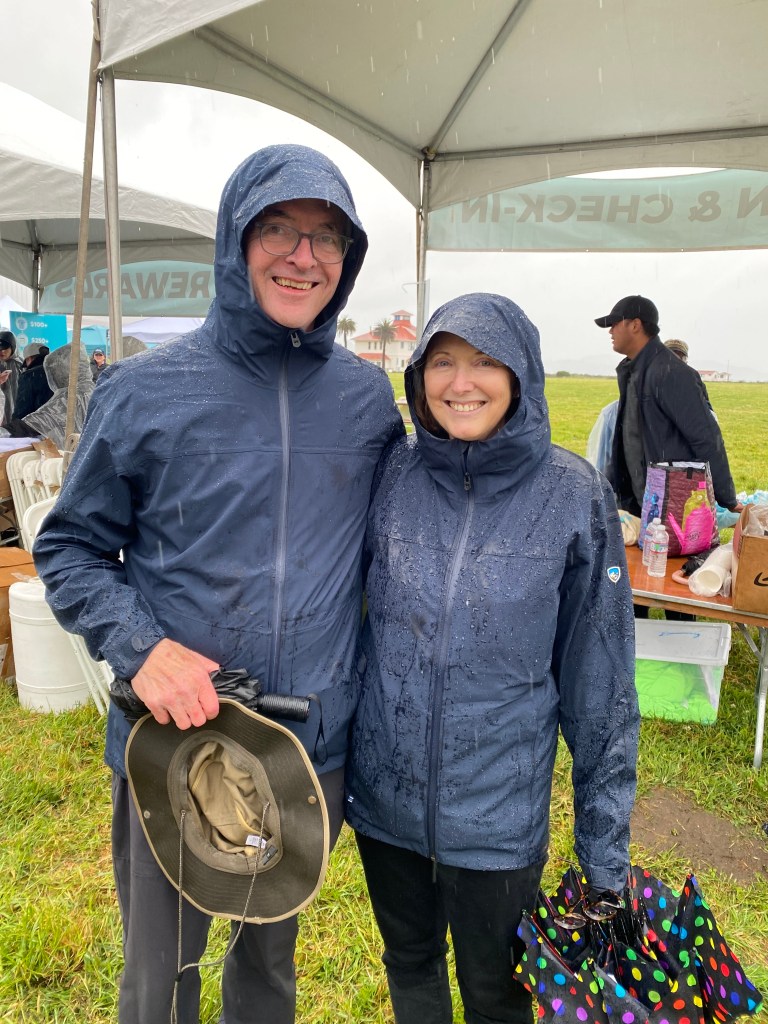
Elisabeth and I rose bright and early to the sound of rain blowing against our apartment windows. There was no question of Moving Day being canceled, though; a series of pleading emails from the event organizers reminded us that things were going to go ahead as planned, come rain or shine. Message received, we dressed in weather-appropriate gear: for me, a SF Ballet shirt, a light sweater, then a heavier sweater and a wool vest, topped off finally by a new-ish rain jacket. Elisabeth wore a variation of my outfit, including a matching rain jacket. We looked like a pair of eggplants.

Eggplants…

Our original plan had been to walk to Crissy Field from our apartment in the Presidio with our good friends, Pauline and Tom (who had hydroplaned the 50 miles from their home in Santa Rosa that morning to cheer us on), up over the south end of the Golden Gate Bridge, and down a steep set of steps to meet up with our SF Ballet team (a.k.a. “Shake, Rattle and Pointe”). It’s normally about a 45-minute walk, but, figuring it would take about twice as long, given the weather (and maybe even longer, as we would likely have been blown off the bridge and right into the Bay), we opted to get there old-school style. We drove.

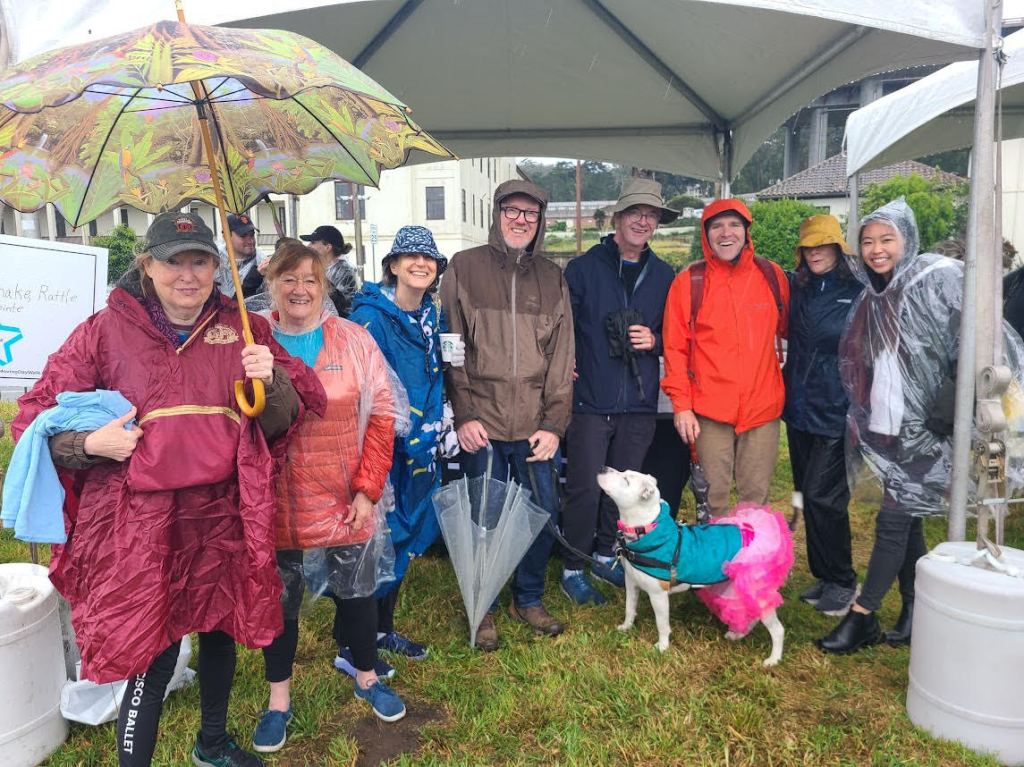
We arrived at the SF Ballet tent right on time. Team members and volunteers had been trickling in over the last hour; you could tell how long a given individual had been there by how closely they resembled a corpse. Recent arrivals still had some pink in their cheeks; earlier unfortunates were pale, blue-lipped and stiff-jawed. Only their teeth-chattering shivers gave them away as still being among the living.

And there in the middle of the tent area, rallying the troops with donut holes and hot coffee, was our unsinkable teacher, Cecelia Beam. (She brought the pastries; the coffee was begged from the Rock Steady boxers next door.) I’ve written about Cecelia and all that she means to those of us with PD in past posts (here and here). Suffice it to say, only Cecelia could stand there, drenched to the bone, water pouring from the brim of her yellow bucket hat, and say, “Isn’t this a great day??” with such heartfelt enthusiasm that, by God, you’d swear cinematic beams of sunshine were right that moment breaking through the clouds. (They most decidedly weren’t.)

A number of our SF Ballet classmates had braved the weather to be there, too. We were scheduled to do a chair-dance demonstration, showing prospective future classmates what our class is like. We had rehearsed our dance numbers over the past few weeks, and Cecelia was counting on us. We weren’t about to let a little firehose-caliber downpour stop our show.

After much slopping and slogging about, trying (and failing) to find a bit of dryness somewhere, a garbled microphone voice at last called for our attention: as promised in all those frantic admin emails, the festivities would be starting precisely on schedule. Shake, Rattle and Pointe would be performing third. (I don’t remember who went first or second; I couldn’t feel my feet.) When our moment finally arrived, Cecelia waved us toward the stage. Surveying her tired, huddled, frozen mass of a team, she called to us, her hands held megaphone-style, through the squall. “Whatever you do, look like you’re having fun,” she cried. “We don’t want to scare off any potential new dancers!” 2

_ _ _

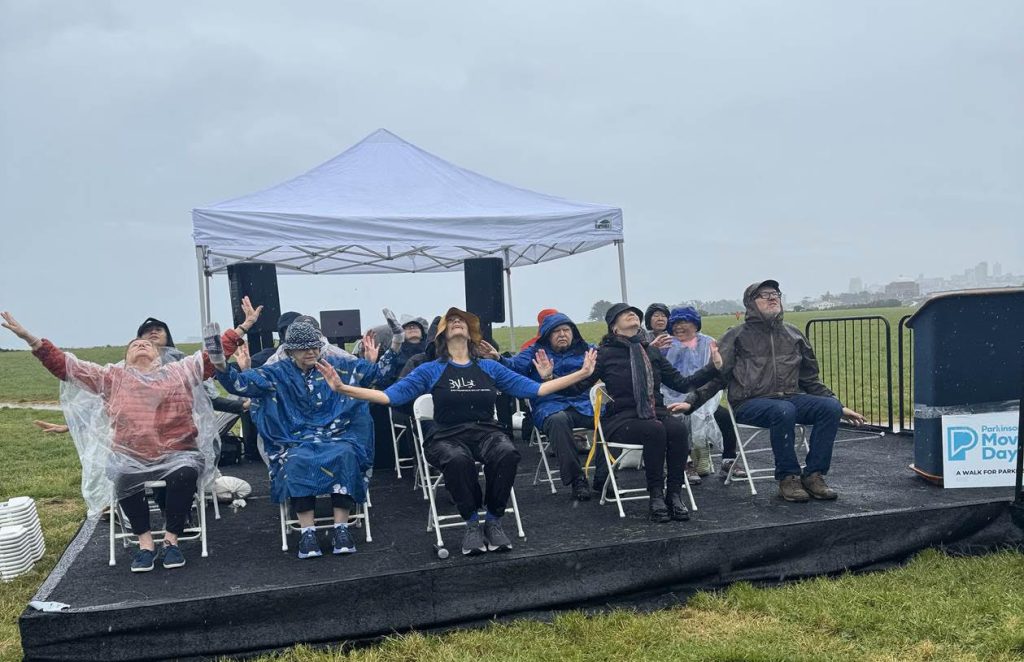
I should mention here that the stage, in this case, was just a modestly raised platform, a roughly 15-by-18 foot extension of the tent under which the DJ was keeping as dry as a DJ can, given the rain coming in horizontal bursts as well as by straight down deluge. Elisabeth and I took our seats in the last row of chairs on the stage – edge-of-the-tent positions that kept our heads out of the rain, while leaving our legs unprotected. I chose my spot strategically: I wanted a chair with a direct visual line to Cecelia, so I could do whatever she did when the music started, and no direct visual line to the audience, so I could chair-dance in peace, unencumbered by fear of public guffawing. Judging from the accompanying photo, it looks like I succeeded…

Where’s Mark? 3

We soon discovered that we weren’t as clever as we’d thought, seating-wise. While it was true that our heads were more or less protected from the downpour by the edge of the tent, our legs were still outside of it, getting rained on. We also hadn’t taken into account that the rainwater up on the roof had to go somewhere, and that, as the tent had no downspouts, the water would simply accumulate, reservoir-like, until the tent roof at last exceeded its capacity, breached its levee, and dumped what felt like gallons of ice water into our laps. This drench-pause-drench cycle continued throughout our time onstage, with alarming frequency and breath-taking force. We thought about moving, but by then the performance had already begun – meaning we would have had to shove the people in front of us off the stage and steal their chairs, something of a no-no in the ballet world – and anyway, we couldn’t get any wetter or colder than we already were, so what was the point? We endured the periodic aqua-dumpings, succumbed to a bad case of the “kids-being-naughty-in-church” giggles and soldiered on.

Our first number consisted of a series of basic ballet moves, adapted for chair dancing. We did tendus, ronds de jambe, and ronds de jambe en dehors with our pointed toes, and some graceful fluffy stuff with our arms, to the song “Don’t Worry About a Thing,” by the noted Jamaican ballet choreographer, Bob Marley. We followed this with two excerpts from Swan Lake: the Big Swan Dance, followed by the Little Swan Dance. (I could be getting the names wrong – they probably sound cooler in French, anyway.) The Big Swan Dance came first, with dramatic swoops and little feathery hand flutters powered by what Cecelia referred to as our “swan arms”: elbows leading on the upswing until wrists nearly touched overhead, then down slowly. Repeat over and over until all the Big Birds have flown away. (All of us flying together was a lovely sight, and would have been lovelier still, had we each had a bit more room to move about onstage than your average corporate-farmed chicken. Picture a lot of colliding elbows… ) The Little Swan dance came next, and was the most fun of the three for me – we got to “march” in our chairs, turn our heads sharply up and around like tiny birds, march some more, tilt our heads from side to side, make nine final marching steps and then finish with a big “ta-daa!” move to wow the crowd.4

Through it all, Cecelia was her usual inviting self, urging the crowd to dance with us, and dance they did. At one point there were several dozen people, many of them swathed in the clear rain parkas handed out by the event staff, swaying, taking their cues from Cecelia, trying out their own swan arms. They looked like a bunch of soaked, happy, shrink-wrapped humans.

When our performance was done, we all hung around in the gale rather than seek higher ground, because we knew what was coming next. Cecelia was called back to the stage to receive an award from the Parkinson’s Foundation, well-deserved recognition for all that she’s done, through her love of dance and teaching, for people with Parkinson’s. I can safely say there wasn’t a dry eye in the house, because by this point in the festivities there wasn’t a dry anything in the house. Once the congratulatory hubbub subsided (we would have carried her off the field on our shoulders, if our shoulders were still capable of that sort of thing) everybody climbed into the nearest rubber raft and paddled for shore.

___

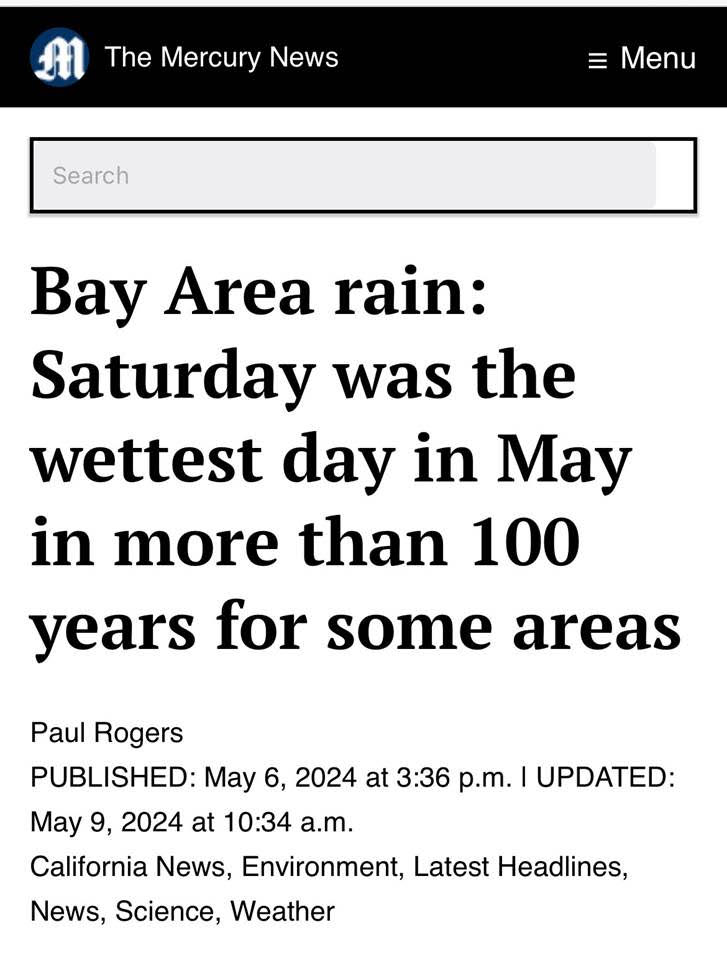
I’m writing this on May 11, one week after Moving Day. I’ve since learned that May 4 was the wettest May day in San Francisco in nearly 30 years. The total – an inch and a half or so – may not sound too impressive to those of you who live in parts of the world where total rainfall is spread more evenly throughout the year. But here in the Bay area, where May typically marks the beginning of the dry season – we may see no more rain at all until autumn – May 4 was a rare, monsoon-like event. Add in that the bulk of the rain fell within just a few hours, half of it blown in sideways on 40mph winds, and you can maybe understand why this was a big deal for us.

It hasn’t rained a drop since Saturday (in fact, the clouds dispersed and the sun broke through later that same afternoon), and from the looks of the extended forecast, it isn’t going to rain for at least the next ten days, and probably longer. The downpour on Moving Day, then, centered as it was on our Bird Dances, may well turn out to be San Francisco’s only appreciable rainfall between mid-April and Labor Day. Maybe even Halloween.

In other words, Mother Nature has it in for Moving Day SF. So, lesson learned. Next year, I’m packing a suitcase full of all-weather gear: wool sweaters, a vest, jackets (heavy and light), a rain jacket (and rain pants this time), an ice axe, a furry hat with ear flaps, a hardhat to deflect golf-ball sized hail, hip-waders, a set of battery-powered hand warmers, and, just in case Mom throws us a curveball, shorts, a tee shirt, flip flops, maybe a pair of swimming trunks, and a tube of sunscreen. Then I’ll strap the whole thing to a dogsled. Because, hey – when it comes to San Francisco weather in early May, you just never know.

(In case you think I was making stuff up…)

_ _ _

Footnotes:

  1. I’ve never been clear on what a “65% chance of precipitation” actually means. Is it that that there’s a 65% chance that rain will fall somewhere within the city limits on that day? A 65% chance that the whole city will get wet? A 65% chance that raindrops will fall on my head? And how much rain are we talking about? Is the mere spitting of a few drops on my windshield enough, or does it need to be a Texas-sized gully-washer? Any weather-people reading this – can you explain it to me? Please?
  2. Note to prospective dance recruits: With the exception of Moving Day, our class is held indoors, in the dry and cozy confines of the SF Ballet School (and chair-dancing is optional; we do center floor and barre work as well). We’re not “Flash Dance,” people.
  3. I’m the ominous, eggplant-hooded shadow lurking at the back of the second row from left.
  4. I’m not, and never will be mistaken for, a dance writer…

Moving Day 2024: A Plea for Pennies for Parkinson’s

Dear faithful reader,

Next Saturday, May 4th, will be my third Moving Day SF as a PwP (Person with Parkinson’s), and my second time attending Moving Day festivities at Crissy Field in San Francisco. Moving Day is the annual fundraiser for the Parkinson’s Foundation (PF), a national organization that funds research and provides educational resources for Parkinson’s disease patients and their caregivers. The PF website is a great place to access information on all things Parkinson’s.
 
As most of you know, I greatly enjoy participating in a weekly Dance Class for People with Parkinson’s group at the San Francisco Ballet School, made possible by funding from the Parkinson Foundation. This funding allows the class to be free for anyone with Parkinson’s and their family members.  
 
This year our Dance Class team (a.k.a., “Shake, Rattle, and Pointe”) will again have a booth—complete with tutus for trying on—from which we hope not to get blown across San Francisco Bay. (Last year was really windy!) As an added attraction, our class will also be doing a brief dance demonstration.
 
That’s right, I’ll be dancing on stage…but no need to worry for my safety! Nobody’s expecting me to do a pirouette or toss a partner in the air. We perform from chairs, which is just fine with me. We’ll be doing a couple of short excerpts from Swan Lake (seriously), and another one set to a tune by that famed ballet choreographer… Bob Marley.
 
After the program ends, we’ll go on a fundraising walk, and if you think I’m leading up to begging for donations… you’re right!
 
So, if you’re feeling charitable or downright philanthropic (and if you’re not, that’s okay, too), here’s how to donate:
 
1)      Click on this link to visit our team page (we’re “Shake, Rattle and Pointe”):

https://secure3.convio.net/prkorg/site/TR/MovingDayEvent/General/783621797?pg=team&fr_id=5066&team_id=72344

2)      Ignore the “Log In” button. Scroll down to the ‘Team Roster’ and click the ‘Donate’ button next to my name.
 
3)      Follow the prompts on the ‘Donate’ page. (Donations are tax deductible.)
 
4)      Accept my undying gratitude…
 
Finally, I’m including one attachment from last year’s event:
 
·      A video of the brief speech I gave about my Parkinson’s journey (see link to my blog below to learn how this came about):

…and a link to the blog post I wrote after last year’s Moving Day. The post includes a copy of the text of my speech (in case my video uploading skills are faulty…)

 https://amovingdisorder.blog/category/moving-day-SF

That’s it! Thanks so much!

Mark


Problems viewing?

I just learned from a reader that if you read my blog posts in the email format, the pictures and photos may not show up. Better way to view: Click on the ‘Read on Blog’ or the ‘Reader’ button in the upper right of the email. Better formats! (Plus, Reader format allows you to scroll to past posts.)

Please email me if you’re having any other problems viewing my posts. (markpsloan@gmail.com) Thanks!

Things I can still do: Walking (and people-watching) in Golden Gate Park

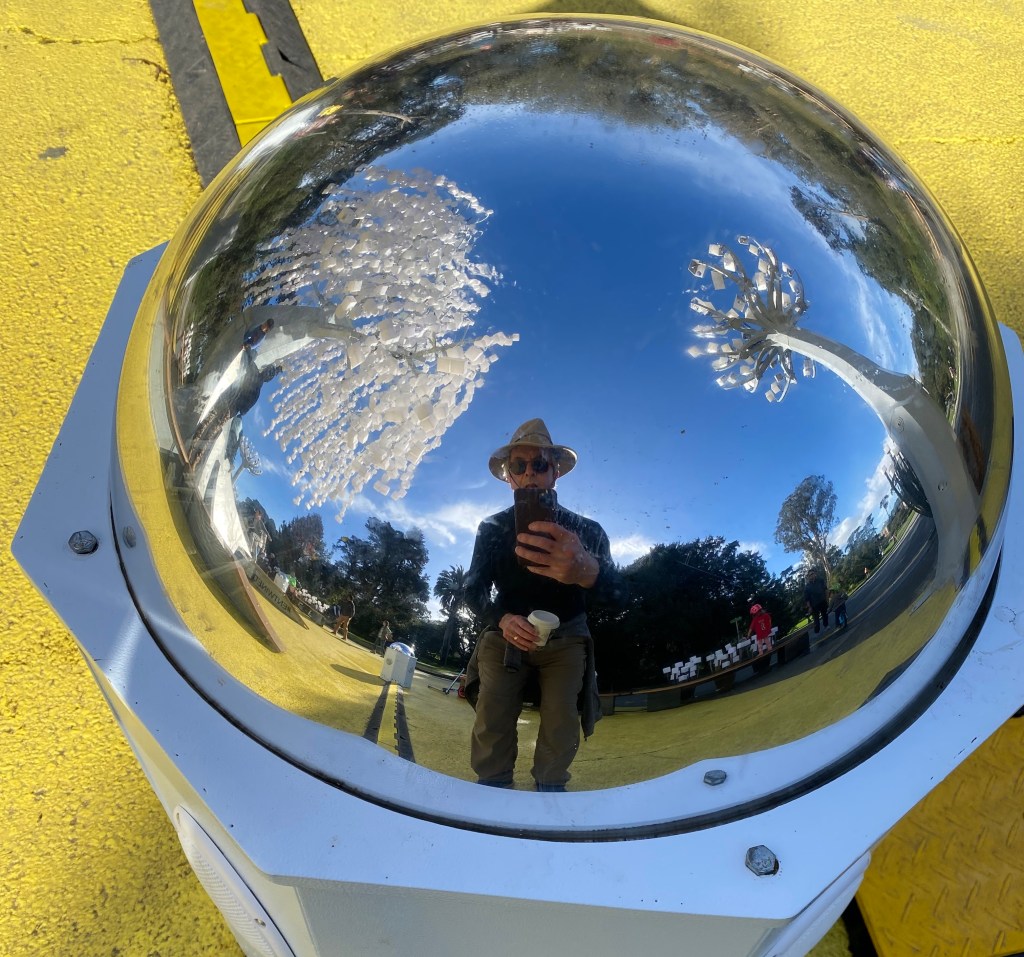
If I were a musician (I’m not), the year was 1971 (it isn’t) and I was about to release a new album (again: no), this would undoubtedly be my album cover photo. It’s got all the requisite ’70s stuff: trippy perspective, weird tree-like structures and, there in the middle, a mysterious-looking guy in shades, doing… what, exactly? Just switch out the iPhone for a set of Panpipes and there I am: a be-hatted hippie in Golden Gate Park, tootling a Jethro Tull cover…

It’s a feature of aging: grieving the loss of youthful physical abilities. We watch in sadness as all that leaping and cavorting we took for granted back in the day slowly fades away. For those of us with progressive neurological diseases, the grieving can be that much sharper, as the losses come earlier and faster than we had expected.

Fortunately, the things I’ve lost so far haven’t been all that dear to me. Take swimming: I never enjoyed it much as a youngster, mainly because I was a chubby kid, not fond of the ridicule that came with peeling off my shirt to cannonball into a pool or lake on a stifling southern Indiana afternoon. I recently discovered, while stepping off a paddleboard in Hawaii and sinking like a rock, that – thanks to PD – I’ve lost even my chubby-kid swimming skills. (Fortunately, this happened in relatively shallow water. I mean, who falls off a paddleboard and drowns in the hotel lagoon?) So, swimming is out, but I figure, hey – if something’s gotta go, it might as well be something I wasn’t too crazy about in the first place.

But enough about losses! Today’s theme is the celebration of things I can still do well, and in that spirit I will point out that I’m still a pretty good walker. Once I’m up and moving – after I’ve slo-mo enticed my feet into shoes, extricated myself from the couch, and wobbled to my feet – I can go for miles, especially if there’s something interesting to walk to.

And for me the most interesting destination of all is San Francisco’s Golden Gate Park on a sunny day, now that the stretch of John F. Kennedy Drive that runs through the heart of the Park is vehicle-free. Out went the cars and trucks, in came the cyclists (bi-, tri-, uni-), baby strollers, rollerbladers, jugglers, dancers, toddlers on leashes, and exuberant exhibitionists. Golden Gate Park is a free-range Promised Land for people-watchers.

I spend at least three hours a week wandering the Park while Elisabeth takes an art class at the DeYoung Museum. Sometimes I cruise by the Conservatory of Flowers, sometimes I try to visit all ten of the Park’s lakes. And if I’m feeling particularly frisky, I hike on down to the Bison Paddock. (Yes, it’s really a thing.) But it’s the journey, not the destination, that makes for the best random sampling of Park people in their natural habitat. Here then, is a compilation of favorite observed/overheard moments from 2024 (s0 far):

  • A 30-something dad, feeding his infant twins on park bench, one baby on each thigh, a bottle in each of his hands. I say, “Looks like you’ve really got your work cut out for you.” He tilts his head back, nods to me with his chin, says, “Mmph.” Looks like he’d like to say more, but he’s got a pacifier stuck in his mouth. I nod, wish him luck, and move on.
  • I spot a woman holding her toddler horizontally in her arms. He’s face down, training pants at his ankles, peeing in the bushes by the side of the trail. Mom looks like she’s watering the greenery with him. When he’s done she shakes him a bit, making sure to get the last of the pee-drops onto the foliage, and says “You did it!” Kid says, “I do it!” about twenty times. Very excited. Mom pulls up his pants and off they go, “I do it! I do it!” echoing down the path.
  • +/- 6-year-old boy, very angry in a pedal boat on Blue Heron Lake*, moving about 0.1 miles per hour. “Daaad!!” he yells, arms tightly crossed. “You said these boats would be faaast!” Dad, a tad flustered: “You want it to go faster, just pedal harder!” Kid: “That doesn’t work! We’re still too slow!!” Dad: “Hey, if the boat’s too slow for you, get out and walk!” Kid looks down, speaks up: “Daaad! That won’t work either! It’s just water!
  • I’m walking back to 14th Avenue to move our car so we don’t get a ticket. I pass a very sad looking young woman slumped on a park bench next to an expressionless elderly woman who may be her grandmother. “So, I said to him,” she says to the older woman, “‘Look, you’ve got to tell me what your intentions are here.’” She breaks down sobbing; the old woman, who appears to be alive, doesn’t so much as blink. I come back ten minutes later, and they’re still there: girl still crying, unblinking grandma not registering much of anything. “I mean, he’s just…no,” the young woman says, sniffling. “He’s just so…no.”
  • I spy two mothers with toddlers off in a meadow. They’re not there together – they’re 50 feet or so apart – but their toddlers apparently have decided to throw simultaneous tantrums. They’re both screaming and choking and baby-swearing, faces down in the grass, pounding the ground. Mid-performance, one of the toddlers finally notices the other one, stops, sits up and watches, fascinated, maybe taking notes. His mother leans down, says something to him, and—Shazaam!— he realizes he isn’t quite done. Wailing again, he picks up where he left off. The mothers stare off in opposite directions, ignoring their little maniacs, waiting, waiting for the storm to pass. (There’s an old pediatric proverb about tantrums: “If you want the play to close down, stop buying tickets. This is clearly not the first tantrum rodeo for either of them.)
  • Two tech-bros jogging by. Blonde-bro: “Didn’t there used to be a statue around here?” Redhead-bro: “Dude, this whole place is nothing but statues.”
  • What’s the female equivalent of a tech-bro? “Tech-sis” doesn’t sound quite right, but at any rate, a woman on a bike, dressed to the nines in neon Italian bicycle ads, bears down on me while berating someone on her phone. I can hear her coming fifty yards away: “Vivisection!” she shouts. “No, vivisection!”she repeats even louder, staccato-spelling the word for the hapless assistant on the other end of the call. “It’s when you cut up something that’s alive, Jeff,” she snarls, whizzing by. (Advice to Jeff: Lock your front door tonight…)
  • Over by the entrance to the Rose Garden, I come across a small boy playing a big saxophone. By my pediatrician’s estimate, he’s somewhere between an average-developing 10 year-old and a late-blooming “tween.” An older man – His father? A teacher? – sits in a camp chair some distance away, sipping from a thermos, calling out encouragement and suggestions. They have an easy working style – the boy finishes a chorus of “Strangers in the Night” (seriously) and looks to the man, who sends the boy a thumbs-up in return. “Nice one, buddy,” he calls, and they both smile. 
  • One last JFK Drive sighting: All alone in the middle of the roadway, a young-ish man in a tight-fitting black body suit twirls and tosses a baton high overhead, the setting sun glinting strobe-like off the spinning shaft. His repertoire is quick and impressive: everything from horizontals and Figure 8s to cutbacks and flat flips and “three spins” with behind-the-back catches. Performing for everyone and for no one in particular, he neatly sums up the Day-in-the-Park vibe. (Full disclosure: I have no baton expertise. I just looked up “twirling tricks” on YouTube.)

That’s it for the Q1 2024 edition of “Mark Spies on People in the Park.” There are many parts of the Park I’ve yet to mine for people-watching purposes: the Tulip Gardens, the Windmills, the Japanese Tea Garden, the Beach Chalet, the Music Concourse with its 100+ year-old bandshell, the meadows, playgrounds, ballfields, etc., etc., ad infinitum. So, more to come, no doubt!

_ _ _

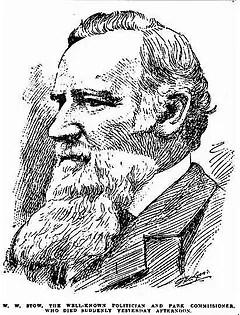
*Some readers may be a bit puzzled: Where is Blue Heron Lake?? You won’t find it on any maps of the Park (yet). That’s because, from the 1890s until January, 2024, Blue Heron Lake was known as Stow Lake, named for William W. Stow, a former speaker of the State Assembly and member of the Golden Gate Park board at the time of his sudden death in 1895. He was also one of California’s most rabidly antisemitic politicians, openly advocating for the forced removal of the state’s Jews and, failing that, imposing a tax on Jews “so high that [they] would not be able to operate any more shops.” A community effort in the 2020s succeeded in ousting Stow from his eponymous lake; the name “Blue Heron Lake” was chosen for the Blue Herons that nest on the island in the middle of the lake every spring.

Which exercise is best for PD? (Or: Do I really have to spend the rest of my life in spin class??)

It sounds a bit trite, but it’s true nonetheless: the best type of exercise when you’ve got PD is any kind of exercise you’ll actually do. Fortunately, just as Parkinson’s disease presents in a wide variety of ways, there is a wide, wide range of exercise types that can help you manage your Parkinson’s symptoms. Surely you can find something you like?

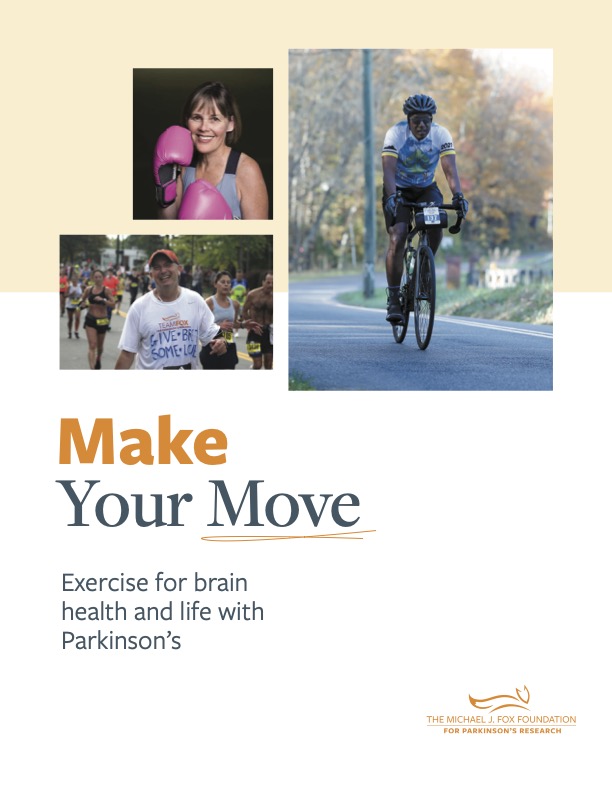
A great place to start is with Make Your Move, a reader-friendly, thoroughly researched publication of the Michael J. Fox Foundation. (See ‘Selected Resources’ list at bottom for additional links.) With clear text and inspiring first-person stories, Make Your Move can get you started on a personalized exercise path to taking control of your symptoms.

+++++

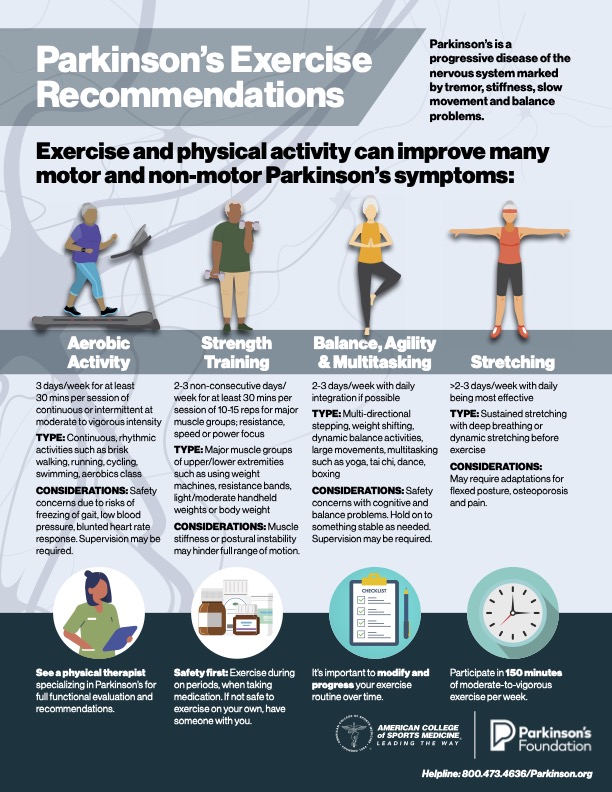
A picture is worth 1,000 words (even if the somewhat wordy graphic from the American College of Sports Medicine below already looks to have 999 or so…):

My motivation to exercise is pretty straightforward: On days that I exercise I feel more alert and engaged with the world. Sometimes I even feel like my old self (well, almost). And I sleep better, too, which gives me a big boost the following day.

Here’s my own (idealized) exercise regimen, adhered to as strictly as time, energy, and willingness on a given day allow:

Aerobic activity: Lots of walking and run-walking, aiming for 10,000 steps (+/- 4 miles) a few times a week. When weather and/or failing old-guy joints intervene, I supplement with an exercise bike.

Strength training: I usually lift weights twice a week at a health club. (I’m still fairly strong for an old coot, but that “fairly” is a pretty big qualifier…). I rotate upper and lower body exercises, and move quickly enough through my reps that my heart rate sometimes gets up into the high-intensity range. I keep lobbying my neurologist to let me count this as an aerobic activity, too, but she’s not budging. (“I know you love your weightlifting, Mark, but…no.“)

Balance, Agility & Multitasking: I cannot praise boxing, specifically the Rock Steady Boxing program, enough. It combines agility and balance with the joy of shouting at, and whupping the tar out of, a boxing bag. (Bonus feature: you don’t actually have to get hit.) Seriously, if you have PD and can find a Rock Steady program near you, sign up! I have similar praise for dance, specifically ballet, which I do once a week, and of which I have waxed poetic in past posts.

Stretching: Lordy, I’d love to stretch less often! I have problems with restless leg syndrome, which on bad nights can wake me up a half dozen times; stretching helps temporarily alleviate the weird, heebie-jeebie sensations that come with RLS. So, yes…I stretch.

Okay, up and at ’em! Hopefully this information will help get you started on a sustainable exercise program. And if (more like when) you fall off the exercise wagon, climb back on as soon as you’re able. Your Parkinson’s isn’t going anywhere!

+++++

Selected Resources:

Michael J. Fox Foundation, Make Your Move: Exercise for brain health and life with Parkinson’s (It’s free, after you register on the first page.)

Parkinson’s Foundation: Exercise

American College of Sports Medicine (with the Parkinson’s Foundation): Exercise Guidelines for Parkinson’s (A more in-depth look at the benefits of exercise.)

Rock Steady Boxing (Search for a gym near you!)

SF Ballet’s Dance Class for People with Parkinson’s (Completely free! If you don’t live near San Francisco, fear not – there’s a Zoom class every Tuesday that you can take from anywhere.)

Exercise and Parkinson’s: Beefing Up Your Brain

There’s a young man who’s been working out at my health club for a few months now. When I first saw him he was sapling-skinny, with scarecrow hair, owlish eyes, and black, square-ish, never-in-style eyeglass frames. I had sympathy for him—I took care of a lot of teen boys wrestling with body image issues in my pediatric career. Dressed in baggy sweats, he could have been the inspiration for one of those 1950s Charles Atlas bodybuilding ads—the 97-pound weakling who gets sand kicked in his face by the muscle-bound beach bully (1):

And sure enough, just like Atlas’s scrawny “Mac”, the young man at the health club soon transformed his body. His determination was a thing to behold, as he followed an exhausting routine of curls, bench presses, squats, pull-downs, and more, adding a bit of weight to the bars each week. His broomstick arms sprouted biceps that steadily grew; pleased with his own progress, the young man took to striking furtive poses in the mirror that covers the back wall of the weight room.

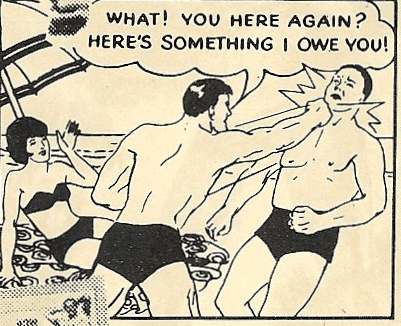
He’s now well on his way to becoming a true Charles Atlas “new man.” Where he once crept into the weight room, he now strides in with confidence. His t-shirt has gotten tighter in the chest and biceps. He’s weed-whacked his hair into a fashionable ‘do’. He’s even got new, au courant glasses. Woe betide the bully who inspired this transformation—he’s in for a good girlfriend (or boyfriend)-witnessed chin-bopping sometime soon:

A righteous ‘bop’

I’ve had to fight the urge to share my Parkinsonian learning with the young man. I’d like to tell him that all that iron he’s been pumping has made his brain stronger, too. Why, he’s got a zillion new neural connections all over his noggin – in the basal ganglia, the zona pellucida, the locus ceruleus, you name it! But he’s a twenty-something guy; who cares how good your brain looks at that age? I figure he’d just take me for a crazy old man. Which, I am.

+++

Here’s an old adage that I just made up: What’s good for the body is good for the brain. It’s true, if maybe not too catchy. When it comes to Parkinson’s, vigorous exercise of any kind, whether running, swimming, brisk walking, cycling, boxing, dancing, strength training à la Charles Atlas—basically, any form of exercise that gets your heart pumping—actually stimulates the growth of new neurons (brain cells) and strengthens connections between neurons in many parts of the brain. This makes for speedier and more efficient communication between areas of the brain, something of great importance to those of us with Parkinson’s.

But, really, there’s no anti-Parkinson’s magic going on here. Moving your body is good for all brains, not just the PD kind. The mechanisms behind the benefit are the same for the afflicted and the un-afflicted alike. It’s just that those of us with PD are starting in a neurological hole—we’ve been losing dopamine-secreting neurons for years, maybe even decades, before we’re diagnosed. Exercise can help you dig your way out a bit, or at least slow down the rate of decline.

How does exercise work its magic on the brain?

I learned back in high school biology that the adult brain was more or less a done deal, a mysterious, gelatinous blob that bossed around the body via an old-school scheme of stimulus and response. You were born with a finite number of neurons in your brain; our teacher told us, and once they’re gone, poof, they’re gone for good. I remember even then thinking that didn’t seem quite right—if head injuries or strokes destroyed brain tissue for good, I wondered, how did some people learn to walk or talk again afterwards?

When I reached medical school, I learned that, rather than a rigid, finished product, the brain was in fact plastic. (No, not in the single-use-shopping-bag sense; neuroplasticity is defined as the ability of the nervous system to reorganize itself, to change its structure, functions, or connections after injury or in response to external stimuli.) The brain has a remarkable—but not unlimited—capacity to heal itself.

The principle of neuroplasticity is critical to brain health in the neurotypical (aka, “normal”) individual and even more so in people afflicted with Parkinson’s disease. There’s currently no cure for PD—no way to undo the damage that’s been done by whatever the heck is causing the disease—and available medications provide only symptomatic relief. Exercise, though, can actually slow PD’s inexorable march. That’s why every newly diagnosed PD patient hears a nearly constant mantra from neurologists, therapists, and everyone else in PD world: You gotta get moving, bud! Movement is medicine! 

And they mean “get moving” quite literally, because body movement sends a signal to both the neurotypical and PD-afflicted brain to crank out increased amounts of a molecule known as brain derived neurotrophic factor (BDNF). BDNF in turn stimulates the growth of neurons in areas of the brain that are active. It’s nature’s way of building up the neuronal pathways that a healthy body uses most, while not wasting energy on those that are neglected. 

Of particular importance for people with PD, movement-stimulated BDNF production promotes the growth of neurons that manufacture dopamine, the neurotransmitter that controls and fine-tunes muscle activity and coordination. (Low levels of dopamine are responsible for the tremors, slowness, and rigidity characteristic of PD.) A virtuous cycle is thus created: body movement increases BDNF and dopamine production—especially in areas of the brain that control movement and balance—which in turn make it easier for you to move, which then stimulates the brain to produce more BDNF and dopamine…and so on.  It’s a variation on the old saying, “use it or lose it”: Use it (move your body!) and grow it (dopamine production).

What type of movement or exercise is best?

Good question! But this post has gotten pretty long, so how about I answer that one in my next post?

Stay tuned!

—–

Footnote:

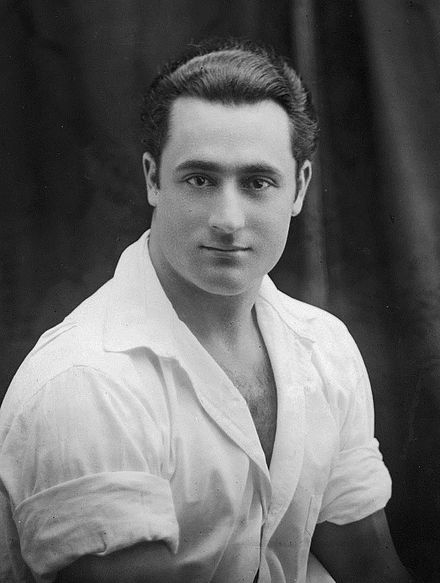
1) Charles Atlas (1892-1972) was born Angelo Siciliano in Calabria, Italy. He emigrated to New York, in 1904, where as a teenager he became fascinated with the bodybuilders and strongmen at a Coney Island circus.

Atlas (he legally changed his name in 1922 after being told he resembled the statue of Atlas atop a Manhattan hotel), a late bloomer, described himself as the original “97-pound weakling” who got himself doubly humiliated one day when a muscle-bound guy kicked sand in his face at the beach as his girlfriend looked on and ridiculed him. Vowing revenge, Atlas whipped himself into muscle-man shape, a transformation that earned him a) the aforementioned revenge, in the form of a beach-bully beat-down; b) a job as a bodybuilder on Coney Island, c) a string of titles, including “America’s Most Handsome Man” and “America’s Most Perfectly Formed Man” and d) a lucrative side gig as a sculpture model. (Among many other artistic commissions, he posed for the statue of Alexander Hamilton that still stands outside the U.S. Treasury building in Washington, D.C.)

Charles Atlas is probably best remembered today for the wildly popular, full-page comic book advertisements for his eponymous body-building course. The story line in the ads hardly changed over the decades: a scrawny, dweeby-looking young man (typically named “Mac,” “Joe”, or “Jack”), dressed in ill-fitting, high-waisted swim trunks, sits with his shapely girlfriend on a beach towel, when, seemingly out of nowhere, a macho bully insults him (“Hey skinny! Yer ribs are showing!”), slaps him, and then kicks sand in his face, while Joe’s girlfriend snickers and further deflates his ego (“Oh, don’t let it bother you, little boy!”). Joe stomps angrily home, kicks a chair, vows revenge, then sends in a coupon for a free Charles Atlas booklet, and –lo!–two panels later he’s back on the beach with muscles popping out all over the place, bopping the bully in the jaw to the lusty approval of his fickle girlfriend (“Oh, Joe!” she coos as the bully skulks away. “You are a real he-man after all!”)

But a moral conundrum is left hanging in the air: Did Charles Atlas really make Joe a better man, or did he just create a new bully?