What did James Parkinson look like?

In an earlier post I wrote about James Parkinson, the British physician who, in 1817, described what would later be called Parkinson’s disease. He had a multi-faceted, truly remarkable life – sort of a British Benjamin Franklin. Parkinson was, in addition to being a renowned physician, a political radical, a best-selling author, an inventor, a crusader for the mentally ill and against child labor, and one of the world’s foremost experts on geology, paleontology, cardiac resuscitation, rabies, and lightning strike injuries.

Given all that, you’d figure it would be easy to discover what the man looked like. After all, museums, palaces, and private mansions throughout Great Britain are festooned with 18th and 19th century oil portraits of virtually every British man (and some women) of means. Yet, inexplicably, no portrait of Parkinson survives.

Fame certainly wasn’t a prerequisite for portrait-sitting in those days. This fact is brought home poignantly by the abundance of paintings of now-unknown subjects – people who, during their lives somehow merited a grand portrait but then were forgotten, quickly or otherwise. Take the case of “An Unknown Man” by the obscure British portraitist Tilly Kittle (1735-1786).1

“An Unknown Man.” (Artist: Tilly Kittle. Date: unknown.)

In Kittle’s rendering, Unknown Man is a plump, baby-faced, apparently wealthy young fellow, surrounded by props – the books, the Roman column, the quill poised in the the inkwell – that would imply a man of some learning and power.  His delicate hands, though, hint at a life of epicurean leisure, likely lived at the expense of servants and peasants. His prominently (proudly?) displayed belly, which threatens to overpower the buttons of his waistcoat, suggests nothing so much as a man about to give birth to twins. Taking a wild stab, I would guess that the young Mr. Man inherited his riches.2

For decades everyone “knew” what James Parkinson looked like – or at least they thought they did. They assumed he was the square-headed, bushy-faced man in the accompanying photograph:
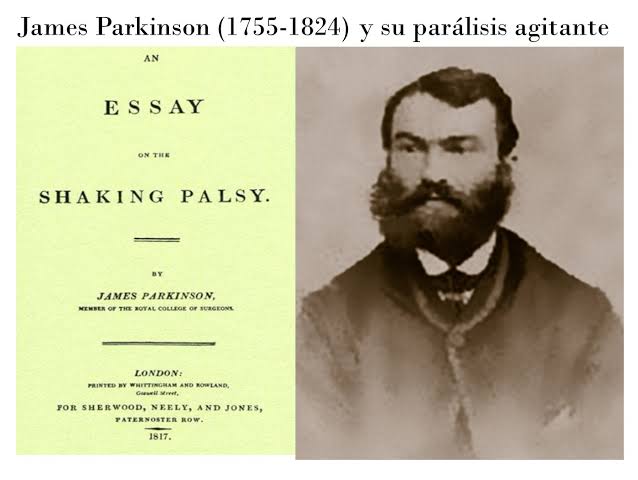
Dr. Parkinson, I presume…

In truth, while he was a James Parkinson, he was not the James Parkinson. The James Parkinson in the photo was, in fact, an Irishman who sailed to Australia during the 1850s gold rush and wound up a Tasmanian lighthouse keeper. He was born eight years after “our” James Parkinson’s death. The tipoff? The first photograph of a human face was taken in 1839, more than a decade after Dr. Parkinson’s death.

This lack of a portrait seemed unjust to me, given the greatness of the man. So, this being the 21st century and all, I decided to put technology on the case – specifically the much loved and loathed new versions of artificial intelligence. I gave DALL-E, the artsy part of openAI’s suite of A.I. programs, its marching orders: “Paint an oil portrait of Dr. James Parkinson, British, in the 18th century style of Tilly Kittle.”

And here’s what I got…
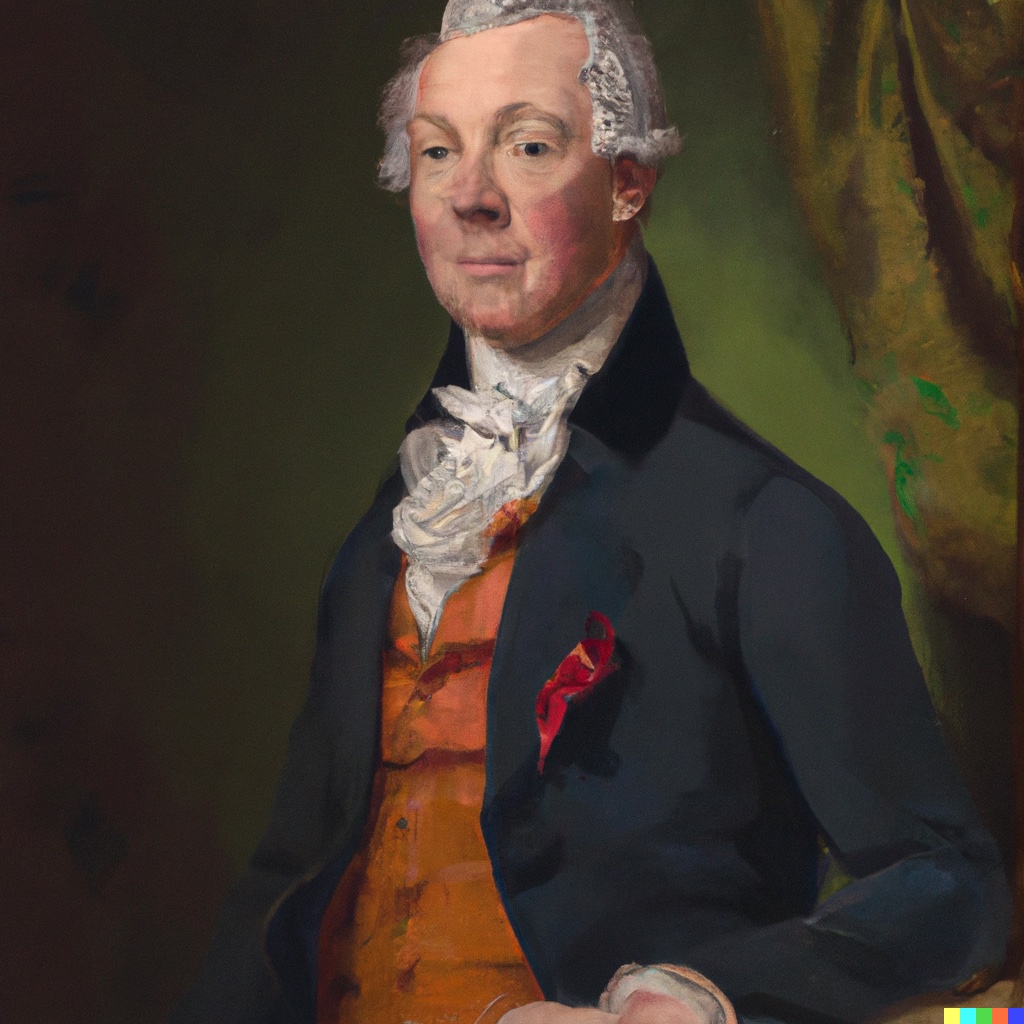
James Parkinson. (“Artist”: A.I. DALL-E, 2023)

Hmm. Looks suspiciously like a slimmed down, age-progressed version of “An Unknown Man,” right down to the left-eyed, thousand-yard stare3 and the proto-1960s flip hairstyle. I thought A.I. would be a bit subtler in its plagiarizing.

I’m not sure if Tilly Kittle would feel flattered or litigious. No doubt some future A.I. iteration will answer that question for him…

_____

Tilly Kittle was a British portrait painter who, after middling success in his early career in England, struck out for India, where he grew rich painting “nabobs and princes,” according to his bio in The Oxford Dictionary of Art and Artists. He returned to London after a decade, where he soon acquired a wife, a mountain of debt, and few clients. After fleeing to Ireland to escape his creditors, he decided to try his luck in India again, but this time died en route, somewhere in present-day Iraq. According to the Oxford Dictionary entry, Kittle is best remembered for ranking “fairly high among the lesser portraitists of his time.” Ouch!

2 Kittle may have been a more perceptive capturer of his subjects’ inner selves than he’s been given credit for. Try this experiment: click on the larger copy of “An Unknown Man” here, cover one side of his face and then the other. You’ll see the right side shows an affable-if-entitled trust fund baby; the left side, meanwhile, reveals the thousand-yard stare of a fellow who just learned, say, that he’s about to give birth to twins.

Try the left-right face experiment described in footnote #2 on the A.I. portrait – same result!
Happy ‘World Parkinson’s Day’…and the History of James Parkinson, No.2!

Dr James Parkinson (1755 – 1824)
Born 11 April 1755, James Parkinson is most famous for his essay ‘An Essay on the Shaking Palsy’ in 1817, which first recognised Parkinson’s as a medical condition.”

– James Parkinson’s biography (in its entirety) on the World Parkinson’s Day website

*****

Parkinson’s Europe established World Parkinson’s Day in 1997 to focus the world’s attention on Parkinson’s disease, the people who live with it, and current research in pursuit of better treatments and, ultimately, a cure.

World Parkinson’s Day is celebrated every year on April 11 – James Parkinson’s birthday – and honors the man who put my current diagnosis on the medical map. But to remember Parkinson solely for his eponymous disease (and with a single-sentence biography) would be to shortchange both him and us. He was an immensely talented man, one who exerted considerable influence on late-18th and early-19th century British science, politics, and society. With this post, the second of I’m-not-sure-how-many, I continue the story of James Parkinson.

*****

If, shortly before his death in 1824, you had asked James Parkinson to guess which of his life’s many accomplishments would still be celebrated nearly 200 years into the future, he likely would have chosen his research on fossils (of which he was considered a world expert) and geology. In honor of his contributions to the field, Parkinson had a number of fossilized creatures named for him, including the doubly-named ammonite, Parkinsonia parkinsoni. He is rightfully considered one of the founders of scientific paleontology.

Or, he might have picked one of his many medical successes: pioneering work on cardiac resuscitation (he was the first physician to be credited with “bringing back to life someone considered dead”), lightning-strike injuries, hernias*, appendicitis, gout, and a number of infectious diseases, including rabies and typhus.

He might also have chosen his advocacy on behalf of the mentally ill, particularly his reforms of Britain’s “mad-houses,” or his efforts to alleviate some of the era’s many other social ills: child abuse, child labor, and abysmal medical care for the poor.

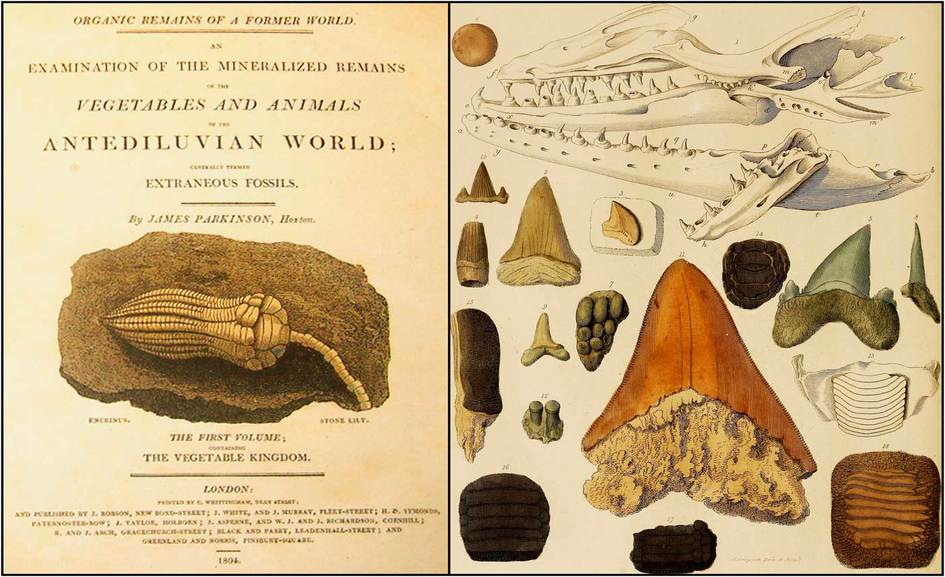
A best-selling author in Britain and the United States, Parkinson might assume that you’re referring to one of his many books – say, his popular volumes on parenting, medical advice, and other health-related topics; The Chemical Pocket-Book (a chemistry textbook); or his magnum opus, Organic Remains of a Former World – a richly illustrated, three-volume treatise on the identification and interpretation of fossils. Organic Remains drove much of early-19th-century Britain’s “fossil-mania” and inspired the poets Alfred Lord Tennyson, Percy Bysshe Shelley, and Lord Byron.**

“Organic Remains of a Former World” (1804)

Finally, he might have chosen his political activism as the thing people would still be talking about in 2023. A champion of the common man and supporter of the French Revolution, Parkinson was called to testify by British authorities in 1795 in an alleged plot to assassinate the King and was nearly charged with treason himself. Appearing before a suspicious Privy Council – a tribunal that included, among others, the prime minister and attorney general of Great Britain – Parkinson talked his way out of trouble, narrowly escaping a long sentence in one of London’s dismal prisons, deportation to Australia, or even execution.*** His skill and courage in out-debating the Council members, as recorded in the Council transcripts, is remarkable.

Imagine his surprise, then, when you tell him that no, it’s none of those things…the accomplishment for which you’ll be best remembered centuries from now is (drumroll…) Parkinson’s disease! An awkward moment passes. You’d have to excuse his look of bafflement, as he wouldn’t have any idea what you’re talking about. Because, you see, Parkinson’s wasn’t “Parkinson’s” to Parkinson; “his” disease wouldn’t be named for him until a half-century after his death.

The pamphlet he wrote about the disease, titled “An Essay on The Shaking Palsy“, was published in 1817, a few years before he died. It was based on Parkinson’s insightful observations of just six individuals, including three he only saw from time to time, walking through the market near his home. While other physicians had described individual signs and symptoms of the malady – tremors, stooped posture, slowness in moving, and such – Parkinson was the first to recognize that these were all part of a single, slowly progressive neurologic disease. After publishing “An Essay on The Shaking Palsy,” Parkinson tended to downplay his key role in its discovery – to his mind, he hadn’t discovered the cause or a cure, so what was there to crow about?****

Parkinson could be forgiven for not guessing the reason we still celebrate his birthday today. Compared to discovering traces of vanished worlds, writing best sellers, improving medical care for ordinary people, or verbally jousting with a prime minister intent on chopping him into pieces, “The Shaking Palsy” was more footnote than main event. At least that’s how Parkinson might have seen it; to me, the man and his many contributions to humanity are a source of wonder.

So, Happy World Parkinson’s Day! Please give a thought to James Parkinson and his remarkable career on April 11 – his 268th birthday. Then visit the Parkinson’s Foundation, the Michael J. Fox Foundation, the American Parkinson’s Disease Association, the Davis Phinney Foundation, the Parkinson’s Association of Northern California (PANC), or the websites of one of the many other PD advocacy groups to learn how you can help in the fight against Parkinson’s disease!

(Next up in the “History of James Parkinson” series: If we’re going to take the full measure of James Parkinson’s magnificent career, we’ll need to start from the beginning. And that beginning begins in Parkinson’s lifelong hometown of Hoxton, a small village located a mile north of Bishopsgate, one of the medieval entry-points into the city of London…)

_____

*Parkinson’s hernia truss design (1802) is the template for today’s trusses, with only a few modifications.

**Shelley collected Parkinson’s writings; Byron’s poem Don Juan makes reference to Organic Remains; and in the poem, In Memoriam, Tennyson gazes at fossils encased in the walls of a stone quarry and muses: “From scarped cliff and quarried stone/ She cries ‘A thousand types are gone:/ I care for nothing, all shall go… (Kind of bleak, that.)

***The punishment for treason was grisly: the condemned was “hanged, drawn, and quartered,” a brutal form of execution in which the victim was hanged from a gallows, then disemboweled while still alive (drawn), and finally beheaded and dismembered (quartered). (Way bleaker than Tennyson…)

****He’d also be shocked, no doubt, to learn that a cure for Parkinson’s disease still eludes modern science.

Welcome to “A Moving Disorder”!

I’m a writer and retired pediatrician, and the unlucky recipient of a 2020 diagnosis of Parkinson’s Disease. There are a lot of us PwPs (People with Parkinson’s) out there – an estimated 500,000 to 1 million Americans live with this disease. I hope to reach the PwP community, including those with the disease, their loved ones, and caregivers, and also anyone interested in science, history, oddball research, rabbit holes and, yes, even humor.

Because there’s more to life than Parkinson’s…

—–

Why “A Moving Disorder”? Isn’t Parkinson’s disease a movement disorder? 

True, Parkinson’s is classified as a “movement disorder,” defined as “a group of nervous system conditions that cause either increased movements or reduced or slow movements.” But the word “movement” strikes me as too static in this case, too stuck-in-one-place. Too much noun and not enough verb.

Take the definitions of “movement” and “moving.” Movement: “The act or process of moving.” Moving: “To be in motion.” It’s a subtle difference, but a real one, and a key to living with Parkinson’s.

Parkinson’s disease is a progressive disorder, with some good days and some bad days, its symptoms waxing and waning, always on the move. It’s the same for those of us who live with this disease—we’re moving­ to try to slow the progression, to beat back the disease, to feel more like our old selves, if only for a while. Dance, boxing, tai chi, yoga, running, strength training, etc., etc.—it’s all about keeping in motion. Moving.

And then there’s another meaning to moving: “Producing strong emotion, especially sadness or sympathy.” There’s no way around that one. People with Parkinson’s and their caregivers often encounter sadness—the emotions that come with diminished physical and mental capacities, your own or those of a loved one. But sadness doesn’t have to be the dominant emotion. There’s still joy and humor to be had.  

So…it’s A Moving Disorder. Okay?

I hope you’ll enjoy my blog. I plan to focus on Parkinson’s—the science of the disease, its history (James Parkinson was a fascinating fellow!) and my personal experiences and reflections. I’ll write about random things that interest me, too—there’s a lot more to life as a PwP than worrying about my nervous system going haywire…  

I hope to hear from you, too, whether you’re a Person with Parkinson’s, a friend or relative of a PwP, or just someone who likes to read about science, history, and personal musings. Please write!

My email address is mpjsloan@amovingdisorder.blog.

Thanks!

Mark Sloan MD

Santa Rosa, California