I’m sitting in a coffee shop on Hayes Street in San Francisco, as I am most Monday mornings. I’m waiting for my wife, Elisabeth, who is taking a ballet class at the San Francisco Ballet School, just around the corner. Elisabeth rekindled her long-dormant love of dancing ballet when she and I started taking the SF Ballet for People with Parkinson’s class a few months ago (more on that wonderful resource in a future post). She’s a pretty good ballerina, plus, she doesn’t have Parkinson’s. Me? At no point in my life, not even when I was a strapping young-man-on-the-town, would I have been mistaken for Mikhail Baryshnikov. I’m a lifelong clumsy dancer at best; Parkinson’s has just made that more painfully obvious. *
Time for a symptom inventory. Today is a good day; I got a good night’s sleep and woke up feeling as energetic as I get these days. Looking at me now—sipping my coffee, gazing out on a steady parade of young tech workers passing in the street—you wouldn’t know that I have Parkinson’s disease (PD). I look like any bespectacled, gray-headed, almost-70ish guy—like somebody’s grandfather, a throwback from the 1970s who stumbled into the 2020s. At least my laptop is new(ish)—lends me a bit of street cred with the waitress.
The thing that bothers me most, always, is my gait. As soon as I stand up I’ll feel it: that slowness and clunkiness, the sensation that my feet aren’t quite landing where my brain expects them to. I had a lot of ‘being-chased’ nightmares when I was a kid—either a tiger or a tornado was close on my heels, and my feet were stuck in mud. It’s kind of like that, minus the carnivores and funnel clouds.
What I’m experiencing is bradykinesia—the slowness of movement that’s one of the cardinal symptoms of PD. Bradykinesia shows up in different ways. There’s the general slowness and clumsiness with walking, as I’ve just described, but also a decrease in movements that should just be automatic, like blinking, or swinging your arms when you walk. Typically, since it comes on so gradually, other people notice it before the PwP does.
Elisabeth was the first to notice the changes, in 2018. I had felt them a bit before she mentioned them, but I chalked them up to the fact that I was taking care of my nearly-100-year-old father at the time. My whole world had slowed down, after all: whether it was getting Dad up in the morning, helping him shower and dress, or fixing his meals, life moved at a centenarian’s pace.
Taking him to church, for example: we’d trudge along side-by-side, him with his walker, me holding his arm, from the parking lot into the side door of St. Rose. When it was time for communion, we’d walk up the main aisle at turtle-speed, Dad doggedly refusing the wheelchair offered by the usher, me waving traffic around us. By the time I got him back to the car and belted in his seat, the parking lot was just about empty. I was slow because he was slow, I figured.
Then Dad moved to my brother’s home, and I never sped back up.
—–
*Well, that’s not entirely true. Back in college, when being a “good” dancer involved beer-fueled faux-polkas and ricocheting one’s partner around sticky, dive-bar dance floors, I did okay.
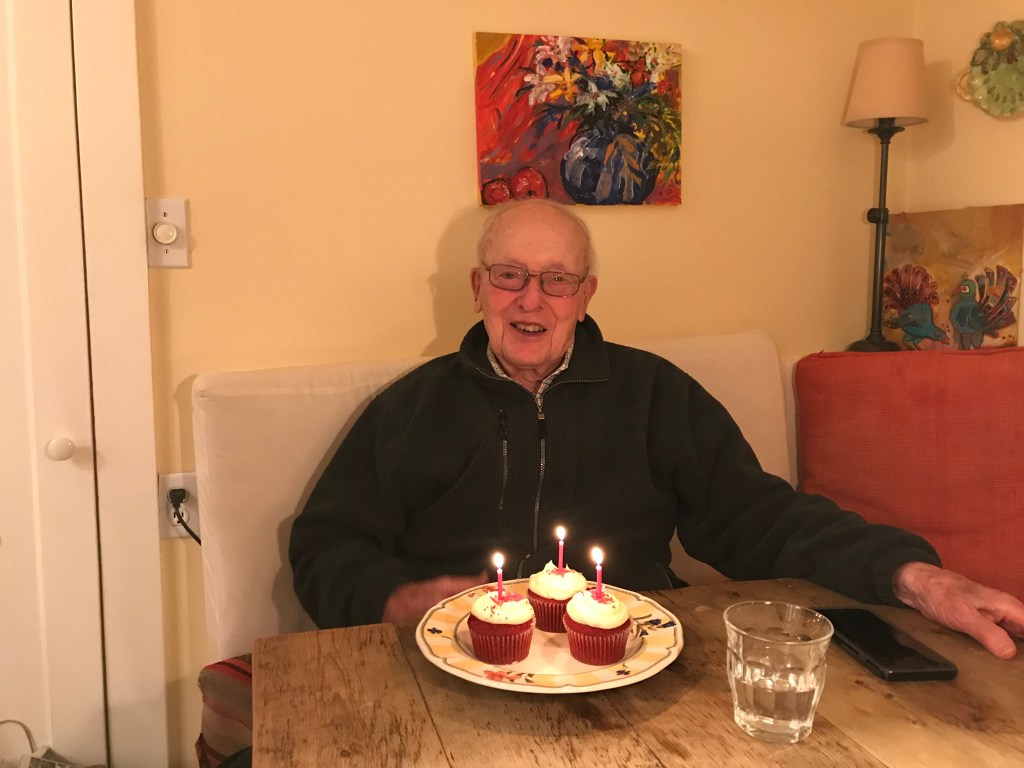
Dad on his 99th birthday, complete with cupcakes…
 A Moving Disorder