Happy ‘World Parkinson’s Day’…and the History of James Parkinson, No.2!

Dr James Parkinson (1755 – 1824)
Born 11 April 1755, James Parkinson is most famous for his essay ‘An Essay on the Shaking Palsy’ in 1817, which first recognised Parkinson’s as a medical condition.”

– James Parkinson’s biography (in its entirety) on the World Parkinson’s Day website

*****

Parkinson’s Europe established World Parkinson’s Day in 1997 to focus the world’s attention on Parkinson’s disease, the people who live with it, and current research in pursuit of better treatments and, ultimately, a cure.

World Parkinson’s Day is celebrated every year on April 11 – James Parkinson’s birthday – and honors the man who put my current diagnosis on the medical map. But to remember Parkinson solely for his eponymous disease (and with a single-sentence biography) would be to shortchange both him and us. He was an immensely talented man, one who exerted considerable influence on late-18th and early-19th century British science, politics, and society. With this post, the second of I’m-not-sure-how-many, I continue the story of James Parkinson.

*****

If, shortly before his death in 1824, you had asked James Parkinson to guess which of his life’s many accomplishments would still be celebrated nearly 200 years into the future, he likely would have chosen his research on fossils (of which he was considered a world expert) and geology. In honor of his contributions to the field, Parkinson had a number of fossilized creatures named for him, including the doubly-named ammonite, Parkinsonia parkinsoni. He is rightfully considered one of the founders of scientific paleontology.

Or, he might have picked one of his many medical successes: pioneering work on cardiac resuscitation (he was the first physician to be credited with “bringing back to life someone considered dead”), lightning-strike injuries, hernias*, appendicitis, gout, and a number of infectious diseases, including rabies and typhus.

He might also have chosen his advocacy on behalf of the mentally ill, particularly his reforms of Britain’s “mad-houses,” or his efforts to alleviate some of the era’s many other social ills: child abuse, child labor, and abysmal medical care for the poor.

A best-selling author in Britain and the United States, Parkinson might assume that you’re referring to one of his many books – say, his popular volumes on parenting, medical advice, and other health-related topics; The Chemical Pocket-Book (a chemistry textbook); or his magnum opus, Organic Remains of a Former World – a richly illustrated, three-volume treatise on the identification and interpretation of fossils. Organic Remains drove much of early-19th-century Britain’s “fossil-mania” and inspired the poets Alfred Lord Tennyson, Percy Bysshe Shelley, and Lord Byron.**
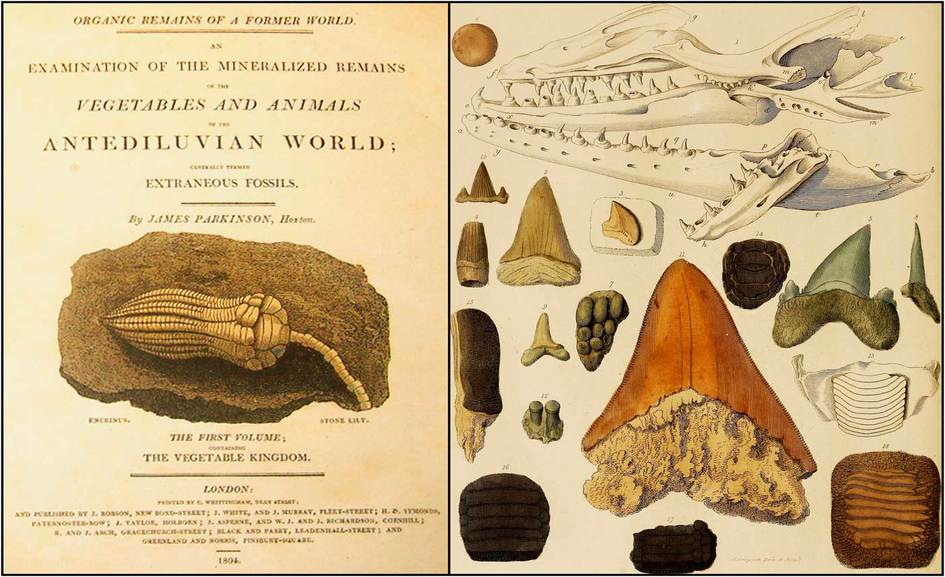
“Organic Remains of a Former World” (1804)

Finally, he might have chosen his political activism as the thing people would still be talking about in 2023. A champion of the common man and supporter of the French Revolution, Parkinson was called to testify by British authorities in 1795 in an alleged plot to assassinate the King and was nearly charged with treason himself. Appearing before a suspicious Privy Council – a tribunal that included, among others, the prime minister and attorney general of Great Britain – Parkinson talked his way out of trouble, narrowly escaping a long sentence in one of London’s dismal prisons, deportation to Australia, or even execution.*** His skill and courage in out-debating the Council members, as recorded in the Council transcripts, is remarkable.

Imagine his surprise, then, when you tell him that no, it’s none of those things…the accomplishment for which you’ll be best remembered centuries from now is (drumroll…) Parkinson’s disease! An awkward moment passes. You’d have to excuse his look of bafflement, as he wouldn’t have any idea what you’re talking about. Because, you see, Parkinson’s wasn’t “Parkinson’s” to Parkinson; “his” disease wouldn’t be named for him until a half-century after his death.

The pamphlet he wrote about the disease, titled “An Essay on The Shaking Palsy“, was published in 1817, a few years before he died. It was based on Parkinson’s insightful observations of just six individuals, including three he only saw from time to time, walking through the market near his home. While other physicians had described individual signs and symptoms of the malady – tremors, stooped posture, slowness in moving, and such – Parkinson was the first to recognize that these were all part of a single, slowly progressive neurologic disease. After publishing “An Essay on The Shaking Palsy,” Parkinson tended to downplay his key role in its discovery – to his mind, he hadn’t discovered the cause or a cure, so what was there to crow about?****

Parkinson could be forgiven for not guessing the reason we still celebrate his birthday today. Compared to discovering traces of vanished worlds, writing best sellers, improving medical care for ordinary people, or verbally jousting with a prime minister intent on chopping him into pieces, “The Shaking Palsy” was more footnote than main event. At least that’s how Parkinson might have seen it; to me, the man and his many contributions to humanity are a source of wonder.

So, Happy World Parkinson’s Day! Please give a thought to James Parkinson and his remarkable career on April 11 – his 268th birthday. Then visit the Parkinson’s Foundation, the Michael J. Fox Foundation, the American Parkinson’s Disease Association, the Davis Phinney Foundation, the Parkinson’s Association of Northern California (PANC), or the websites of one of the many other PD advocacy groups to learn how you can help in the fight against Parkinson’s disease!

(Next up in the “History of James Parkinson” series: If we’re going to take the full measure of James Parkinson’s magnificent career, we’ll need to start from the beginning. And that beginning begins in Parkinson’s lifelong hometown of Hoxton, a small village located a mile north of Bishopsgate, one of the medieval entry-points into the city of London…)

_____

*Parkinson’s hernia truss design (1802) is the template for today’s trusses, with only a few modifications.

**Shelley collected Parkinson’s writings; Byron’s poem Don Juan makes reference to Organic Remains; and in the poem, In Memoriam, Tennyson gazes at fossils encased in the walls of a stone quarry and muses: “From scarped cliff and quarried stone/ She cries ‘A thousand types are gone:/ I care for nothing, all shall go… (Kind of bleak, that.)

***The punishment for treason was grisly: the condemned was “hanged, drawn, and quartered,” a brutal form of execution in which the victim was hanged from a gallows, then disemboweled while still alive (drawn), and finally beheaded and dismembered (quartered). (Way bleaker than Tennyson…)

****He’d also be shocked, no doubt, to learn that a cure for Parkinson’s disease still eludes modern science.
At long last – Covid

Starting day 3 with Covid, and I’ve got to say…it’s not fun. I have what’s considered ‘mild to moderate’ disease at present. Mainly bad cold stuff, dominated by a world-class runny nose (more like a sprinting nose), sneezing, sore throat, a hacking cough, body aches and big-time fatigue. I’m typing this at one-third my usual hunt-and-peck pace, which means I’ve gone from slow to glacial.

Me, just now…

I’m surprised it’s taken this long for the virus to mow me down. During the early days of the pandemic I was teaching in the pediatric clinic at the Santa Rosa Family Medicine Residency*, where I was the pediatric director until my retirement last year. We’d go see kids maskless (we didn’t know any better at first), and often times the child or parent would be sick with cold symptoms, coughing all over us. In retrospect, a lot of them probably had Covid, but somehow I managed to dodge that bullet – repeatedly.

Since then I’ve learned a lot about staying Covid-free. Masks, gloves, eye shields, and Covid vaccine and boosters galore… I retired a year ago figuring I’d beaten the whole thing. Then last week my wife, Elisabeth, came down with it and three days later – despite masking and isolating from one another – it was my turn.** Not sure where we got it, but one thing’s sure: Covid is one tricky, patient virus.

Anyway, that’s enough whining from the patient for now. I’ll be back soon with another post, this one about the upcoming World Parkinson’s Day…

___

* Hey, kids! If you want to grow up to be a truly excellent family physician, the Santa Rosa Family Medicine Residency is the program for you. Great residents, great faculty!

**Please understand, I’m not blaming my beloved. Elisabeth has been way more careful with masking in public than me – kind of ironic that she caught it first…

Diagnosing Parkinson’s disease – a tricky business

Some diseases are easy to diagnose. Take chickenpox—back in the day, before chickenpox vaccine became popular and case numbers plummeted, I’d see itchy, rashy, feverish kids several times a week during the winter and early spring. The stories were consistent: fevers for a day or two, then came the rash – dozens of small vesicles (thin-walled blebs filled with a watery fluid), each one on a red base.* 

Quick, name that rash! (Hint: it’s not Parkinson’s)

I’d typically see the kids about 4 days into the rash, when the fevers and itchiness were driving everyone batty. I’d check for secondary bacterial infections and we’d discuss comfort measures that can make waiting out the illness less awful for both sick child and sleep-craving parent. Barring any unusual complications, things were better in a few days, and the scabby young victim now had lifelong immunity. Easy diagnosis, predictable stuff.

You might be tempted to think that Parkinson’s disease would be easy to diagnose too, if you never looked past the opening lines of the Movement Disorder Society’s (MDS) clinical diagnostic criteria (See Table 1):

“The first essential criterion [in diagnosing PD] is parkinsonism, which is defined as bradykinesia  and at least one of these two: a resting tremor or rigidity.” **

  • (Bradykinesia is defined as “reduction in speed and amplitude of voluntary movement.” This is much more than just slow walking. It includes such things as tiny handwriting that gets even smaller as the person writes; decreased facial expressiveness; weak voice; less frequent blinking; decreased arm swing when walking; and difficulty with dressing and with turning in bed.)

So, if you’ve got a slow-moving, retired pediatrician with either shaking limbs or unusual stiffness you’re looking at a guy with PD, right?

Not so fast… 

What you’ve got so far is parkinsonism; you haven’t diagnosed Parkinson’s disease – at least not yet. PD is the most common neurologic condition that causes parkinsonism, but it’s far from the only one. So, once you clear the parkinsonism hurdle, you’ve got the rest of the Movement Disorder Society’s diagnostic criteria to consider: Supportive Criteria, Absolute Exclusion Criteria, and Red Flags. (Again, see Table 1. I never said this would be easy…)

Supportive criteria:

These are signs and symptoms that are often found in people with Parkinson’s but are not required to make the diagnosis. They include the effects of taking a “dopaminergic” medication (levodopa, for example)– is there a “clear and dramatic response?” Does the patient experience dyskinesia as a side effect? Other supportive criteria include the loss of the sense of smell and evidence of PD-related heart disease.

Absolute exclusion criteria:

The name says it all. Absolute exclusion criteria can exclude PD from your diagnostic possibilities…absolutely. The criteria include a number of complex neurologic features that would point to other diseases; taking medications that are known to cause parkinsonism (e.g., some seizure medications); not improving despite taking high doses of dopaminergic medications; having a normal PD-related brain scan; and (the neurologist’s wild card) an expert’s opinion that something else is going on.

Red flags: 

These are signs and symptoms that may warn of something other than PD, but aren’t quite definitive in and of themselves. Among them is another batch of complex neurologic signs and symptoms that boil down to this: if your symptoms progress too quickly or too slowly (or not at all); if you fall down or faint a lot; if your symptoms are symmetrical (PD usually affects one side of the body more than the other); or if you’re not having sleep problems, constipation, psychiatric problem, and a host of other non-movement-related symptoms within 5 years of your diagnosis…maybe you don’t have PD after all.

Final score:

If your neurologist finds that you have parkinsonism, plus at least two supportive criteria, and no red flags or absolute exclusion criteria, you’ve got “clinically established PD.” If your supportive criteria exceed your red flags (of which there can be no more than two), you are considered to have “probable PD.” And if you have more than 2 red flags or any absolute exclusion criteria, you most likely have something other than PD. Back to the diagnostic drawing board with ye!

As you can see, it’s complicated. That’s why it can take weeks, months, sometimes even years for a slowly progressive disease like PD to declare itself, and why you really need a neurologist – even better, a neurologist who specializes in movement disorders like PD – to help you get an accurate diagnosis. (Retired pediatrician = not the guy you’re looking for.)

Coming up in the “Parkinson’s – the Basics” series: Now that you’ve got your diagnosis, you may ask yourself, “What is Parkinson’s disease, anyway? And why did I get it?” And the biggest question of all: “What’s next for me?” Answers (or at least some answers) to follow…

_____

* The classic description of the chickenpox lesion – “a dewdrop on a rose petal” – harkens to a more poetic medical era. A more accurate description: “An unattractive, sometimes yellowish bloblet plopped on a tiny patch of red skin. When it hasn’t been scratched beyond all recognition, that is…” (Copyright: me)

** Sometimes a picture really is worth a thousand words – click on link at bottom for a concise discussion of these three cardinal features of PD:

  • Bradykinesia (see in post above)
  • Resting tremor: “…slow, regular movements of the hands and sometimes the legs, neck, face, or jaw, when those parts are at rest; the tremor usually stops when that part is voluntarily moved.” 
  • Rigidity: “…a stiffness of the arms or legs beyond what would result from normal aging or arthritis. Some people call it ‘tightness’ in their limbs.”
    • There are two main types of rigidity: “lead pipe rigidity,” which presents as a smooth resistance to movement of the limb, and “cogwheel rigidity,” which is a ratchet-like jerkiness superimposed on lead pipe rigidity.

MEDSKL – “Parkinson’s Disease: What You Need to Know

Adventures with ChatGPT – or, how (not) to name a blog

Much has been made of late about ChatGPT, the artificial intelligence chatbot that has everyone, from writers and editors, to computer programmers and software engineers, scrambling to understand what it all means for their careers. I’m not worried about losing my job – humans will always do “retiree” better than robots – so my first encounter with the program was one of curiosity rather than fear and loathing.

In my very first post I told the story of how I came to call my blog “A Moving Disorder.” I focused on the subtle difference between “movement” and “moving” in making my final choice. When I read it now, the whole process sounds a bit tweedy and philosophical – I can practically see myself in a comfy chair by a roaring fire, pipe in one hand, brandy snifter in the other, Irish wolfhound (“Rex”) curled at my feet. It was actually a bit messier than that.

Me, thinking big thoughts…

This is where ChatGPT enters the story: Around Christmas, when my son John Patrick, a tech guy, was visiting from Montana, I got stuck on coming up with a name for my blog. I asked him to use ChatGPT to see what title it might create for me. A good son, John Patrick jumped right on it. The following is the lightly edited transcript of Man versus Chatbot:

(John Patrick to ChatGPT): Can you suggest some names for a blog about personal experiences and science behind Parkinson’s? The author’s name is Mark Sloan and it should overall be positive sounding.

(ChatGPT replies): Here are a few suggestions:

  1. “Mark’s Journey with Parkinson’s”
  2. “Parkinson’s Chronicles with Mark Sloan”
  3. “The Science of Parkinson’s with Mark Sloan”
  4. “Finding Strength with Parkinson’s”
  5. “Living Well with Parkinson’s”
  6. “Mark Sloan’s Parkinson’s Journey”
  7. “Navigating Parkinson’s with Mark Sloan”
  8. “Positively Parkinson’s with Mark Sloan”
  9. “Science and Experience with Parkinson’s”
  10. “Living with Parkinson’s, Finding Hope with Mark Sloan”

(JP): Can you suggest some shorter, catchier names?

(CGPT): Here are a few shorter, catchy names:

  1. “Parky with Marky”
  2. “Mark’s Parky Adventures”
  3. “The Funny Side of Parkinson’s”
  4. “Laughing through Parkinson’s”
  5. “Parkinson’s and Chuckles”
  6. “The Chuckle Chronicles”
  7. “Finding Humor in Parkinson’s”
  8. “Laughing at Parkinson’s”
  9. “The Parkinson’s Party”
  10. “Parkinson’s and Laughter”

(JP): “Parky with Marky” – nice one, can you give me a few more ideas similar to that?

(CGPT): Certainly! Here are a few more ideas for a blog about Parkinson’s with a humorous approach:

  1. “Mark Sloan’s Parkinson’s Palooza”
  2. “The Parkinson’s Playground”
  3. “Mark’s Parkinson’s Party”
  4. “The Parkinson’s Punchline”
  5. “Parkinson’s and Laughter with Mark Sloan”
  6. “The Parkinson’s Comedy Club”
  7. “Laughing at Life with Parkinson’s”
  8. “The Parkinson’s Giggle Fest”
  9. “Humor and Healing with Parkinson’s”
  10. “The Parkinson’s Chuckle Zone”

(JP): Ok, can you try with a bit less humor and instead focus on short concise names no longer than “Parky with Marky”?

(CGPT): Certainly! Here are a few shorter, concise names for a blog about Parkinson’s:

  1. “Mark’s Parkinson’s Journey”
  2. “Living with Parkinson’s”
  3. “Parkinson’s and Strength”
  4. “Navigating Parkinson’s”
  5. “Finding Hope with Parkinson’s”
  6. “The Parkinson’s Experience”
  7. “Parkinson’s and Perseverance”
  8. “Overcoming Parkinson’s”
  9. “The Parkinson’s Journey”
  10. “Parkinson’s and Triumph”

(JP): These names are still too long. It’s ok if you use abbreviations or other clever shortcuts

(CGPT): Here are a few shorter names using abbreviations or clever shortcuts:

  1. “Parky with Mark”
  2. “Mark’s Parky Life”
  3. “Parkinson’s Strong”
  4. “Navigating Parky”
  5. “Hope for Parky”
  6. “The Parky Experience”
  7. “Persevering with Parky”
  8. “Overcoming Parky”
  9. “The Parky Journey”
  10. “Triumphing with Parky”

(JP): Thanks!

(CGPT): You’re welcome! I’m glad I could help. Let me know if you have any other questions.

(Me): In the end (i.e., around midnight), it was a tossup between “Parky with Marky” and “Mark Sloan’s Parkinson’s Palooza.” After a good night’s sleep, I went with “A Moving Disorder” (guaranteed chatbot-free).

Family history No.1 – Grandpa Dalton

I should have seen it coming, I guess.

First it was my grandfather – my mother’s father.   James Dalton was just out of his teens when he emigrated from County Limerick to Chicago in the mid-1910s. He was a handsome, strapping, farm-grown lad – a touch over six feet tall, with a big chest, broad shoulders, and a face that moved from deadpan to delighted in an instant. He was a talented musician and dancer, and according to my grandmother, caught the eyes of most of the young ladies in Chicago’s bustling Irish community.* She told me this a half-century later, as we sat side by side in metal chairs, fishing for bluegill off a Wisconsin dock. She tilted her head toward Grandpa, dozing in the shade nearby, his hat pushed down over his eyes. “And would you believe it now?” she said with a half-smile.

In my earliest memories of him, Grandpa Dalton would have been in his late 60s, maybe early 70s: impossibly old to my kindergarten-aged self. He moved slowly, a bit bent at the hips, with a serious, even stern look much of the time. He liked to laugh, though. It’s just that sometimes his face didn’t show it.

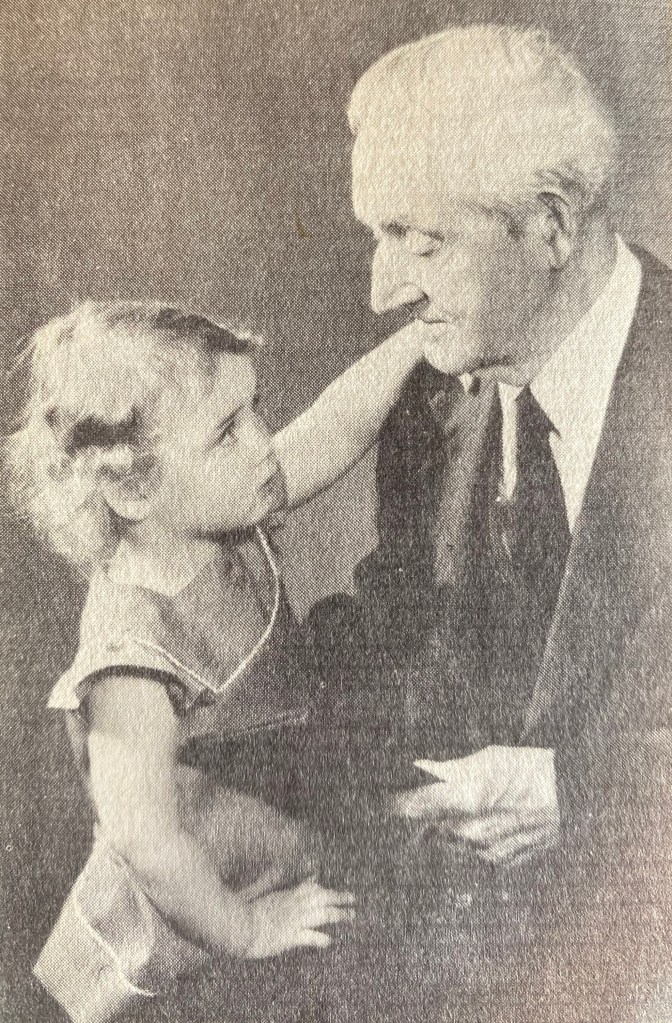
My grandfather, James Dalton, with his granddaughter (and my cousin), Mary Jo, 1974.

Mary Jo’s pose was spontaneous. My grandmother had died a few days before the photo was taken; Mary Jo noticed her Grandpa was sad and asked him why. This was taken as he explained it all to her.

We visited my grandparents in Chicago a few times a year. We lived five hours away, in southern Indiana, and the sheer amount of parental work involved in moving six kids anywhere, especially on a trip long enough to invite a dozen pee breaks and at least a couple of us throwing up in milk cartons at any one time, limited our visits mostly to holidays.

So, I saw Grandpa in vignettes—mental time-lapse snapshots taken every few months. With each visit he seemed a bit more bent over, his gait slowing, his speech quieting, his face less mobile. On one visit, when I was in mid-high school, Mom mentioned to Grandpa that I was six feet tall now. “He’s as tall as you were when I was a girl,” she said. Grandpa looked me up and down in mock seriousness, as though measuring me. Then he patted the top of his own head, a good half-foot beneath mine. “Sometimes I can’t believe myself,” he said with a resigned sigh.

Grandpa lived with us for a year after my grandmother died. He brought a bag of prescription bottles with him. When I was loading them into the medicine chest I noticed one marked “L-Dopa.” What a weird name for a medicine, I thought. I asked Mom about it and that’s when I first heard of Parkinson’s disease. I’ll admit, I wasn’t very curious about it at the time. All my older Irish relatives seemed to have wobbly gaits, tremors, hearing aids, and canes. I figured Parkinson’s was just another name for getting old.  

A heavy smoker, Grandpa was something of a medical miracle. Given his lung disease, Parkinson’s, prostate cancer, and a raft of other medical challenges, he had no business making it to 90 years of age. By the time he died – run over by a car shortly after his 90th birthday party – he was bent forward, his back curved in a near semi-circle, as though, if not for his walker, he would have collapsed forward until his head rested on his knees, giving up his long fight with gravity once and for all. 

Grandpa’s body may have failed him, but he died with his spirit intact, singing his songs and telling his stories of Ireland right up until the end.

Next up in “Family History”: Mom’s turn…

—–

*Grandpa played the concertina. His sister, Kit, played the violin, and their parents and siblings pitched in on a number of instruments. Their childhood home in County Limerick was always filled with music; when the children grew up and moved on, a neighbor lamented, “It was all so very quiet… .”

The history of James Parkinson, Part 1

Introduction: Why don’t they name diseases after people anymore?

My aunt died of Lou Gehrig’s Disease (better known today as amyotrophic lateral sclerosis—ALS) in the 1980s. A cruel disorder that progressively weakens the muscles of its victims until they can no longer move or breathe, her death was a grim, protracted, miserable ordeal, much like Gehrig’s a half century earlier. Gehrig, a New York Yankee legend and one of the greatest baseball players ever, was just 37 years old when he died in 1941. 

If you’ve never heard of Lou Gehrig, or only have a vague idea of who he was, you’ve hit on one of the reasons that diseases are rarely named for individuals anymore. People – even once-world-famous ones like Gehrig – eventually fade from public memory. Gehrig went from being the New York Yankees’ “Iron Horse” in his prime, to the face of a pitiless disease for a generation or two, to something of an afterthought today. *

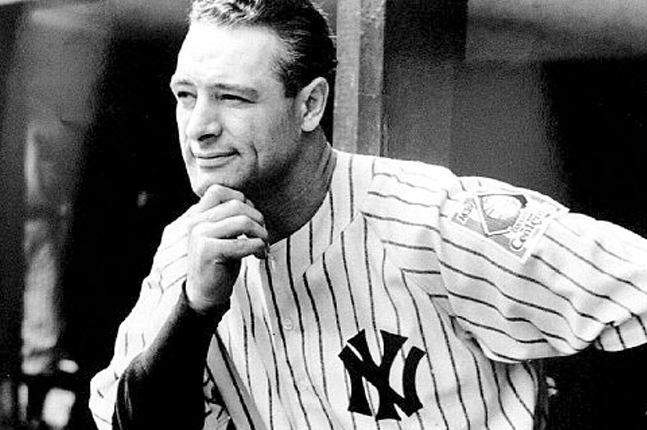
Lou Gehrig (1903-1941): An American icon

There are other reasons for shying away from naming diseases for people, including the fact that the person credited with discovering the disease often didn’t actually do so, or at least, not by themselves. Medical archives are filled with the unrecognized contributions of junior researchers—often women—and scientists of color. White male scientists, particularly those in the 18th, 19th, and early 20th centuries, had no qualms about hogging all the credit for themselves. **

Then there’s the issue of the namesake’s behavior, particularly when that behavior involves war crimes. Take the case of Hans Reiter, a German physician who first described what came to be known as Reiter’s syndrome: a triad of arthritis, urethritis (a painful inflammation of the urethra), and uveitis (a painful inflammation of the eye). Reiter’s syndrome was the term I memorized in medical school in the 1970s; I never gave a second thought to who Reiter was, or what he did with the rest of his life.

But Hans Reiter had a very dark side: a fanatical Nazi, he was the physician in charge of “quality control” at the Buchenwald concentration camp during World War II. There, he directed hideous research on prisoners, many of whom died. (His experiments with a failed typhus vaccine alone killed more than 200.) 

Hans Reiter (1881-1969) – A really bad man

As if murdering innocent people weren’t enough, it also turned out that Reiter wasn’t even the first individual to describe “Reiter’s” syndrome – he was about 200 years late on that one – and that he was way off base as to the cause (he blamed a syphilis-like bacteria). Although it took several decades, the medical community ultimately booted Reiter and renamed his syndrome reactive arthritis. ***

So, why has James Parkinson been spared the bum’s rush? Why does he still own his eponymous disease, while bad actors like Reiter (and some good ones, too) have been consigned to history’s dustbin? As we’ll see in upcoming posts in the “History” series, Parkinson’s longevity is due to a combination of modesty, timing, and a fascinating, incredibly productive life. 

_____

* In fairness, ALS was already ALS long before Lou Gehrig. (It was named in 1874 by the French physician Jean-Martin Charcot; coincidentally, Charcot also popularized the term, “Parkinson’s disease.”). The huge public outpouring of grief following Gehrig’s death led to the Lou Gehrig’s Disease/ALS connection—a link that no doubt gave a boost to ALS fundraising efforts.

** One example: Alice Ball (1892-1916), a Black researcher at the University of Hawaii, developed the first effective treatment for leprosy. When she died at age 24, possibly due to a lab accident involving chlorine gas, a white male colleague claimed the discovery for himself. It took the University of Hawaii nearly 90 years to formally recognize her work.

***Reiter spent a shockingly brief time in prison for his deeds, gaining early release possibly in exchange for helping the Allies with their biological warfare programs. (Yikes!)

Hayes Street

I’m sitting in a coffee shop on Hayes Street in San Francisco, as I am most Monday mornings. I’m waiting for my wife, Elisabeth, who is taking a ballet class at the San Francisco Ballet School, just around the corner. Elisabeth rekindled her long-dormant love of dancing ballet when she and I started taking the SF Ballet for People with Parkinson’s class a few months ago (more on that wonderful resource in a future post). She’s a pretty good ballerina, plus, she doesn’t have Parkinson’s. Me? At no point in my life, not even when I was a strapping young-man-on-the-town, would I have been mistaken for Mikhail Baryshnikov. I’m a lifelong clumsy dancer at best; Parkinson’s has just made that more painfully obvious. *

Time for a symptom inventory. Today is a good day; I got a good night’s sleep and woke up feeling as energetic as I get these days. Looking at me now—sipping my coffee, gazing out on a steady parade of young tech workers passing in the street—you wouldn’t know that I have Parkinson’s disease (PD). I look like any bespectacled, gray-headed, almost-70ish guy—like somebody’s grandfather, a throwback from the 1970s who stumbled into the 2020s. At least my laptop is new(ish)—lends me a bit of street cred with the waitress.

The thing that bothers me most, always, is my gait. As soon as I stand up I’ll feel it: that slowness and clunkiness, the sensation that my feet aren’t quite landing where my brain expects them to. I had a lot of ‘being-chased’ nightmares when I was a kid—either a tiger or a tornado was close on my heels, and my feet were stuck in mud. It’s kind of like that, minus the carnivores and funnel clouds. 

What I’m experiencing is bradykinesia—the slowness of movement that’s one of the cardinal symptoms of PD. Bradykinesia shows up in different ways. There’s the general slowness and clumsiness with walking, as I’ve just described, but also a decrease in movements that should just be automatic, like blinking, or swinging your arms when you walk. Typically, since it comes on so gradually, other people notice it before the PwP does.

Elisabeth was the first to notice the changes, in 2018. I had felt them a bit before she mentioned them, but I chalked them up to the fact that I was taking care of my nearly-100-year-old father at the time. My whole world had slowed down, after all: whether it was getting Dad up in the morning, helping him shower and dress, or fixing his meals, life moved at a centenarian’s pace. 

Taking him to church, for example: we’d trudge along side-by-side, him with his walker, me holding his arm, from the parking lot into the side door of St. Rose. When it was time for communion, we’d walk up the main aisle at turtle-speed, Dad doggedly refusing the wheelchair offered by the usher, me waving traffic around us. By the time I got him back to the car and belted in his seat, the parking lot was just about empty. I was slow because he was slow, I figured.

Then Dad moved to my brother’s home, and I never sped back up.

—–

*Well, that’s not entirely true. Back in college, when being a “good” dancer involved beer-fueled faux­-polkas and ricocheting one’s partner around sticky, dive-bar dance floors, I did okay.

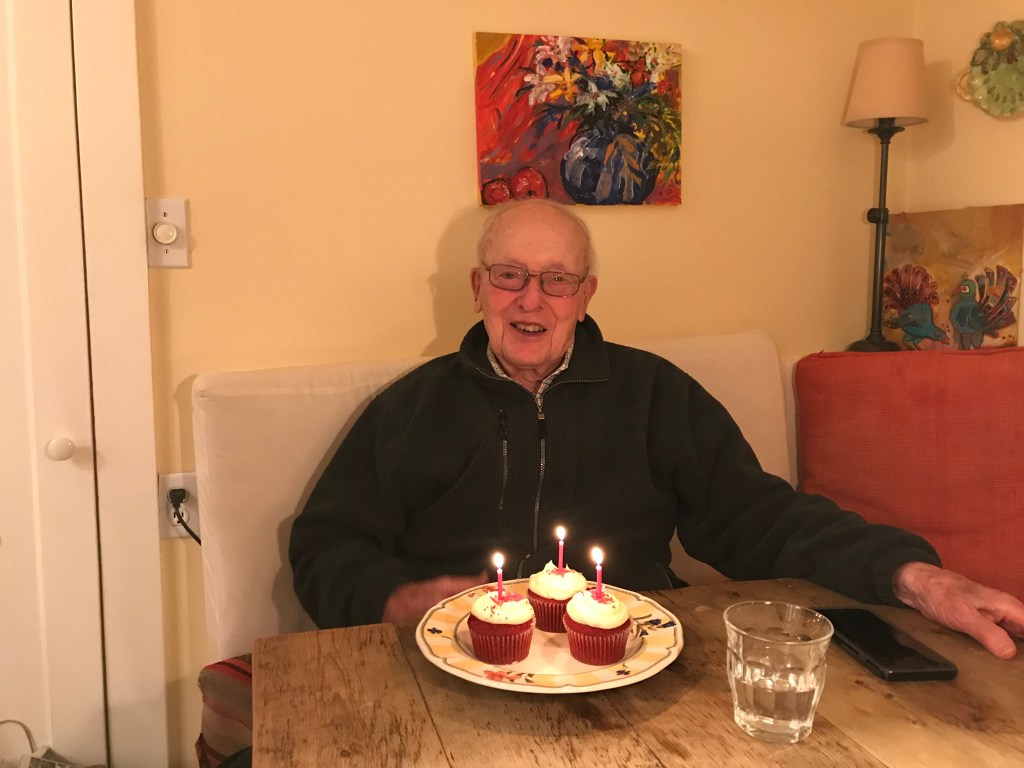
Dad on his 99th birthday, complete with cupcakes…

Parkinson’s – one tough disease to explain (No. 1)

If my blog had a title like “A Broken Leg,” explaining my medical woes would be so much easier. What’s my condition, you ask? Why, it’s right there in the title: I broke my leg. How did I get it? I slipped on a banana peel, maybe, or proved that there is such a thing as “too old to learn to rollerblade.” How do you treat it? You slap a hunk of plaster on it and then wait. What are my chances of complete recovery? Pretty good, if I stop buying Safeway bananas and sell my rollerblades on eBay pronto.

But, no…I had to go and get a disease that can take years to diagnose, is highly variable in its symptoms, and can involve pretty much any body system you’d care to name. The etiology – the medical term for the reason I got it in the first place – can be genetic, or related to toxic exposures, or recurrent head injuries, or some combination of things. Or just bad luck. The treatment is complex, involving an often mystifying array of medications, brain implants, therapies (physical, occupational, speech, psycho), and exercise – everything from ballet, to tai chi, to boxing. The chances of complete recovery? Slim to none. Frankly, I’d rather have a broken leg. Maybe six.

But, hey, this is a Parkinson’s journal, so in upcoming posts in this series I’ll try to explain the medical intricacies…

Not my first rodeo…

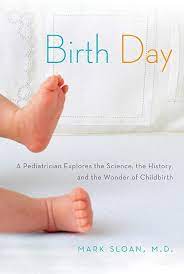
This is my second go-round with blogging. My first blog (boldly, if not very creatively, titled “Mark Sloan M.D.“) ran from 2011 to 2015. I started writing it following the publication of my book, Birth Day: A Pediatrician Explores the Science, the History, and the Wonder of Childbirth, intending it to be an ongoing discussion of childbirth-related issues and child health in general.

Shameless self-promotion…

Alas, the childbirth world is as polarized as anything else these days. On one end of the spectrum are the natural birth advocates, who see birth as a natural event that should be allowed to progress as nature intended; on the other end are the hospital-based birth practitioners, who see birth as potentially dangerous, prone to often unpredictable complications, and the hospital as the safest place to have a baby. The natural birth side views hospital birth as a ticket to interventions (epidurals, c-sections, etc.); the hospital birthers see home birth as unnecessarily risky, and its practitioners as willfully oblivious to the dangers.

Yes, I realize that’s a simplistic view of the state of American birth. The reality is that it’s more of a continuum; I encountered many doctors, midwives and nurses who worked to bridge the gap between sides. In my blog (and in Birth Day) I strove for a reasonable middle ground, sticking to the facts and encouraging women to make educated choices that aligned with their personal beliefs and preferences. From reader feedback I’ve received over time, I’m proud that my blog helped individual women achieve a meaningful birth experience, and that it helped to move some of the discussions along to resolution.

So far, in my limited exposure to PwP World, I don’t see such polarization. Could be that’s the case, or maybe since I’m still a fairly new member, I’m naive to the controversies. I look forward to finding out.

About me

I’m a writer, a retired pediatrician, a husband of nearly 40 years, a father of two grown children, and, since 2020, a person with Parkinson’s (PwP). My symptoms started well before I was diagnosed, though, meaning that for years and perhaps decades I was a Person Who Didn’t Know He Had Parkinson’s (PwdkhhP)… like most of us later-onset PwPs, I imagine.

I wanted to be a teacher before I became a pediatrician. Looking back, I see that that’s what I became after all—pediatrics is all about teaching. It’s about breaking down sometimes complex medical and scientific concepts into simple, comprehensible explanations…and then pitching those explanations to everyone from inquisitive kindergartners to frightened parents of tiny premature infants.

I got pretty good at it, and it’s in that spirit of demystifying often-complex Parkinson’s concepts—everything from the basic science of the disease, to epidemiology, genetics, treatment, and more—that I’ll approach this blog.

And I’ll warn potential readers–I’m prone to going down rabbit holes I find interesting. That’s how I learned, while writing my book Birth Day, that the first successful cesarean section was performed by a 19th-century woman masquerading as a male British Army surgeon, and that not all of Henry VIII’s wives got their heads chopped off. (Two of them died of childbirth complications.) Hopefully, you’ll enjoy my sometimes random digressions.

Personal Fun Fact:

I’m not McSteamy. I’m not Dick Van Dyke, either.

Biggest writing accomplishment:

My book, Birth Day: A Pediatrician Explores the Science, the History, and the Wonder of Childbirth, was published in early 2009 by Ballantine Books. It’s partly a memoir (I dragged many a family member into my story), partly an exploration of how humans came to give birth in the strange way that we do, and partly about the historical events that have shaped, and been shaped by, the birth of a child. There’s a lot of humor mixed in, too. Birth Day got great reviews—from the Washington PostThe Journal of Midwifery and Women’s Health, the New England Journal of Medicine, the San Francisco Chronicle, and many other publications. Birth Day was a Northern California Book Awards finalist, and was named a “Top 10 Science Book of 2010” by the Japan Financial Times. (Yes, there’s a Japanese edition. And no, I can’t read it.)

Biggest sports accomplishment:

I was once ranked in the top 50 in the world in that most glamorous of sporting events, the shot put. Granted, this was an age-group thing (I was 60, a relative youngster among my fellow 60-64-year-old competitors), I finished exactly 50th (right between beefy, middle-aged guys from Ireland and Latvia),and there were only about 150 men my age in the world that year still tossing around cannonballs for fun. Which, if you were grading my performance, means I’d get a B-minus or so. Still, I can truthfully say that I once ranked in the top 50 worldwide in something. I’ll probably have that carved on my tombstone.

More about the arcane world of senior shot-putting later…

Biggest pediatric accomplishment:

I loved the continuity that came with practicing pediatrics in one place for a long time. By the time I retired I was taking care of my “grandpatients”—the children of my grown-up patients, some of whom I’d known since they themselves were in the womb. It was a privilege to be a part of so many lives over so many years, both in sickness and in health.

Oh, and I never dropped any kids on their heads. (I’ll probably have that carved on my tombstone, too.)