Another episode of “Living with Parkinson’s”: In which I visit the neurologist

Every six months, come rain, shine, earthquake, or wildfire, I go to see Dr. S, my neurologist.(1) This is ostensibly a follow-up visit, or so the honey-voiced appointment clerk tells me, to check on my Parkinson’s “progress.” She says this like I’m recovering from a broken leg, a bad case of hives, or maybe pneumonia—a self-limited medical calamity that’s expected to resolve in time. But Parkinson’s isn’t like that. It’s going to get worse, the only question is how fast. So, twice a year I check in with Dr. S to see whether my Parkinson’s is sticking to the speed limit or engaging in a bit of reckless driving.

Dr. S’s office is a 30-mile freeway trip from our house – down in Marin County, that legendary land of hot tubs, up-upscale shopping malls, and over-the-top estates tucked back in the redwoods. We will see none of that on our visit today, though; Dr. S’s office is a literal stone’s throw from the freeway.

After a half-hour of medium-bad traffic, Elisabeth noses the Kia into the neurology parking lot. For some reason Dr. S’s office shares a building with the county coroner’s office, a rather unsettling relationship I haven’t yet had the courage to explore. We enter the non-coroner side of the building, take our seats in the waiting room, and wait to be called. My health plan offers online check-in these days; this is my first attempt to use the service. As I understand it, having checked in by phone yesterday, all I have to do is sit and wait until, magically, a staff member will appear to take me to my doctor.

The lady at the registration desk notices me, eyeing me a bit suspiciously at first as I skip the line and plop into a chair. Patients come, patients go, while Elisabeth and I catch up on old People magazines. During a registration lull she waves, catches my attention, motions me to her window. “Sir,” she says. “Can I help you?” In my Parkinsonian head the words of explanation are all there, sorting themselves for an orderly exit, but my mouth can’t quite usher them out. I wave my phone in the air and point. “Already done,” I rumble-mumble. “Online.” The lady seems like she’s seen this before. “Let’s make sure about that.” She takes my card, types in my number. “There,” she says with a smile, returning my card. “Now you’re checked in.” I thank her and return to my seat, where Elisabeth waits, eager to update me on Prince Harry’s new life in California.

The door to the patient care area whooshes open. A young medical assistant calls my name. We follow her down the hallway and through the usual rooming-in procedures: weight, blood pressure, an oxygen saturation reading from the little E.T. thingie she clips to my index finger. Then come the questions: Any new allergies? (No.) Do I smoke? (No, for the thousandth time.) How many hours do I exercise a week? (Oodles, I want to say, but instead I throw out an estimate that seems to satisfy her.) Do I feel safe at home? (I shoot Elisabeth a sidelong glance, think for a moment about passing the medical assistant a “Help me!!” note, then think twice and say, “Safe? Sure.”) Her work completed, the assistant smiles sweetly and tells us Dr. S will be right in. And, a few minutes later, there she is.

Dr. S knocks at the door and enters, her hands glistening with freshly applied sanitizer. She is a slender woman with dark, kind eyes, and a warm smile that I only see from time to time – it all depends on the clinic’s Covid masking requirements du jour. Her presence is reassuring; there’s a comforting routine to these appointments. 

We start with a bit of chit-chat, announcing the next-springtime arrival of our first grandchild. Dr. S seems genuinely happy for us. She asks about my recent ear surgery ( a minor, and unsuccessful, attempt to fix a eustachian tube problem). I tell her that the ear problem is making it difficult for me to carry on a simple conversation – my voice was soft to begin with, then made softer by Parkinson’s, and now, thanks to the loud vibration of my eardrum when I speak above a certain volume, it’s even worse. “Wow, that sounds like it’s really impacting you,” she says, and I nod. She makes a note to herself. “I’ll get in touch with your surgeon, so he knows how much this is bothering you.” And I know she will. Dr. S is one of the most empathic doctors I know.

She moves on to my Parkinson’s symptoms. Have I fallen since our last visit? Any new tremors? Am I depressed? Sleeping well? How about heartburn? Nausea? Constipation? She doesn’t ask me about seeing or hearing things that aren’t there this time – hallucinations are not uncommon as Parkinson’s advances. Either she assumes I’d tell her, or maybe (probably?) she got sick of my bantering: “But if I can see them, how would I know that they’re not real?” Such a funny guy.

Now comes the neurologic examination, a series of hoops and hurdles designed to see how well my sometimes meandering description of how I’m doing correlates with objective reality.

Dr. S starts with my hands. She tells me to make a modified “okay” sign: thumb and index finger making a flattened “o,” with the other three fingers extended above them. (If you have a flashlight and a wall handy, you’ll see that this makes a passable shadow-animal profile of Wile E. Coyote’s head.)

Sorta-kinda like this guy…

“Okay now, do this,” Dr. S says as she opens and closes her “o” (i.e., Wile E.’s mouth), rapidly tapping her index finger on her thumb. I do that; my Wile E. looks like he’s babbling now. I think I’m doing pretty well, speed-wise, until I look at Dr. S’s shadow animal – the graceful fox from the old Disney movie, The Fox and the Hound, I think – babbling about twice as fast as mine. (Bibibibi versus bah-bah-bah, if you’re taking notes.) She calls a halt to this cartoon standoff a few moments later.

Next, we move on to what I call the “dying-fish-flop” test. (I know it has another, more clinical sounding name, but hey, I’m retired: I’ve already forgotten more medicine than I ever knew.) Dr. S puts her hand on her thigh and flip-flops it back and forth, palm-up/palm-down, and invites me to follow suit. I do, and once again I’m struck by the difference in speed between us. Her fish looks like it has a decent chance of flopping off her lap, out the door, across the hall and back into the river from whence it came. Mine gives a resigned gasp, gazes heavenward, and prepares itself for the grill.

Dr. S runs me through a number of other tests. I touch the tip of her index finger, then my own chest, then back and forth like this until she’s satisfied that my finger won’t wander off willy-nilly and poke me in the eye; I tap my toes on the floor; I cross my arms, Aladdin-like, and stand up from my chair as quickly as possible. There are other parts to the exam – she smacks me a lot with a rubber-tipped hammer, for one thing – but I get exhausted just trying to describe them. Through it all – the Wile E. Coyote, the dying fish, the genie-levitating thing, the hammering and the rest, Dr. S concentrates, her face – or at least her eyes, since she’s still wearing a mask – inscrutable.

“Okay,” she says, when she finally runs out of hoops for my hands and feet to jump through. “Let’s go out in the hallway.” Ha! I know what comes next. She may not seem like the violent type, but I don’t let that placid exterior fool me. As soon as we get out of the exam room, Dr. S is going to try like heck to knock me over. I pull on my shoes (a glacially slow process these days) and follow Dr. S into the hallway. Elisabeth smiles and flashes me a quiet thumbs up.

“Turn and face the wall,” Dr. S says, like a kindly-voiced cop about to cuff a robbery suspect. “I’m going to pull you backwards, hard.” She shows me her outstretched left arm, the one that, she assures me, will catch me if I fall. (A bit of perspective here: I’m tall, with a fair amount of leftover muscle from my athletic youth. Dr. S is eight or ten inches shorter than me and slightly built; I doubt she played football. I’ll know I’m in trouble the day she manages to floor me.) She tugs on my shoulder a few times, but comes up short in our quasi-sumo match. I’m still standing.

We re-enter the exam room; Dr. S returns to her stool while I settle into my chair. She smiles and tells me she’s pleased – I’ve had little disease progression since our last visit. We do a quick review of my plan, make a couple of minor adjustments, and then we say our goodbyes. “See you in six months,” Dr S says. “Bring pictures of that grandbaby!” “Thanks,” I reply with a smile. “I’ll definitely do that.” Someday Dr. S will have to give me bad news; for now, though, I’ll take her “(almost) no news is (pretty much) good news” summary to heart.

Neurology is a much more physical specialty than I realized, what with all the pushing, pulling, and hammer swinging. If, God forbid, Dr. S ever keels over from exertion in the middle of examining me and passes on to that big neurology waiting room in the sky – the one where online check-in actually works – I’ll know just what to tell the inquiring TV reporters as they gather around me for comment.

“At least she was doing what she loved,” I’ll say. (“Which was trying her best to knock me over,” I’ll keep to myself.)


  1. “Dr S” isn’t my neurologist’s real name. Heck, it’s not even her real initial…

Parkinson’s treatments: Movement and music

It’s a mantra familiar to anyone with Parkinson’s, drilled into your head from the day you’re diagnosed: “Movement is medicine.” Neurologists, physical therapists, other people with Parkinson’s and their family members, even random strangers watching you struggle to climb out of a car – they all sing the praises of movement (and exercise in general) as one of the best ways to reduce PD symptoms.

This is the first in a series of posts about movement and exercise and their benefits for people with Parkinson’s. I’m going to start with a personal plug for a specific type of movement, one that I only semi-willingly took up and that I now can’t really imagine doing without: ballet. Specifically, San Francisco Ballet’s Dance Class for People with Parkinson’s.

In the spirit of “show, don’t tell,” here’s a brief video starring Keith and Dan, two veteran members of the class. (P.S.: My star turn, a total of 8 seconds or so, shows up around the 2:10 mark – I’m the tall galoot in the back row, slowly disappearing stage left.)

So, what is it about dance? Why did ballet leap from a “no-go” in my mind to an every Saturday “must-do”? I found a good explanation in a 2008 Scientific American article: “[S]ynchronizing music and movement—dance, essentially— constitutes a ‘pleasure double play.’ Music stimulates the brain’s reward centers, while dance activates its sensory and motor circuits.” As we’ll see in my next post, dopamine – the neurotransmitter that plays a central role in PD – is a major player in why we dance.

But my now one-year-old love of ballet class is more than just circuits, reward centers, and neurotransmitters. It’s also about people, starting with our warm, funny, dedicated teacher, Cecelia Beam. From early-bird warmups to post-session cookie feasts (she hates to admit it, but she’s partial to Oreos), Cecelia, an accomplished ballerina in her own right, is chatting, joking, cajoling, encouraging everyone – a combination of gentle drill-sergeant and therapist.

Then there’s the camaraderie: the companionship of people – like Keith and Dan – who are dealing with the ups and downs of a shared disease. No one knows better what you’re going through than someone who’s battling the same thing. Surprisingly, very few of our conversations center on illness. It’s typical middle-aged-and-elderly-folk talk: kids, grandkids, retirement, travel, hobbies…regular stuff. No one has to explain why they’re moving so slowly, or why their hands shake. That’s all background noise.

Finally, there are the very things described in the Scientific American article: the joy I feel when the live pianist begins to play, the focus on technique that takes me away from my everyday, PD-afflicted world, and the physical relaxation that follows exertion. I feel spry-er, or at least less clunky, when I leave class than I did going in.

So, next up: Exercise and Parkinson’s. Why does exercise help? Is there something different about the effects of exercise on people with PD than those without? How much exercise is enough? And which types of exercise are best? Much to talk about…

_____

PS: I want to encourage anyone with PD who lives in the Bay Area (or who is just visiting) to stop by and check out a Saturday class. It’s free, and friends and family are welcome. The only catch, if you can call it that, is that if you show up, you’ve got to join in. There are no “looky-loos,” to borrow a Cecelia-ism; everybody dances. But hey, if I can come around to loving it, so can you!

Here’s more information about the class (from an email Cecelia sends out each week):

San Francisco Ballet School’s Dance Class for People with Parkinson’s

Movement is the Medicine” for People with Parkinson’s

Classes are free of charge!

Saturdays, 1:30 – 2:45pm Studio Class

Stay after class to have a cookie, check in and chat!

New students and accompanying care partners/friends/family – must register here (once):   https://payit.nelnet.net/form/II96jTdm

New Dancers: remember don’t worry about doing everything perfectlyWhat’s important is that you enjoy yourself (because that’s how you will keep dancing/moving), listen to the music and move BIG. Over time you will become more familiar with the ballet vocabulary and dances.

Invite friends and family to join you – it may give you more of an incentive to regularly take class.

Directions to the studio: 455 Franklin Street, Civic Center, San Francisco

GETTING HERE – San Francisco Ballet (sfballet.org)

SF Ballet’s Dance Class for People with Parkinson’s is supported by a community grant from the Parkinson’s Foundation

Living with Parkinson’s: “Martin” and the Masked Barista. And owls.

I’m at a coffee shop in Missoula, Montana, with Elisabeth. (Yes, I live in coffee shops.) We’re waiting to have lunch with our son, John, who is dutifully working the morning away at his tech job down the street. Elisabeth is reading about owls, or serial killers, or something about politics. (She’s bit of the omnivore, reading-wise.) Eventually she’ll start talking to me about what she’s learned, and pretty soon I will have acquired a new factoid that I will store away for possible later use. Like, did you know that some people think owls aren’t really that smart? Seems to be a brewing controversy. Well, there you go.

“Martin,” hard at work in Missoula…

I am enduring, yet again, the small, daily insults that the combination of Parkinson’s Disease and poor hearing can inflict on a person. A sparkly-eyed, curly-haired, Covid-mask-wearing barista named Sandra takes my order from behind the coffee shop counter. She leans steadily forward, politely trying to hear what it is that I’m mumbling. (It doesn’t help that the coffee shop is filled with atomic-bombishly loud music that reduces human-to-human communication to a series of more-thunderous-than-the-music roaring and awkward pantomime.) I lean forward too, trying to catch the gist of Sandra’s replies, because her mask eliminates the possibility of lip-reading, a skill I’ve acquired by necessity in recent years.

After a couple-three tries, featuring a goodly amount of gesticulation to go along with my PD-ravaged vocal entreaties, Sandra catches on that I am asking her to make a cafe latte for me and a chai latte for Elisabeth, and to fork over one of the cinnamon-cardamom morning buns in the glass case to her right. She nods, smiles – at least I think she’s smiling – and asks what name she should call out when my order is ready. “Mark,” I bellow, drawing out my name as “Mmmmmark-kuh” to ensure accuracy. Sandra smiles again. “Okay,” she shouts, “Thank you, Martin!”

I don’t catch this until the name “Martin” flashes on the order screen, freezing me for a moment – am I paying for some other guy’s coffee? Elisabeth, patient as always, explains the Mark/Martin thing to me, and I see that I am left with two options: a) I can repeat my name, louder this time, at the risk of sounding like an old crank yelling at the neighborhood kids to turn that damned music down!; or b) I can, just this once, shut up and be Martin. I choose the latter course of action.

“Come along, Martin,” Elisabeth says, giggling, as she leads me to a table. She finds it all quite funny, says she’s always wanted to date a guy named Martin, and now, hey! Opportunity knocks. We pick a table in a far corner in vain hope of a less-jarring musical experience and wait to be called to the pickup counter. “Stay focused,” she says. At least that’s what I think she says.

A few minutes later Elisabeth elbows me and points toward the counter where our drinks sit, cooling. “Your order’s up, Marty,” she shouts in my better ear. I rise and go fetch to the sound of more giggling. She’s enjoying this way too much.

What did James Parkinson look like?

In an earlier post I wrote about James Parkinson, the British physician who, in 1817, described what would later be called Parkinson’s disease. He had a multi-faceted, truly remarkable life – sort of a British Benjamin Franklin. Parkinson was, in addition to being a renowned physician, a political radical, a best-selling author, an inventor, a crusader for the mentally ill and against child labor, and one of the world’s foremost experts on geology, paleontology, cardiac resuscitation, rabies, and lightning strike injuries.

Given all that, you’d figure it would be easy to discover what the man looked like. After all, museums, palaces, and private mansions throughout Great Britain are festooned with 18th and 19th century oil portraits of virtually every British man (and some women) of means. Yet, inexplicably, no portrait of Parkinson survives.

Fame certainly wasn’t a prerequisite for portrait-sitting in those days. This fact is brought home poignantly by the abundance of paintings of now-unknown subjects – people who, during their lives somehow merited a grand portrait but then were forgotten, quickly or otherwise. Take the case of “An Unknown Man” by the obscure British portraitist Tilly Kittle (1735-1786).1

“An Unknown Man.” (Artist: Tilly Kittle. Date: unknown.)

In Kittle’s rendering, Unknown Man is a plump, baby-faced, apparently wealthy young fellow, surrounded by props – the books, the Roman column, the quill poised in the the inkwell – that would imply a man of some learning and power.  His delicate hands, though, hint at a life of epicurean leisure, likely lived at the expense of servants and peasants. His prominently (proudly?) displayed belly, which threatens to overpower the buttons of his waistcoat, suggests nothing so much as a man about to give birth to twins. Taking a wild stab, I would guess that the young Mr. Man inherited his riches.2

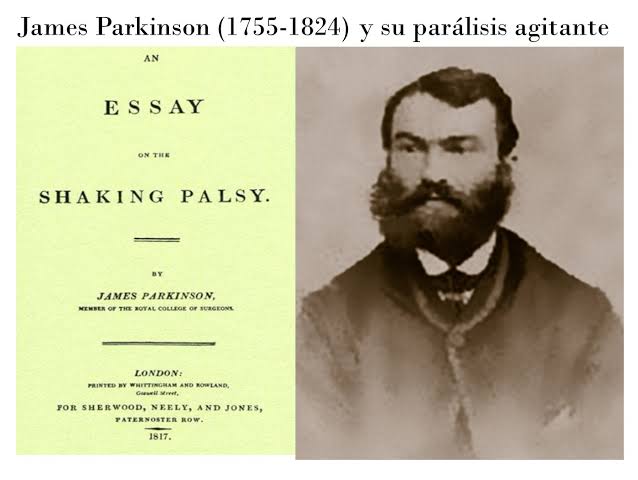
For decades everyone “knew” what James Parkinson looked like – or at least they thought they did. They assumed he was the square-headed, bushy-faced man in the accompanying photograph:

Dr. Parkinson, I presume…

In truth, while he was a James Parkinson, he was not the James Parkinson. The James Parkinson in the photo was, in fact, an Irishman who sailed to Australia during the 1850s gold rush and wound up a Tasmanian lighthouse keeper. He was born eight years after “our” James Parkinson’s death. The tipoff? The first photograph of a human face was taken in 1839, more than a decade after Dr. Parkinson’s death.

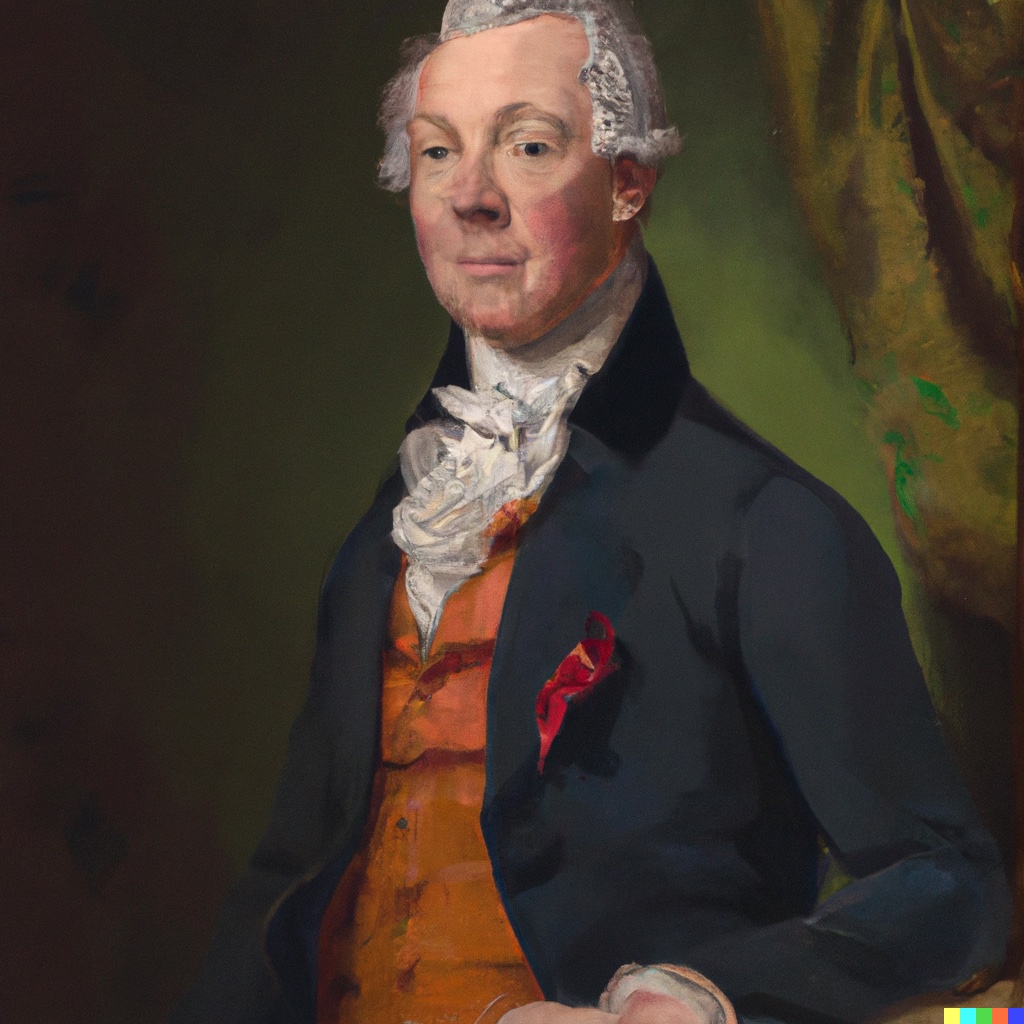
This lack of a portrait seemed unjust to me, given the greatness of the man. So, this being the 21st century and all, I decided to put technology on the case – specifically the much loved and loathed new versions of artificial intelligence. I gave DALL-E, the artsy part of openAI’s suite of A.I. programs, its marching orders: “Paint an oil portrait of Dr. James Parkinson, British, in the 18th century style of Tilly Kittle.”

And here’s what I got…

James Parkinson. (“Artist”: A.I. DALL-E, 2023)

Hmm. Looks suspiciously like a slimmed down, age-progressed version of “An Unknown Man,” right down to the left-eyed, thousand-yard stare3 and the proto-1960s flip hairstyle. I thought A.I. would be a bit subtler in its plagiarizing.

I’m not sure if Tilly Kittle would feel flattered or litigious. No doubt some future A.I. iteration will answer that question for him…

_____

Tilly Kittle was a British portrait painter who, after middling success in his early career in England, struck out for India, where he grew rich painting “nabobs and princes,” according to his bio in The Oxford Dictionary of Art and Artists. He returned to London after a decade, where he soon acquired a wife, a mountain of debt, and few clients. After fleeing to Ireland to escape his creditors, he decided to try his luck in India again, but this time died en route, somewhere in present-day Iraq. According to the Oxford Dictionary entry, Kittle is best remembered for ranking “fairly high among the lesser portraitists of his time.” Ouch!

2 Kittle may have been a more perceptive capturer of his subjects’ inner selves than he’s been given credit for. Try this experiment: click on the larger copy of “An Unknown Man” here, cover one side of his face and then the other. You’ll see the right side shows an affable-if-entitled trust fund baby; the left side, meanwhile, reveals the thousand-yard stare of a fellow who just learned, say, that he’s about to give birth to twins.

Try the left-right face experiment described in footnote #2 on the A.I. portrait – same result!

Is it Parkinson’s, or just “Old Man Breaking Down” syndrome?

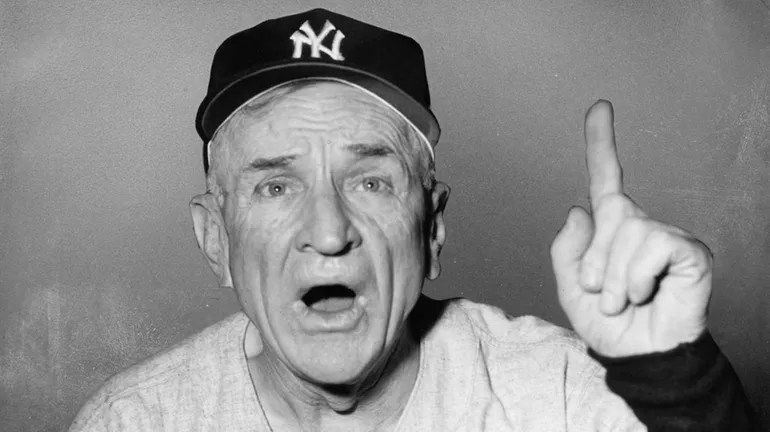
“I’ll never make the mistake of turning seventy again.”

Casey Stengel (1890-1975), blaming his 1960 firing as New York Yankees manager on a “youth movement.”

It’s Monday. I’m back at my favorite coffee spot on Hayes Street, a couple of blocks down from the San Francisco Opera House and the SF Ballet School, waiting for Elisabeth to finish her afternoon dance class. As usual, I’m surrounded by young people – I’m easily the oldest customer here by 20 years or so. Today I’m in observation mode, watching how techie-youth move, taking inventory of any apparent aches and pains they may exhibit. After an hour, a conclusion: they don’t seem to have any, as far as my trained-but-retired doctor’s eye can tell. 

Oh, to be young again! I watch them jump up from their chairs to order food, or grab drinks, or to greet one another at the door with hugs and air smooches. They seem improbably flexible, impossibly fluid in movement – the exact opposite of a “movement disorder.” This is especially remarkable, since they likely spend the bulk of their days slumped in front of one screen or another. But they’re still a good decade or so from that catching up to them. For now, life is all loose and boing-y and physically fabulous.

Now, imagine for a moment that the coffee shop demographic suddenly flips, and the tables are filled with people my age—boomers all, in their mid-60s to mid-70s. There’s a different vibe. The noise level has dropped considerably. People don’t jump up for their food; they call for waiters. And one topic of conversation is heard at every table: health, or the lack of it. From the life-threatening (cancer, heart disease, hypertension), to the life-altering (diabetes, cataracts, bad knees and hips), to the nuisance level (aches and pains, “senior moments,” flatulence), who’s-got-what and how-do-you-treat-that discussions dominate. 

Me, I’ve got all the basic aches and pains that come with having arrived on the planet at the dawn of the (first) Eisenhower Administration. My neck twangs as I type this, my knees are a bit sore from my Ballet for People with Parkinson’s class, and my shoulder aches for reasons I can’t recall. (Old football injury, ca. 1970?) My balance is a bit dicey, too. I tend to blame a lot of my physical woes on Parkinson’s, but I wonder: how much of this do I owe simply to being seventy years old? In other words, if I could subtract Parkinson’s from my personal health equation, how much different would I feel today?

Here’s the problem: a lot of otherwise neurologically normal-for-age older adults show mild Parkinsonian signs and symptoms. Many elders are stiff of trunk or limb, move at a turtle-like pace, or have problems with gait and balance. But by definition, the sum total of their signs and symptoms falls short of the accepted criteria for making the diagnosis of PD. 

I recently started having episodes of vertigo—abrupt, severe (and mercifully brief) bouts of the “whirlies,” in which the room spins and I have to grab hold of whatever is nearby to keep from falling. These bouts are more or less predictable. When my whirlies hit, it’s always positional: I’m either leaning down to pick something up from the floor or rolling over onto my side in bed. I’ve found that I can get it to stop quickly by changing position.

My first instinct was to blame the vertigo on PD, since the two often come together. But then, in reading and discussing my symptoms with my neurologist and physical therapist, it became clear that I was suffering from Benign Paroxysmal Positional Vertigo, an age-related condition that involves the balance centers in the inner ear. It’s a pain, but it’s not related to PD. 

But it really doesn’t matter what’s causing my vertigo. A hard floor is a hard floor, no matter what got you there. That’s why the advice you’ll get from movement disorder professionals about preventing falls at home is pretty much the same as you’d get from anyone who works with the elderly. The same goes for any number of symptoms – constipation, to name a common one – that overlap both PD and just getting older. The treatments are very similar, PD or no.

The good news? My vertigo didn’t signal a new milestone in my PD progression. The bad news? I’ve got BPPV. The sorta-good news? At least BPPV is something new to wow my boomer coffee shop friends with… if I can get a word in edgewise while they’re busy bemoaning their prostates, that is.

The science of Parkinson’s: A “Clue”

Since launching A Moving Disorder back in late February, I’ve been meaning to write a series of posts about the science of Parkinson’s disease. But I’ve found that it’s much harder to write about what makes Parkinson’s tick than it is to write about myself, or my family, or even shot-putting (a.k.a., the Sport of Kings). That’s because, even after two centuries of observations, experience, and research, much of the who-what-where of Parkinson’s remains a mystery. A casual researcher can quickly end up in the tall weeds, out where words and phrases like apoptosis, autophagy, synucleinopathy, and programmed cell death compete for space with qualifiers like poorly understood…unclear…elusive…not fully elucidated in dozens and dozens of academic papers.

I pride myself on being able to translate fairly complex medical and scientific topics into more easily digestible nuggets for the non-science reader. It’s a skill that has done me well in both my writing and my pediatric career. I tend to use a lot of analogies. (One example: a go-to way to explain an ear infection to weary parents was to compare it to faulty plumbing.1

But, I have to say, Parkinson’s is straining my explainer-brain. I’ve started, stopped, and scrapped more drafts than I can count. For weeks, analogies came and went. For a while, PD was a war going on in my brain, or maybe an alien invasion; then it was, among other things, a sniper, a spy, an expert poisoner, and a hit man. Finally, it occurred to me: the best analogy to help explain the science of PD isn’t warfare, or contract killing, or even bad plumbing. It’s the old board game, “Clue.”

Could’ve been worse. I could’ve picked ‘Candyland.’

For the Clue-less, the game centers on a dastardly murder committed at the fictional Tudor Mansion in Hampshire, England. The object of the game is to identify: a) the murderer, b) the weapon used, and c) the room in the mansion where it all went down. Players assume the identities of the suspects (Reverend Green, Colonel Mustard, Miss Scarlett, Mrs. Peacock, Professor Plum, and Dr. Orchid*), then ponder the available weapons (revolver, dagger, lead pipe, candlestick, rope, and wrench) and location of the grisly deed (nine possibilities, anywhere from the Kitchen to the Conservatory. It’s a big mansion.) The first player with the correct who-what-where trifecta wins.

So, let’s apply a Clue-filter to Parkinson’s disease. What do we already know for certain?

Well, we know for sure there’s been a murder – more correctly murders plural – of millions of specialized nerve cells called dopaminergic neurons2. We know, too, the room where the crime is taking place, more or less: the substantia nigra pars compacta3, an area deep inside the brain. We also know, that the cardinal symptoms of PD – bradykinesia, rigidity, and resting tremor – are due to the resulting low levels of dopamine in the brain. 

What don’t we know for certain? A whole lot of things, as it turns out.

We don’t know what the “weapon” is, for example. What evidence does Parkinson’s leave behind in its victims? If you could put any of those recently deceased neurons on a microscopic autopsy table and peek inside, you’d find the same thing over and over: unruly strands and clumps of a protein called alpha-synuclein, fatally gumming up the cellular works. 

But what does it all mean? Is alpha-synuclein directly responsible for cell death, or is it instead a byproduct of some other toxic process(es)? Although most research tends to point toward the former, how neurons die in Parkinson’s disease is still “not entirely clear,” or “poorly understood,” or “frustratingly elusive,” etc… (Clue-speak translation: alpha-synuclein is no lead pipe.) 

The Clue-concept of a “room” is shakier than I may have made it sound a bit ago, too. While it’s true that PD wreaks its havoc mainly in the substantia nigra, the damage isn’t limited to that location – other parts of the brain get whacked, too, and neurons in the gut, the olfactory (smell) system, and many other out-of-brain sites are also involved. It’s as though the murders took place (and are still taking place) in all nine rooms at once… plus the pool house, the scullery, the horse barn, and some bonus rooms you weren’t even considering. 

We don’t yet know the murderer’s identity, either. Decades of research have narrowed things down a bit: the culprit is probably a combination of a genetic predisposition and a toxin (or toxins) of some sort. But we don’t even know how many murderers there are. The list of genes implicated in the pathogenesis of PD is a long one; the list of potential toxins is even longer. 

There are 324 possible correct combinations of suspect/weapon/location in Clue. There are probably thousands of possibilities for Parkinson’s: the murderer’s identity remains murky, the weapon isn’t clear, but at least we’ve got a pretty good idea where the murders are taking place. 

One final, certain thing: when Parkinson’s disease finally gets sorted out, the solution to the mystery won’t be as simple as a) Colonel Mustard, b) in the library, with c) a candlestick. It may well be something like this: a) chemical manufacturers, b) in the cornfield, with c) herbicides or pesticides that are highly toxic to the human brain. 

____

Footnotes:

  1. It’s like this: in an ear infection, the eustachian tube – that tube you “pop” when you pop your ears, the one that connects the middle ear space to the back of the nose – acts just like a clogged drainpipe, but germs can still shimmy up the drainpipe from the nose to the middle ear space, and then…oh, never mind. It all made more sense if you were a sleep-deprived parent of a very fussy kid back in my practice heyday. At least I hope it did. 
  2. I’ll be talking more about dopamine and dopaminergic neurons (the nerve cells that use dopamine to communicate with one another) very soon. 
  3. Ditto for the substantia nigra – discussion to follow in a future post.

Report from the Sonoma Wine Country Games: Battle of the Shot-Put Titans!

Well, that’s quite the eye-grabbing headline, now, isn’t it?

The reality is somewhat more sedate and less bang!/pow! than I may have led you to believe, though. Because, after all, what is senior shot-putting but the solo, semi-leisurely tossing of cannonballs, accompanied by grunting and howling, among grown (often overgrown) men and women? The NBA finals, it’s not. The Olympics? Hardly. On the Spectator Excitement Scale, senior shot-putting is just this side of snail-racing. Except, perhaps, for the competitors’ loved ones, a few dozen of whom gathered last Sunday in the shade of a huge oak tree at the Santa Rosa High School shot-put area in Santa Rosa, California – my home town – to cheer on their elders.

Case in point: Elisabeth Face-Timed our kids and her mom so they could watch my performance live. By the second round of throws, everybody had hung up, with not terribly convincing requests that she send them a video if I won.

I can’t say I blame them. Or Elisabeth, for that matter, for not arm-twisting them into staying on the phone. My poor spouse…there were 22 other guys throwing in the men’s shot put. I was in the second flight, which means she had to sit, wilting devotedly in the heat, through the entire first flight – 15 aged, beefy guys, 90 throws in all – before I ever entered the ring. (“It was bonkers,” she confided later, after driving home with the AC kicked up to “polar vortex.”) She tells me I owe her big for this, and who am I to disagree?

But, hey, I won.

A re-enactment. (Don’t try this at home.)

Okay, truth be told, I didn’t whup all 22 of the others. We were spread over a half-dozen age groupings (the youngest competitor was 50; the oldest, 84), putting shots of different weights (the older you get, the lighter the shot – one of the rarely mentioned benefits of living long enough to watch your body crumble). My group (70-74 years old) consisted of me and two other fellow-graymen: a friendly former coach wearing Velcro braces on his trunk, both knees, and both elbows, and a short-ish man with very long, well-muscled arms and huge, powerful hands. He had clearly not spent the last 40 years trying to coax kids into letting him stick a flashlight into their ears with promises of Hello Kitty stickers.

But I knew I had it won by my third throw, not because I heaved it out of the park, but because one of my competitors – the former coach – had already withdrawn, citing aggravation of an unspecified-but-probably-already-splinted injury. Meanwhile, the man with the big hands was visibly drained by the heat, his distances steadily decreasing with each round. He spent the time between throws in a camp chair with ice packs on both knees and the back of his neck.

And me? Well, my Parkinson’s was on its best behavior that morning. I felt energetic and relatively spry for a change. My balance was okay, but not so much that I dared to attempt a glide – that backward sliding motion that was standard shot-putting technique back in the day. To avoid an unsightly tumble, I just stood there and chucked the thing.

To my surprise, I later learned that I’m currently ranked 24th in the U.S. in my age group, and 5th in California. This sounds pretty impressive until you realize there are only 37 guys ranked nationally in my age group so far this season, which means I’m pulling a C-minus if we’re grading on the curve. (Whatever. I’ll take it.)

I’m going to go out on a limb and guess that I’m #1 in my age group for People with Parkinson’s. Maybe we should have our own Olympics.

Rabbit hole No.1 : Senior shot-putting

Back in my very first post I said, “There’s more to life than Parkinson’s.” My symptoms are currently in what I’d consider the moderate range – mainly gait- and balance-related issues. But I can still get around pretty well, and I still have enough energy to explore other interests. So, from time to time I’ll drop a “rabbit hole,” a non-PD post, as a change of pace. Here’s my first (not counting the one I wrote about my Covid experience, written last month while in the feverish grip of the virus…).

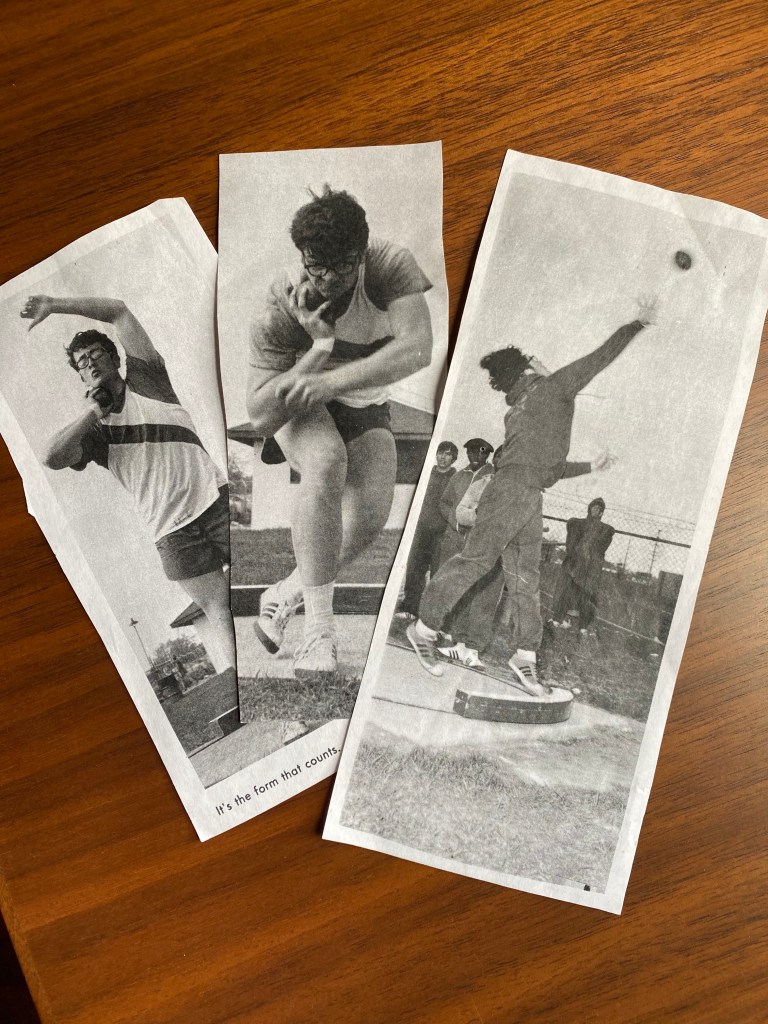
To paraphrase (and mangle) the British poet Alfred Lord Tennyson (1809-1892), “In the Spring (a young) an old man’s fancy lightly turns to thoughts of (lovetossing cannonballs.” Yes, that’s right: this coming Sunday, June 4th, will mark my return to senior shot-putting — after a five-year absence — at the Sonoma Wine Country Games in Santa Rosa, California.*

Senior (in high school) shot-putting, 1971

As I mentioned in my “About Me” post, in 2013 I ranked in the top 50 worldwide in the 60-to-64 year age group. This was helped in large measure by the fact that 99+% of guys my age grew up and quit shot-putting a long time ago. But still…

Senior track and field is a hoot. As you’ll see if you ever attend a meet, there’s all kinds of emeritus-athlete stuff going on. It starts early in the morning: you’ll see gray-hairs (and no-hairs) stretching, jogging, throwing heavy things, warming up for the pole vault, doing run-throughs in the long jump pit. Old friends gather in the stands over coffee and stopwatches. Complaints of sore joints and pulled muscles are met with knowing laughter. I love this stuff.

I’m not expecting too much from myself this year. I don’t like to make pre-meet excuses, but hey, here they are: My training schedule, laid out with such precision in early March, has been sabotaged by two rounds of Covid, Achilles tendonitis, a family medical emergency, the ravages of age, and, well…Parkinson’s. I’ve only been able to throw the shot twenty times or so, and my coordination and timing are way off. So, if I drop the shot on my foot and break it (the foot, not the shot), you’ll know why.

Okay! Enough with the moaning! I’ll post updates as the track season progresses (or doesn’t…)

_____

*The reason for the five-year hiatus is pretty simple: you hit a new age group every 5 years. I turned 70 this year, meaning in June I’ll be among the youngest competitors in the 70-to-74-year-old group. One thing that senior track teaches you is that it’s good to be “young” – almost all the records are set by athletes in the first year of an age group, before the march of time marches right over you. I competed at 60 and again at 65; not wishing to witness my own interim deterioration, I took a five-year snooze both times before coming back. I’ll probably do that again once this track season is done, resurfacing (hopefully – knocking on wood as I write this) as a boyish 75-year-old.

A “moving” Moving Day SF

The hour-by-hour weather forecast for the morning of May 6—for Moving Day SF—was pretty typical for San Francisco: Rain, then clouds, then fog, then sunshine, then clouds again, and maybe, just maybe, some more rain. (Windy as heck, too, but mercifully, no blizzards.) Let it be noted that the sun was shining brightly as I made my way up the ramp to the speaker’s podium.

Moving Day SF, a fundraising walk event, was held at Crissy Field, a former U.S. Army air base that lies on the northern edge of San Francisco, just to the east of the Golden Gate Bridge. Standing on its broad, grassy meadow, a visitor can quickly overdose on beauty. In a single sweep of the head, you can take in the Bridge, Alcatraz Island, Angel Island, the town of Sausalito across the waters, and San Francisco Bay itself, which that morning was teeming with sailboats, from the simple to the ungodly. High-tech, state-of-the-art catamarans from the U.S., Australia, Great Britain, Spain, and New Zealand zipped back and forth, preparing for a Sunday, ultra-rich-folk-only competition with a million dollars going to the winner. How they kept from crashing into each other and the many slower-moving boats dotting the Bay, I’m not sure. (As to who won: Don’t know. Don’t care.)

But we weren’t there for the boat races. We were there for Moving Day SF, an annual project of the Parkinson’s Foundation, which brings together members of the Parkinson’s community to celebrate their work on behalf of people living with this disease. This year 300 or so PwPs (people with Parkinson’s), their family members, caregivers, and friends turned out despite the your-guess-is-as-good-as-a-meteorologist’s weather report. They danced, they sang, they played ping-pong (a particular challenge, given the blustery gusts coming in from the ocean), and then they walked, a lot, earning money for Parkinson’s research.

Elisabeth and I were there for a couple of reasons. First, our dance class—from San Francisco Ballet School’s Dance Class for People with Parkinson’s—was scheduled to give a ten-minute demonstration. And secondly, I had been “asked” (read: dragooned*1) by Cecelia Beam, our dedicated and impossible-to-refuse ballet teacher, to give a five minute talk on my Parkinson’s experiences.

A fine bunch of ballerinas… Me, Cecelia Beam, and Elisabeth.

The dance demonstration was easier than it may sound. For starters, we did it in chairs—there would be no pirouettes or tossing of partners into the air. (Phew!) Even better, when Cecelia planted her chair front row center, I put my chair a couple of rows back, directly in line with hers, so I could see her every move. When the music started, I just did whatever she did, albeit a half-beat late. 

We danced our way through three songs: “Mother Nature’s Son,” by the Beatles (lots of sun-worshipping arm stuff); an excerpt from the ballet Romeo and Juliet (emphasis on foot-shuffling and tossing imaginary things into the air); and “Lights,” the 1978 classic-rock standard by the band Journey.*2 An eclectic mix, to be sure.

Now, there are certain things in this life that reliably get me tearing up. The first is chatting with kids, particularly 3- and 4-year-olds, which I loved to do back before I retired from my pediatric practice. Preschoolers have fascinating views of how the world works, and sometimes novel explanations for why they’re sick or hurt. It’s a heartbreakingly beautiful stage of life.

Another thing is what I call “non-performative acts of kindness.” Anybody can be kind to others if they think they’re going to derive benefit from it—an expected payback, say, or maybe a boost in building a personal “brand.” But when I see someone do something for someone else, without expectation of anything in return…that gets to me.

So, when I looked out from the stage as Journey’s lead singer Steve Perry lit into “Lights,” I saw a remarkable sight: everyone, and I mean everyone, in the audience was locked onto Cecelia, following her lead, moving with us, taking part in a communal celebration of dance. And I thought to myself, These are some of the kindest people in the world.They had turned out on an iffy-weather day to support their loved ones, and each other, and now they were dancing with our group—not because they were expecting something in return, but because they felt a bond with all of us who are dealing with Parkinson’s in one way or another. We were all moving together—and it was, well, moving.

After the dance was over, the emcee—a NASDAQ executive whose father has Parkinson’s—called me up to tell my story. I was a bit nervous—this was my first time talking to a large group of strangers since Parkinson’s had taken a bit of my voice. (I used to love public speaking—after my book was published in 2009, I spoke at a number of conferences in the U.S., Canada, and Australia.) I was soft-spoken to begin with, and between my now even softer soft-spokenness, occasional hoarseness, and tendency to start coughing out of nowhere, the prospect of pulling off even a five-minute speech was a bit daunting. So, in the week leading up to Moving Day, I did extra speech therapy exercises. I wrote and rewrote my talk, marking it up as my speech therapist had suggested, with slashes and dashes—speed bumps to slow me down—and CAPS where emphasis was needed. I read it aloud, over and over, watching for word combinations that might be easily slurred. By the time I stood at the podium, I was sick of my talk—in the past, a sure sign that I was ready to give it. 

Long story short, it went well. After a brief sound check with the audience to make sure I had the microphone properly positioned, I plunged ahead with my marked-up script. Not as spontaneous as I would have liked, but everyone heard me, they laughed at the jokes, and applauded at the end. I think they got my message: When Parkinson’s tries to take something away from your life, you look to those kind-hearted people waiting to help, and you adapt. You move on.

(I’ve included a non-marked-up copy of my talk below.)

_____

*1 The word “dragoon” is derived from the French word “dragon” (the fire-breathing kind). It was also a slang term for a 17th-century musket, which spit fire from its muzzle when fired. To be “dragooned” came to mean anything forced upon a person—especially non-voluntary military service—by means of firearms. Understand, I’m not saying Cecelia pulled a musket on me. No need: she’s a master in the art of gentle (and persistent) persuasion, although I’m sure she’s capable of breathing fire when necessary. Not wanting to test that theory, I just said ‘yes’ to her invite.

*2 Oh, come on… don’t pretend you don’t know it! Sing along with me: “When the lights go down in the City / And the sun shines on the bay / Ooh, I wanna be there in my City, oh / Oh, oh, oh…

_____

MOVING DAY SF – May 6, 2023

GOOD MORNING, EVERYONE!

My name is Mark Sloan, and this is my Parkinson’s story.

I am a third-generation person with Parkinson’s Disease. My grandfather, who came to America from Ireland in the 1910s, was first. My mother, a journalist who raised six boisterous kids, was next. And now, apparently, it’s my turn. This is not the sort of family tradition I’d hoped to carry on—I’d rather it was something like a top-secret Sloan family lasagna recipe—but, well, here I am.

Given my family history, I always knew that Parkinson’s was a possibility. But I had fully expected to be a lucky one, that the disease would pass me by. So, when I received my diagnosis in 2020, I was shocked. I reacted to the news the way I’m sure many people do when first diagnosed: with massive denial. I rationalized and explained away my symptoms. I told myself, Look, you’re taking care of your 99-year-old father—you’re moving slowly because he’s moving slowly! Or this one: It’s not really Parkinson’s – it’s that darn migraine medicine you’ve been taking! And so on. I grasped at straws until, finally, there were no more straws to grasp.

Next, I drew inward. As a pediatrician, I had spent nearly forty years helping parents and kids negotiate all kinds of health issues, from the trivial to the tragic. Now, on the receiving end of a life-changing diagnosis, I initially turned away from those who wanted to help me. I declined well-meaning offers of connections to individuals and support groups that might help me adjust to my new reality. I became sad, a bit moody, and, having watched my mother struggle with the disease, I obsessed on what was to come: Would I lose my voice? Would I lose my ability to walk? Would I lose my ability to think and be creative? And then there was the biggest question of all: Would my life at some point cease to be worth living? 

I’d like to say there was a dramatic “Aha!” moment when things turned around, maybe my grandfather’s ghost appearing at the foot of my bed, rattling some chains, and scolding me in his lilting Limerick accent: “Oh, Mark, just snap out of it!” But no. Once it became clear that my Parkinson’s experience wasn’t going to be a rapid collapse, but rather a long-term, slow-rolling decline, I calmed down a bit. I remembered that both my grandfather and my mother had lived into their nineties, living with Parkinson’s for at least a couple of decades. It was time to knock off the self-pity and get serious about this disease.

It was my renewed commitment to exercise that eventually led me to the San Francisco Ballet School’s Dance Class for People with Parkinson’s. To be more accurate, I was dragged to the class—not exactly kicking and screaming, but close—by my wife, Elisabeth, who read about the class at one of my first neurology appointments. To be clear: of the many exercise options recommended for people with Parkinson’s—everything from hiking and biking to tai chi and boxing—ballet was at the very bottom of my list. I’ve always been an awkward dancer at best, and the idea of taking lessons from an actual ballet teacher, at the actual San Francisco Ballet School, in the shadow of the actual Opera House, was intimidating, to say the least. But Elisabeth is nothing if not persistent, and so one Saturday afternoon I found myself reluctantly wading through a sea of tutu-clad ten-year-olds, nervously making my way to the first-floor dance studio in my squeaky-new, size-13 ballet shoes.

What a delightful surprise it was! The veteran dancers in the class, some dancing with their family members, welcomed me warmly. And there at the center of the action, as live piano music accompanied the dancers, was the wonderful Cecelia Beam, ballet teacher extraordinaire. She reassured me that this class wasn’t about execution or perfection—it was about moving. I quickly came to love the class, both for the physical confidence it’s given me, and for the opportunity to socialize with other people with Parkinson’s. There’s even a side benefit: I’ve learned that Parkinson’s Disease is the ideal cover for an awkward dancer; I can blame my stumbles and bumbles on my disease, and not on my natural tendency to crash into things. It’s been great!

So, if I could time-travel to 2020, back to when I was first diagnosed, what advice would I offer myself? 

Well, first of all, I’d say don’t waste so much time on denial. Parkinson’s will progress, no matter how much you wish that it would just go away. Next, exercise more, starting right this minute—with any type of exercise you already love. Or maybe try something new, like joining a dance class, at, say, the San Francisco Ballet? Third, get involved—with community activities, research studies, support groups, anything that keeps you motivated and alive in the world. And fourth, accept help when it’s offered. There are so many good-hearted people in the Parkinson’s community; let them help you as you make the most of life with Parkinson’s Disease.

Finally, I’d tell the slightly younger me to stay optimistic. There really is a lot of exciting research on prevention, testing, and treatment right now. And who knows? Gene therapy, or some tool yet to be invented, may someday end up being an actual cure for this disease. 

Well, it looks like my five minutes are up. Thank you for coming to Moving Day, and for listening to my story!

Mark Sloan

Family history No.2: Mom’s turn…

My mother, Peg Sloan, died in 2017 of Parkinson’s-related aspiration pneumonia. She inhaled some thick pudding, one of the last foods she was allowed to eat as her swallowing grew dangerously uncoordinated, and that set the end in motion. She had been hospitalized with pneumonia several times; this time was the worst, and Mom had decided beforehand to refuse extraordinary measures to keep her alive.

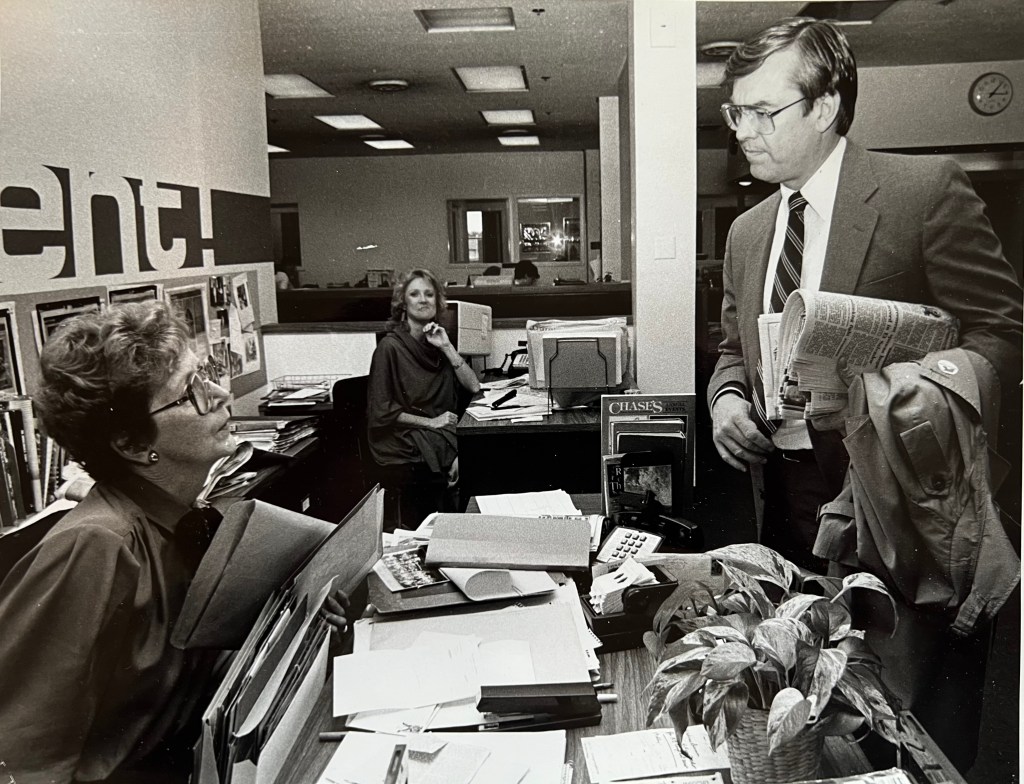
Long before Parkinson’s closed in on her life, Mom had been a writer and editor. She spent her entire professional career at the Kankakee Daily Journal, a small-to-medium-sized newspaper in a small-to-medium-sized town in east-central Illinois. 

Starting as an op-ed contributor, she was soon named editor of “Accent,” a lifestyle-themed section of the paper that had long been heavy on the doings of Kankakee’s elite: weddings, engagements, costumed soirees, and the like. Mom dragged Accent out of its rich-folk doldrums and pushed it into the present. By the mid-1980s, just a few years after she took over the editorial reins, Accent had twice been honored by United Press International, including an award for its follow-up investigation of a secretive religious cult near Kankakee that had vanished five years previously, taking the children of several local residents with them. 

Mom also wrote a popular weekly “personals” column. Her first published essay was on the trials and tribulations of being a redhead.*1 By her retirement she had written more than 700 columns on a wide variety of subjects, including her Irish heritage, her travels, the sometimes-humbling experiences of a big-city girl who married into a farm family, and—her go-to topic—the ups and downs of raising six kids. My mother’s warm, accessible, often funny writing style won her a devoted readership, syndication in a smattering of small Midwestern papers, and a number of awards. Mom was honored for her columns by the Illinois chapters of the Associated Press and United Press International, and the National Federation of Press Women.  

Peg Sloan (left) meets with CBS newsman Bill Kurtis during the investigation of a religious cult near Kankakee, late 1970s. (And yes, that’s the same Bill Kurtis who’s now the announcer, judge, and scorekeeper on the popular NPR program, Wait Wait…Don’t Tell Me!)

The most remarkable thing about Mom’s journalism career is that it didn’t start until she was in her fifties. Before ever setting foot in the Daily Journal offices, Mom raised the six of us. And when I say that she raised us, she did just that. For nearly thirty years Mom was up to her elbows in mid-century mothering: diapering, cooking, sewing, first aid, PTA meetings, birthday parties, church socials, football Fridays, and laundry, laundry, laundry. Not until the last of us was grown and out of the house (or nearly so – my youngest brother, Chris, abruptly became a “latchkey kid” when Mom joined the Daily Journal a few months before his high school graduation) did she pursue her long-deferred dream.

She told me years later that she had always wanted to be a writer, that if she’d been born a generation later she would have been a journalist right out of school. Mom kept that desire hidden from her kids for decades, but from time to time it slipped out.

I must have been about ten years old when I came across Mom sitting on a stool in the laundry area of our basement, barricaded behind baskets of dirty and/or wet clothes, scribbling with a pencil in a small, spiral-bound notebook. 

This was truly strange behavior. One thing to know about my mother: she absolutely abhorred heat and humidity, so for her to spend even one extra mid-July minute in our often-hellish southern Indiana climate—in our stuffy basement with the washer and dryer running, no less—meant that whatever she was working on must have been important. *2

She didn’t notice me at first. I watched sweat run down her cheeks and drip off the tip of her nose. Her soaked blouse clung to her shoulders. I knew adults had heart attacks sometimes—was that what this was? She paused and stared into space for a moment, immobile, then quickly erased a line and started scribbling again. I watched her a minute or so, until I couldn’t contain my concern.

“Mom?” I shouted, loud enough to be heard over the clanking Maytags. “Are you okay?” I touched her arm. “Maybe you should go upstairs and sit by the air conditioner?” *3

Startled by my sudden appearance, she slapped her notebook shut, slipped it into a shoebox with several others, and grabbed a towel to wipe the perspiration from her face. “Yes, let’s get upstairs,” she said with a wan smile. “I’m boiling.” 

Later, camped out with a glass of ice water by the air conditioner in her bedroom (I inherited my mother’s hatred of Evansville’s wilting summertime swamp-heat), Mom slipped some rubber bands around her shoebox full of notebooks and slid it high up on closet shelf. My eyes followed the box; she could see I was curious about it.

“I was just writing a grocery list,” she said.

The notebook had been filled with writing. “That’s a lot of groceries,” I said.

“Well,” she said, smiling, “you kids eat a lot of food.” She took my glass to the kitchen to refill it, and that was that.

Mom retired from the Journal in the mid-1990s. When I asked her why she was giving up her column, she shrugged and said, “I guess I’ve said all that I have to say.” Looking back, this was about the same time that her Parkinson’s symptoms first emerged, although she wouldn’t be diagnosed for several more years. I’d noticed that her hands now shook, especially when trying to hold a cup of her beloved coffee. Her once-gorgeous handwriting had shrunk to the point of near-illegibility. Her gait had slowed, and she stooped a bit when she walked. Mom was an elegant, proud woman – I can’t help but think that she could feel her talents slipping away, and wanted to retire while she was still at the top of her game. She wouldn’t have wanted anyone’s pity.

_____

When I arrived at the hospital on the day before Mom died, she was barely conscious, but she was comfortable, thanks to the efforts of the hospice staff. When she saw me she raised her hand, smiled weakly, and said, “Oh, you came!” 

I stayed by her bedside that night, as part of a round-the-clock vigil shared with my sibs. Mom was breathing softly, eyes closed, no longer interacting with the world. But I thought she might still hear me, so I read her favorite columns to her, one after the other: the stories of her adored Irish father, the affection that slowly grew between Mom and her no-nonsense farmer mother-in-law, her childhood in a multi-cultural, pre-air-conditioning Chicago neighborhood, her kids—us. She didn’t respond, but she didn’t struggle, either.

The next afternoon, with Dad and her children at her side—just two months shy of their 70th wedding anniversary—Mom quietly stopped breathing. It was Valentine’s Day, my parents’ favorite personal holiday. 

_____

*1 – The cons of being a redhead, per Mom: ghostly pale skin, freckles, raging sunburns. Pros: Um, not so many, apparently… 

*2 – One Evansville summertime climate example will suffice: There was a section of the Yellow Pages devoted entirely to companies that would come and remove the melted road tar your kids tracked onto your wall-to-wall carpet with their shoes. Road tar in Evansville was sort of like mud in cooler climes, I imagine, but a lot harder to get out.

*3 – We had one window air conditioner for the whole house, in my parent’s bedroom: a boxy Whirlpool colossus that was about as loud as the washer and dryer combined. If you kept the bedroom doors closed all day with the Whirlpool blasting away, the room was tolerably comfortable for sleeping at night. I would often find Mom in her bedroom on summer afternoons, hugging the Whirlpool like a long-lost friend, her red hair blowing in the breeze. The rest of us slept in a converted attic bedroom, which was just as hot as that sounds. (Dad did install a window air conditioner in the attic eventually, but it’s cool-air zone was even smaller than the one downstairs…)