In waxing poetic (and at length) in my last post about the weather conditions on Moving Day, I neglected to mention our raison d’être for braving the deluge…fundraising! So, how did our SF Ballet’s Parkinson’s Foundation Fundraising Team – “Shake, Rattle, and Pointe” – do in the total-donations contest?
Well, we were up against more than 40 other teams, and…
(The Parkinson’s Foundation‘s overall Moving Day SF goal was $145,000. They’ve achieved > 95% of that goal so far!)
A big thank you to my friends, relatives, and blog readers for supporting me in raising money for PD research and services, and for donating more than $2000! I appreciate it, and you, very much. Thanks again!!
About a week before this year’s edition of Moving Day SF – the annual Parkinson’s Foundation fundraiser held Saturday, May 4, at Crissy Field in San Francisco – I decided to check out the long-range weather forecast. Last year’s celebration featured a meteorological mixed bag of light rain, fog, cold wind, bright sun, then more fog and cold wind blowing in under the Golden Gate Bridge. I achieved my exercise goals that day just by putting on and peeling off my multi-layers of sweater, vest, windbreaker, and heavy coat, and still ended up half-frozen. I wanted to do a more efficient bit of layer-planning for this year’s event; hence the early weather check.
I wasn’t expecting rain; San Francisco’s last round of wet weather had ended on April 13, and scanning my iPhone’s forecasting app, I saw a week’s worth of sunshine leading up to May 4, and another week of sunshine afterwards. But there on the 4th itself, isolated from all the smiling suns on either side of it, was a lonely dark cloud with raindrops falling from its cartoon underbelly. There was a 65% chance of rain that day, the tiny blue text told me.1
I didn’t worry too much about it at that point. Lots of times those predicted rainstorms don’t materialize. The “% chance” diminishes as the day approaches and finally disappears altogether, the little dark cloud at last swallowed up by yet another inanely smiling sun emoji. I figured that’s what would happen here, too.
But as the day approached, the “% chance” increased steadily, so that by Friday, the day before the event, we were looking at a 95% chance of rain on May 4. It got even worse. Drilling down into the forecast, the heavy Saturday rain was predicted to peak between 9AM and noon – the exact hours of our event.
I read all this on my phone at 5pm on Friday, a hand held to my forehead to shield my eyes from the brilliant sunshine pouring from a beautiful San Francisco sky. As far as I could see – all the way to the Pacific Ocean on the horizon, maybe all the way to Japan – there wasn’t a single cloud in the sky. How could heavy rain be possible within a few hours? Where was it going to come from? Okinawa?
But the weather in San Francisco is prone to change at the drop of the hat that just blew off your head, and change it soon did. By 8pm it was cloudy and misting, around midnight the rain started for real, and by morning the whole city – including Crissy Field, the Moving Day site – was soaked.
_ _ _
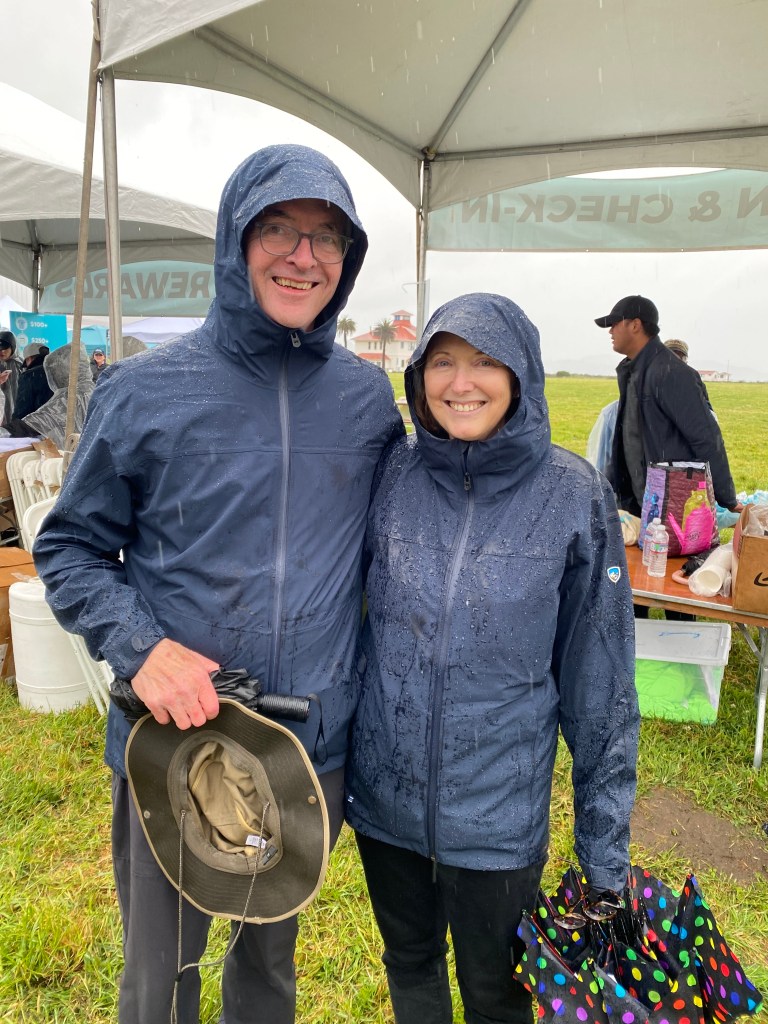
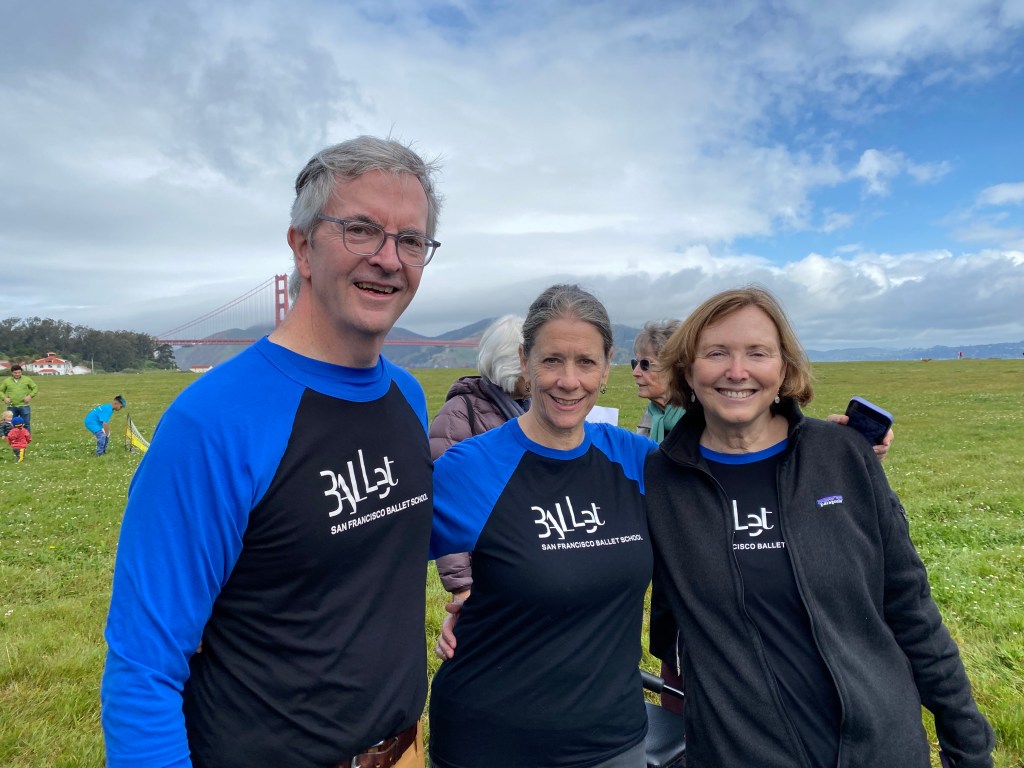
Elisabeth and I rose bright and early to the sound of rain blowing against our apartment windows. There was no question of Moving Day being canceled, though; a series of pleading emails from the event organizers reminded us that things were going to go ahead as planned, come rain or shine. Message received, we dressed in weather-appropriate gear: for me, a SF Ballet shirt, a light sweater, then a heavier sweater and a wool vest, topped off finally by a new-ish rain jacket. Elisabeth wore a variation of my outfit, including a matching rain jacket. We looked like a pair of eggplants.
Eggplants…
Our original plan had been to walk to Crissy Field from our apartment in the Presidio with our good friends, Pauline and Tom (who had hydroplaned the 50 miles from their home in Santa Rosa that morning to cheer us on), up over the south end of the Golden Gate Bridge, and down a steep set of steps to meet up with our SF Ballet team (a.k.a. “Shake, Rattle and Pointe”). It’s normally about a 45-minute walk, but, figuring it would take about twice as long, given the weather (and maybe even longer, as we would likely have been blown off the bridge and right into the Bay), we opted to get there old-school style. We drove.
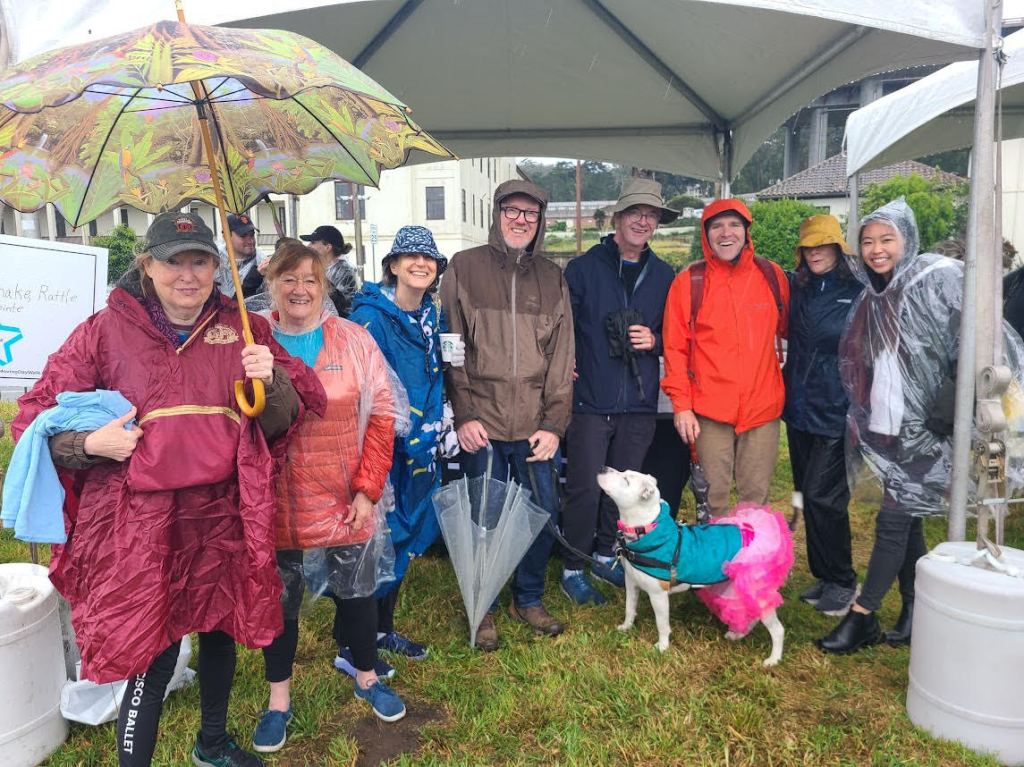
We arrived at the SF Ballet tent right on time. Team members and volunteers had been trickling in over the last hour; you could tell how long a given individual had been there by how closely they resembled a corpse. Recent arrivals still had some pink in their cheeks; earlier unfortunates were pale, blue-lipped and stiff-jawed. Only their teeth-chattering shivers gave them away as still being among the living.
And there in the middle of the tent area, rallying the troops with donut holes and hot coffee, was our unsinkable teacher, Cecelia Beam. (She brought the pastries; the coffee was begged from the Rock Steady boxers next door.) I’ve written about Cecelia and all that she means to those of us with PD in past posts (here and here). Suffice it to say, only Cecelia could stand there, drenched to the bone, water pouring from the brim of her yellow bucket hat, and say, “Isn’t this a great day??” with such heartfelt enthusiasm that, by God, you’d swear cinematic beams of sunshine were right that moment breaking through the clouds. (They most decidedly weren’t.)
A number of our SF Ballet classmates had braved the weather to be there, too. We were scheduled to do a chair-dance demonstration, showing prospective future classmates what our class is like. We had rehearsed our dance numbers over the past few weeks, and Cecelia was counting on us. We weren’t about to let a little firehose-caliber downpour stop our show.
After much slopping and slogging about, trying (and failing) to find a bit of dryness somewhere, a garbled microphone voice at last called for our attention: as promised in all those frantic admin emails, the festivities would be starting precisely on schedule. Shake, Rattle and Pointe would be performing third. (I don’t remember who went first or second; I couldn’t feel my feet.) When our moment finally arrived, Cecelia waved us toward the stage. Surveying her tired, huddled, frozen mass of a team, she called to us, her hands held megaphone-style, through the squall. “Whatever you do, look like you’re having fun,” she cried. “We don’t want to scare off any potential new dancers!” 2
_ _ _
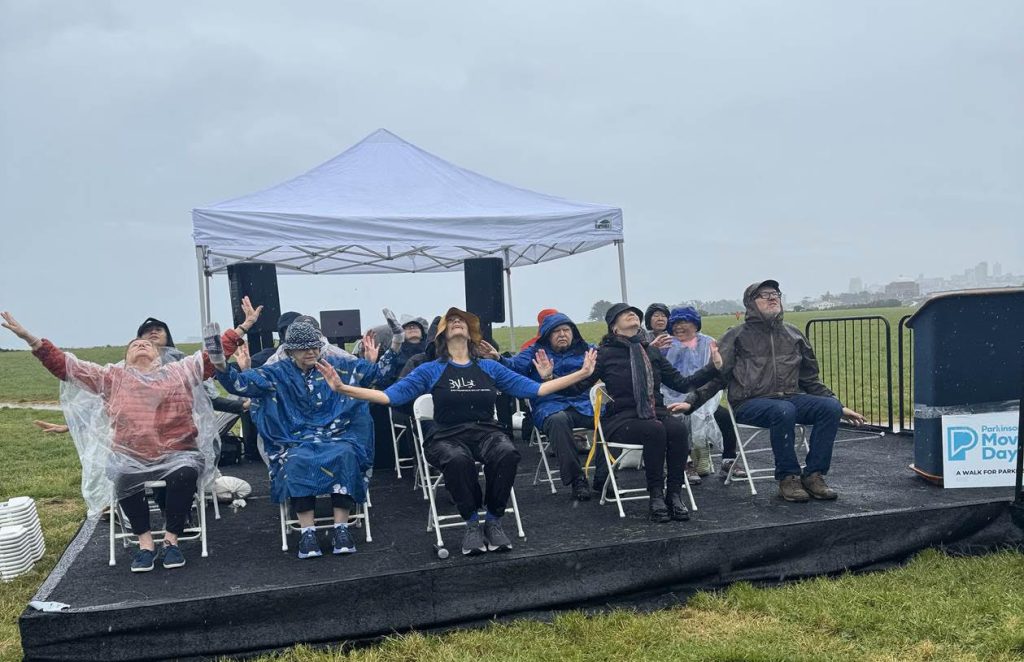
I should mention here that the stage, in this case, was just a modestly raised platform, a roughly 15-by-18 foot extension of the tent under which the DJ was keeping as dry as a DJ can, given the rain coming in horizontal bursts as well as by straight down deluge. Elisabeth and I took our seats in the last row of chairs on the stage – edge-of-the-tent positions that kept our heads out of the rain, while leaving our legs unprotected. I chose my spot strategically: I wanted a chair with a direct visual line to Cecelia, so I could do whatever she did when the music started, and no direct visual line to the audience, so I could chair-dance in peace, unencumbered by fear of public guffawing. Judging from the accompanying photo, it looks like I succeeded…
Where’s Mark? 3
We soon discovered that we weren’t as clever as we’d thought, seating-wise. While it was true that our heads were more or less protected from the downpour by the edge of the tent, our legs were still outside of it, getting rained on. We also hadn’t taken into account that the rainwater up on the roof had to go somewhere, and that, as the tent had no downspouts, the water would simply accumulate, reservoir-like, until the tent roof at last exceeded its capacity, breached its levee, and dumped what felt like gallons of ice water into our laps. This drench-pause-drench cycle continued throughout our time onstage, with alarming frequency and breath-taking force. We thought about moving, but by then the performance had already begun – meaning we would have had to shove the people in front of us off the stage and steal their chairs, something of a no-no in the ballet world – and anyway, we couldn’t get any wetter or colder than we already were, so what was the point? We endured the periodic aqua-dumpings, succumbed to a bad case of the “kids-being-naughty-in-church” giggles and soldiered on.
Our first number consisted of a series of basic ballet moves, adapted for chair dancing. We did tendus, ronds de jambe, and ronds de jambe en dehors with our pointed toes, and some graceful fluffy stuff with our arms, to the song “Don’t Worry About a Thing,” by the noted Jamaican ballet choreographer, Bob Marley. We followed this with two excerpts from Swan Lake: the Big Swan Dance, followed by the Little Swan Dance. (I could be getting the names wrong – they probably sound cooler in French, anyway.) The Big Swan Dance came first, with dramatic swoops and little feathery hand flutters powered by what Cecelia referred to as our “swan arms”: elbows leading on the upswing until wrists nearly touched overhead, then down slowly. Repeat over and over until all the Big Birds have flown away. (All of us flying together was a lovely sight, and would have been lovelier still, had we each had a bit more room to move about onstage than your average corporate-farmed chicken. Picture a lot of colliding elbows… ) The Little Swan dance came next, and was the most fun of the three for me – we got to “march” in our chairs, turn our heads sharply up and around like tiny birds, march some more, tilt our heads from side to side, make nine final marching steps and then finish with a big “ta-daa!” move to wow the crowd.4
Through it all, Cecelia was her usual inviting self, urging the crowd to dance with us, and dance they did. At one point there were several dozen people, many of them swathed in the clear rain parkas handed out by the event staff, swaying, taking their cues from Cecelia, trying out their own swan arms. They looked like a bunch of soaked, happy, shrink-wrapped humans.
When our performance was done, we all hung around in the gale rather than seek higher ground, because we knew what was coming next. Cecelia was called back to the stage to receive an award from the Parkinson’s Foundation, well-deserved recognition for all that she’s done, through her love of dance and teaching, for people with Parkinson’s. I can safely say there wasn’t a dry eye in the house, because by this point in the festivities there wasn’t a dry anything in the house. Once the congratulatory hubbub subsided (we would have carried her off the field on our shoulders, if our shoulders were still capable of that sort of thing) everybody climbed into the nearest rubber raft and paddled for shore.
___
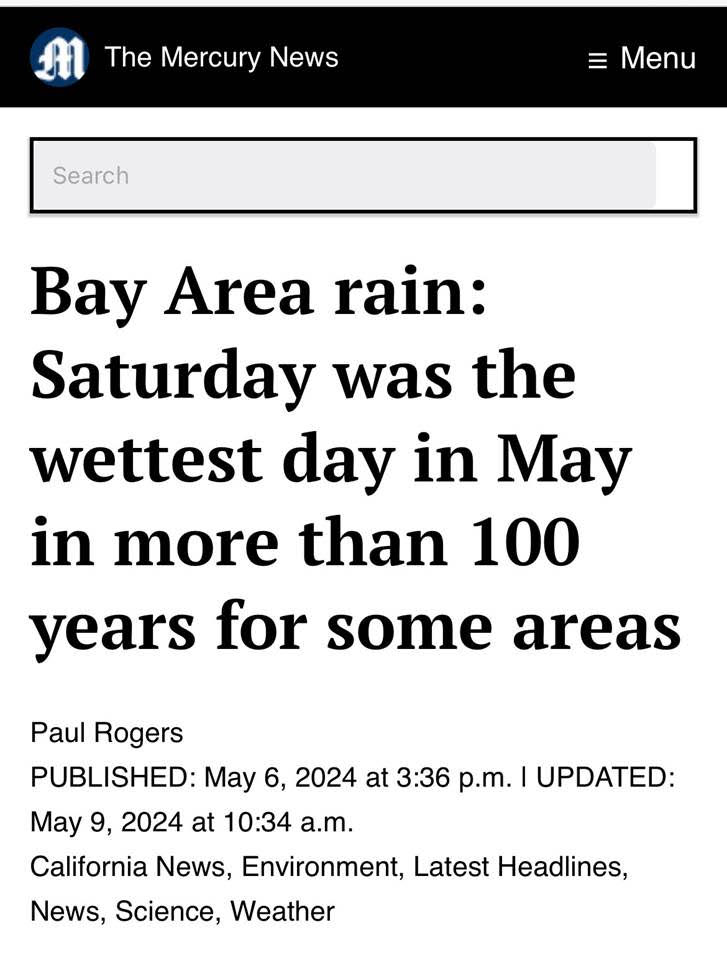
I’m writing this on May 11, one week after Moving Day. I’ve since learned that May 4 was the wettest May day in San Francisco in nearly 30 years. The total – an inch and a half or so – may not sound too impressive to those of you who live in parts of the world where total rainfall is spread more evenly throughout the year. But here in the Bay area, where May typically marks the beginning of the dry season – we may see no more rain at all until autumn – May 4 was a rare, monsoon-like event. Add in that the bulk of the rain fell within just a few hours, half of it blown in sideways on 40mph winds, and you can maybe understand why this was a big deal for us.
It hasn’t rained a drop since Saturday (in fact, the clouds dispersed and the sun broke through later that same afternoon), and from the looks of the extended forecast, it isn’t going to rain for at least the next ten days, and probably longer. The downpour on Moving Day, then, centered as it was on our Bird Dances, may well turn out to be San Francisco’s only appreciable rainfall between mid-April and Labor Day. Maybe even Halloween.
In other words, Mother Nature has it in for Moving Day SF. So, lesson learned. Next year, I’m packing a suitcase full of all-weather gear: wool sweaters, a vest, jackets (heavy and light), a rain jacket (and rain pants this time), an ice axe, a furry hat with ear flaps, a hardhat to deflect golf-ball sized hail, hip-waders, a set of battery-powered hand warmers, and, just in case Mom throws us a curveball, shorts, a tee shirt, flip flops, maybe a pair of swimming trunks, and a tube of sunscreen. Then I’ll strap the whole thing to a dogsled. Because, hey – when it comes to San Francisco weather in early May, you just never know.
(In case you think I was making stuff up…)
_ _ _
Footnotes:
I’ve never been clear on what a “65% chance of precipitation” actually means. Is it that that there’s a 65% chance that rain will fall somewhere within the city limits on that day? A 65% chance that the whole city will get wet? A 65% chance that raindrops will fall on my head? And how much rain are we talking about? Is the mere spitting of a few drops on my windshield enough, or does it need to be a Texas-sized gully-washer? Any weather-people reading this – can you explain it to me? Please?
Note to prospective dance recruits: With the exception of Moving Day, our class is held indoors, in the dry and cozy confines of the SF Ballet School (and chair-dancing is optional; we do center floor and barre work as well). We’re not “Flash Dance,” people.
I’m the ominous, eggplant-hooded shadow lurking at the back of the second row from left.
I’m not, and never will be mistaken for, a dance writer…
Next Saturday, May 4th, will be my third Moving Day SF as a PwP (Person with Parkinson’s), and my second time attending Moving Day festivities at Crissy Field in San Francisco. Moving Day is the annual fundraiser for the Parkinson’s Foundation (PF), a national organization that funds research and provides educational resources for Parkinson’s disease patients and their caregivers. The PF website is a great place to access information on all things Parkinson’s.
As most of you know, I greatly enjoy participating in a weekly Dance Class for People with Parkinson’s group at the San Francisco Ballet School, made possible by funding from the Parkinson Foundation. This funding allows the class to be free for anyone with Parkinson’s and their family members.
This year our Dance Class team (a.k.a., “Shake, Rattle, and Pointe”) will again have a booth—complete with tutus for trying on—from which we hope not to get blown across San Francisco Bay. (Last year was really windy!) As an added attraction, our class will also be doing a brief dance demonstration.
That’s right, I’ll be dancing on stage…but no need to worry for my safety! Nobody’s expecting me to do a pirouette or toss a partner in the air. We perform from chairs, which is just fine with me. We’ll be doing a couple of short excerpts from Swan Lake (seriously), and another one set to a tune by that famed ballet choreographer… Bob Marley.
After the program ends, we’ll go on a fundraising walk, and if you think I’m leading up to begging for donations… you’re right!
So, if you’re feeling charitable or downright philanthropic (and if you’re not, that’s okay, too), here’s how to donate:
1) Click on this link to visit our team page (we’re “Shake, Rattle and Pointe”):
2) Ignore the “Log In” button. Scroll down to the ‘Team Roster’ and click the ‘Donate’ button next to my name.
3) Follow the prompts on the ‘Donate’ page. (Donations are tax deductible.)
4) Accept my undying gratitude…
Finally, I’m including one attachment from last year’s event:
· A video of the brief speech I gave about my Parkinson’s journey (see link to my blog below to learn how this came about):
…and a link to the blog post I wrote after last year’s Moving Day. The post includes a copy of the text of my speech (in case my video uploading skills are faulty…)
The hour-by-hour weather forecast for the morning of May 6—for Moving Day SF—was pretty typical for San Francisco: Rain, then clouds, then fog, then sunshine, then clouds again, and maybe, just maybe, some more rain. (Windy as heck, too, but mercifully, no blizzards.) Let it be noted that the sun was shining brightly as I made my way up the ramp to the speaker’s podium.
Moving Day SF, a fundraising walk event, was held at Crissy Field, a former U.S. Army air base that lies on the northern edge of San Francisco, just to the east of the Golden Gate Bridge. Standing on its broad, grassy meadow, a visitor can quickly overdose on beauty. In a single sweep of the head, you can take in the Bridge, Alcatraz Island, Angel Island, the town of Sausalito across the waters, and San Francisco Bay itself, which that morning was teeming with sailboats, from the simple to the ungodly. High-tech, state-of-the-art catamarans from the U.S., Australia, Great Britain, Spain, and New Zealand zipped back and forth, preparing for a Sunday, ultra-rich-folk-only competition with a million dollars going to the winner. How they kept from crashing into each other and the many slower-moving boats dotting the Bay, I’m not sure. (As to who won: Don’t know. Don’t care.)
But we weren’t there for the boat races. We were there for Moving Day SF, an annual project of the Parkinson’s Foundation, which brings together members of the Parkinson’s community to celebrate their work on behalf of people living with this disease. This year 300 or so PwPs (people with Parkinson’s), their family members, caregivers, and friends turned out despite the your-guess-is-as-good-as-a-meteorologist’s weather report. They danced, they sang, they played ping-pong (a particular challenge, given the blustery gusts coming in from the ocean), and then they walked, a lot, earning money for Parkinson’s research.
Elisabeth and I were there for a couple of reasons. First, our dance class—from San Francisco Ballet School’s Dance Class for People with Parkinson’s—was scheduled to give a ten-minute demonstration. And secondly, I had been “asked” (read: dragooned*1) by Cecelia Beam, our dedicated and impossible-to-refuse ballet teacher, to give a five minute talk on my Parkinson’s experiences.
A fine bunch of ballerinas… Me, Cecelia Beam, and Elisabeth.
The dance demonstration was easier than it may sound. For starters, we did it in chairs—there would be no pirouettes or tossing of partners into the air. (Phew!) Even better, when Cecelia planted her chair front row center, I put my chair a couple of rows back, directly in line with hers, so I could see her every move. When the music started, I just did whatever she did, albeit a half-beat late.
We danced our way through three songs: “Mother Nature’s Son,” by the Beatles (lots of sun-worshipping arm stuff); an excerpt from the ballet Romeo and Juliet (emphasis on foot-shuffling and tossing imaginary things into the air); and “Lights,” the 1978 classic-rock standard by the band Journey.*2 An eclectic mix, to be sure.
Now, there are certain things in this life that reliably get me tearing up. The first is chatting with kids, particularly 3- and 4-year-olds, which I loved to do back before I retired from my pediatric practice. Preschoolers have fascinating views of how the world works, and sometimes novel explanations for why they’re sick or hurt. It’s a heartbreakingly beautiful stage of life.
Another thing is what I call “non-performative acts of kindness.” Anybody can be kind to others if they think they’re going to derive benefit from it—an expected payback, say, or maybe a boost in building a personal “brand.” But when I see someone do something for someone else, without expectation of anything in return…that gets to me.
So, when I looked out from the stage as Journey’s lead singer Steve Perry lit into “Lights,” I saw a remarkable sight: everyone, and I mean everyone, in the audience was locked onto Cecelia, following her lead, moving with us, taking part in a communal celebration of dance. And I thought to myself, These are some of the kindest people in the world.They had turned out on an iffy-weather day to support their loved ones, and each other, and now they were dancing with our group—not because they were expecting something in return, but because they felt a bond with all of us who are dealing with Parkinson’s in one way or another. We were all moving together—and it was, well, moving.
After the dance was over, the emcee—a NASDAQ executive whose father has Parkinson’s—called me up to tell my story. I was a bit nervous—this was my first time talking to a large group of strangers since Parkinson’s had taken a bit of my voice. (I used to love public speaking—after my book was published in 2009, I spoke at a number of conferences in the U.S., Canada, and Australia.) I was soft-spoken to begin with, and between my now even softer soft-spokenness, occasional hoarseness, and tendency to start coughing out of nowhere, the prospect of pulling off even a five-minute speech was a bit daunting. So, in the week leading up to Moving Day, I did extra speech therapy exercises. I wrote and rewrote my talk, marking it up as my speech therapist had suggested, with slashes and dashes—speed bumps to slow me down—and CAPS where emphasis was needed. I read it aloud, over and over, watching for word combinations that might be easily slurred. By the time I stood at the podium, I was sick of my talk—in the past, a sure sign that I was ready to give it.
Long story short, it went well. After a brief sound check with the audience to make sure I had the microphone properly positioned, I plunged ahead with my marked-up script. Not as spontaneous as I would have liked, but everyone heard me, they laughed at the jokes, and applauded at the end. I think they got my message: When Parkinson’s tries to take something away from your life, you look to those kind-hearted people waiting to help, and you adapt. You move on.
(I’ve included a non-marked-up copy of my talk below.)
_____
*1 The word “dragoon” is derived from the French word “dragon” (the fire-breathing kind). It was also a slang term for a 17th-century musket, which spit fire from its muzzle when fired. To be “dragooned” came to mean anything forced upon a person—especially non-voluntary military service—by means of firearms. Understand, I’m not saying Cecelia pulled a musket on me. No need: she’s a master in the art of gentle (and persistent) persuasion, although I’m sure she’s capable of breathing fire when necessary. Not wanting to test that theory, I just said ‘yes’ to her invite.
*2 Oh, come on… don’t pretend you don’t know it! Sing along with me: “When the lights go down in the City/ And the sun shines on the bay / Ooh, I wanna be there in my City, oh / Oh, oh, oh…“
_____
MOVING DAY SF – May 6, 2023
GOOD MORNING, EVERYONE!
My name is Mark Sloan, and this is my Parkinson’s story.
I am a third-generation person with Parkinson’s Disease. My grandfather, who came to America from Ireland in the 1910s, was first. My mother, a journalist who raised six boisterous kids, was next. And now, apparently, it’s my turn. This is not the sort of family tradition I’d hoped to carry on—I’d rather it was something like a top-secret Sloan family lasagna recipe—but, well, here I am.
Given my family history, I always knew that Parkinson’s was a possibility. But I had fully expected to be a lucky one, that the disease would pass me by. So, when I received my diagnosis in 2020, I was shocked. I reacted to the news the way I’m sure many people do when first diagnosed: with massive denial. I rationalized and explained away my symptoms. I told myself, Look,you’re taking care of your 99-year-old father—you’re moving slowly because he’s moving slowly! Or this one: It’s not really Parkinson’s – it’s that darn migraine medicine you’ve been taking! And so on. I grasped at straws until, finally, there were no more straws to grasp.
Next, I drew inward. As a pediatrician, I had spent nearly forty years helping parents and kids negotiate all kinds of health issues, from the trivial to the tragic. Now, on the receiving end of a life-changing diagnosis, I initially turned away from those who wanted to help me. I declined well-meaning offers of connections to individuals and support groups that might help me adjust to my new reality. I became sad, a bit moody, and, having watched my mother struggle with the disease, I obsessed on what was to come: Would I lose my voice? Would I lose my ability to walk? Would I lose my ability to think and be creative? And then there was the biggest question of all: Would my life at some point cease to be worth living?
I’d like to say there was a dramatic “Aha!” moment when things turned around, maybe my grandfather’s ghost appearing at the foot of my bed, rattling some chains, and scolding me in his lilting Limerick accent: “Oh, Mark, justsnap out of it!” But no. Once it became clear that my Parkinson’s experience wasn’t going to be a rapid collapse, but rather a long-term, slow-rolling decline, I calmed down a bit. I remembered that both my grandfather and my mother had lived into their nineties, living with Parkinson’s for at least a couple of decades. It was time to knock off the self-pity and get serious about this disease.
It was my renewed commitment to exercise that eventually led me to the San Francisco Ballet School’s Dance Class for People with Parkinson’s. To be more accurate, I was dragged to the class—not exactly kicking and screaming, but close—by my wife, Elisabeth, who read about the class at one of my first neurology appointments. To be clear: of the many exercise options recommended for people with Parkinson’s—everything from hiking and biking to tai chi and boxing—ballet was at the very bottom of my list. I’ve always been an awkward dancer at best, and the idea of taking lessons from an actual ballet teacher, at the actual San Francisco Ballet School, in the shadow of the actual Opera House, was intimidating, to say the least. But Elisabeth is nothing if not persistent, and so one Saturday afternoon I found myself reluctantly wading through a sea of tutu-clad ten-year-olds, nervously making my way to the first-floor dance studio in my squeaky-new, size-13 ballet shoes.
What a delightful surprise it was! The veteran dancers in the class, some dancing with their family members, welcomed me warmly. And there at the center of the action, as live piano music accompanied the dancers, was the wonderful Cecelia Beam, ballet teacher extraordinaire. She reassured me that this class wasn’t about execution or perfection—it was about moving. I quickly came to love the class, both for the physical confidence it’s given me, and for the opportunity to socialize with other people with Parkinson’s. There’s even a side benefit: I’ve learned that Parkinson’s Disease is the ideal cover for an awkward dancer; I can blame my stumbles and bumbles on my disease, and not on my natural tendency to crash into things. It’s been great!
So, if I could time-travel to 2020, back to when I was first diagnosed, what advice would I offer myself?
Well, first of all, I’d say don’t waste so much time on denial. Parkinson’s will progress, no matter how much you wish that it would just go away. Next, exercise more, starting right this minute—with any type of exercise you already love. Or maybe try something new, like joining a dance class, at, say, the San Francisco Ballet? Third, get involved—with community activities, research studies, support groups, anything that keeps you motivated and alive in the world. And fourth, accept help when it’s offered. There are so many good-hearted people in the Parkinson’s community; let them help you as you make the most of life with Parkinson’s Disease.
Finally, I’d tell the slightly younger me to stay optimistic. There really is a lot of exciting research on prevention, testing, and treatment right now. And who knows? Gene therapy, or some tool yet to be invented, may someday end up being an actual cure for this disease.
Well, it looks like my five minutes are up. Thank you for coming to Moving Day, and for listening to my story!
 A Moving Disorder