My nephew married a delightful young woman in Montana this past summer. The ceremony was very much a Montana affair: the bride rode down the aisle on horseback (it’s okay — it was outdoors), the flower girls wore matching white cowboy boots, and the officiant did the marrying from beneath the brim of a black Stetson hat.
At the rehearsal dinner the night before the wedding, the bride’s and groom’s friends and family members told stories about the couple. These were the kinds of stories you tend to hear at weddings, from early childhood memories to recent adventures — the kind that tend to grow longer and more convoluted in direct proportion to the number of drinks the speaker has downed prior to grabbing the mic. But, no problem: the stories were sweet and funny and spoke well of the betrothed couple.
I had no intention of telling any stories that evening. There was a time I enjoyed public speaking, a time that followed a decades-long period of hating public speaking. I was a shy kid from a family of shy-ish Irish-American folk not prone to spinning extravagant wedding tales.* My elementary school approach to being forced to speak in public consisted of turning red, staring a hole in the floor, and spluttering my message as quickly and quietly as I could.
Things improved somewhat through high school and college, mainly due to forced repetition, but I can’t say that I actually enjoyed talking to crowds until my book, Birth Day, came out in 2009, and I embarked on a brief publicity tour. My appearances at first were mostly in small, independent bookstores. (Once, in Utah, I spoke to an attentive audience of one.) But then, as interest in Birth Day grew, I was invited to speak to larger groups at meetings and conferences around the U.S. and Canada. As I grew more comfortable with speaking to large groups of strangers, I discovered that I actually enjoyed interacting with an audience. I was a man transformed: my inner “ham” emerged.
I discovered that the key to winning over audiences — and boosting my confidence in the bargain — was to hit them early in the presentation with humor. My go-to Powerpoint icebreaker was a “speaker disclosure” slide that was simply a picture of Dr. Mark “McSteamy” Sloan, the hunky plastic surgeon on the TV show Grey’s Anatomy, with my “disclosure” (“I’m not him…”) typed next to McSteamy’s left bicep.
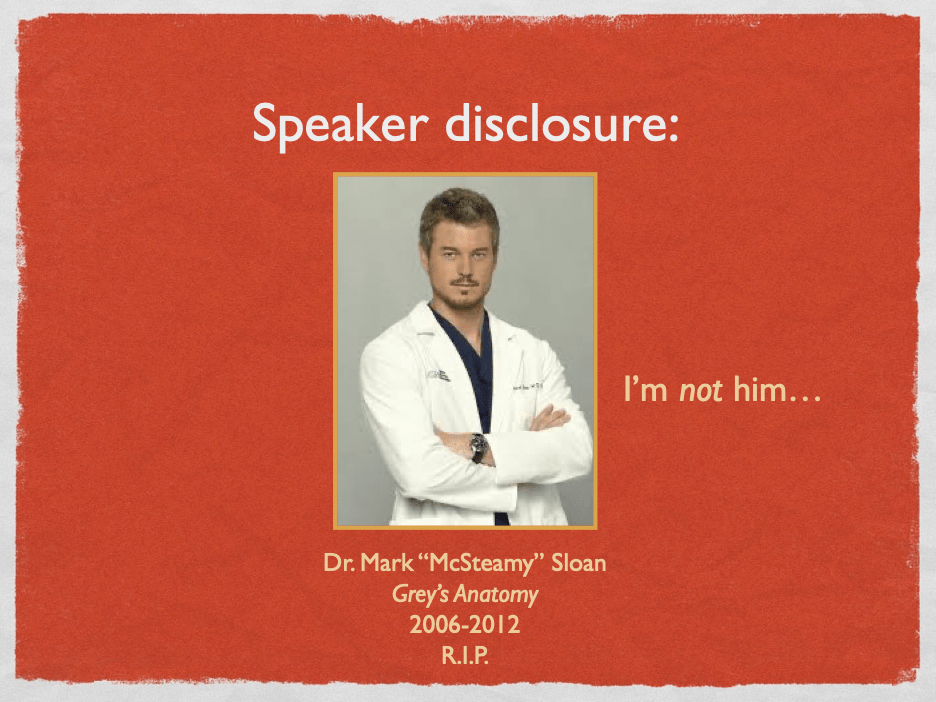
I’d stand there, deadpan, and wait for the slide to sink in. The crowd would inevitably erupt — this being McSteamy’s early 2010s heyday — and then, when the initial hubbub died down, I’d offer to refund the registration fees of any disappointed Mc Steamy fans, which led to even more hubbing and bubbing. By the time things settled down I had both the audience’s attention and the confidence I needed to talk for an hour about the wonders and oddities of human birth.
My public speaking career hit its peak in 2013, when I was invited to deliver the keynote speech at the Western Australia Rural Health Association conference, the annual gathering of half the continent’s far-flung family doctors, in Perth. Peeking through the curtains offstage, waiting to be introduced, my heart sank. The audience looked pretty tough. Picture a few hundred sunburnt Crocodile Dundees packed into a steeply banked auditorium, backslapping and shouting greetings to colleagues they hadn’t seen in a year or more. It had all the earmarks of an “old home week” reunion, writ large. I suddenly regretted not ditching my McSteamy slide — had they even seen Grey’s Anatomy in the vast isolation of the rural Western outback? Would they stare uncomprehendingly at my strange American pop-cultural reference, hoot me off the stage, and then leave, en masse, in search of cold beer?
But it was way too late to make changes to my slide deck. So, I marched to the podium, shook the hand of the woman who introduced me, and launched into my talk. Up went McSteamy, and just as I’d feared, my wildly popular American slide was met with a wall of what seemed like puzzled Ozzie silence. A few awkward moments passed as I searched for a way to gracefully move ahead. Then, from a seat high up in the back, came a deep, booming voice: “We loove McSteamy!” The place went nuts and I knew I was good to go. Nobody asked for a refund.
I did a few more large-crowd speaking dates after Australia. Things naturally tailed off as readers moved on to other books, other authors. My speaking gigs became centered more on local community events, and teaching pediatrics and writing skills to family medicine residents. Then, a few years later, I began having problems with my voice — hoarseness and coughing, difficulty with enunciation and projection — early symptoms of what would turn out to be Parkinson’s. Speech therapy helped me fight back, but in the end, Parkinson’s robbed me of my public-speaking confidence. My large-crowd grand finale was at my daughter Claire’s wedding a few years ago, at which, in my father-of-the-bride role, I got to roast Claire and her new husband in front of 150 guests. I kept McSteamy out of things; the audience loved it anyway.
So, I had no intention of getting up and speaking at the rehearsal dinner — until I got up and spoke, that is. A few of the stories from friends and family had centered on the intense adolescent rivalry between the groom and his older brother, a rivalry that sometimes spilled over into actual fights. I suddenly recalled a vivid example of one of those near fights, but one that ended with a bit of a twist. Maybe it was a desire to soften the warring-sibs tales a bit, or maybe I just wanted to speak to an audience again, but suddenly — bing, bam, boom — there I was, up front, talking.
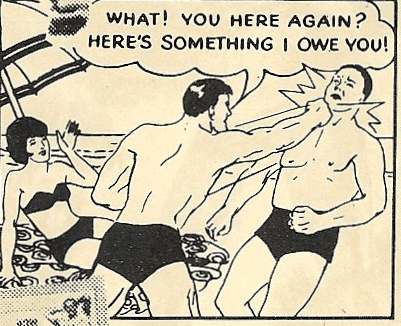
Long story short, my tale involved the groom in middle school, his budding high-school football star older brother, and my startled introduction to the “swirly,” defined by the Oxford English Dictionary as “a prank in which a person’s head is immersed in a toilet bowl while it is simultaneously flushed.” (The immersed head in this case being the future groom’s, inserted into the toilet by his brother.) Immediately post-swirly, the swirl-ee broke free of his tormentor, and amidst much bellowing and posturing it seemed that sibling blood might soon be let.

Just as straightforward as it looks…
My brother charged into the ensuing melee — this was obviously not his first offspring police action — and quickly separated his sons. In a scene that looked like something out of Animal House, he sat on the edge of the bathtub between his boys, one smirking to his right and the other, red faced and drippy headed, on his left. They sat in weary silence for a time. Finally, my brother tossed his younger son a towel and sighed. “You may not believe this,” he said, “but someday you two are actually going to love each other.” Twenty-five years later, I said in closing, that day had arrived.
I don’t know how my voice sounded — whether I was loud enough, or spoke too fast, or mushed my words into a congealed lump — and I really didn’t want to know. Some people laughed, some clapped, there were even a few “awww”s. On a warm, breezy Montana evening, eleven years removed from Perth and exactly four years since my diagnosis, I’d been heard, and that was enough.
Footnotes:
* My father was a big fan of wedding-speech concision. He often spoke admiringly of a distant relative, who, in his role as best man at his friend’s wedding, rose to cheer the newlyweds, raised his glass, and — perhaps in a nod to his blood alcohol level — completely forgot his speech. He stood blearily silent for a moment, then slurred/shouted “Ah, what the hell. Happiness forever!” and passed out on the floor. (“Now that,” Dad said, “was a toast.”)


 A Moving Disorder